The United States is the world's largest crude oil producer, so why have gasoline prices skyrocketed due to the conflict in the Middle East?
2026-03-24 15:13:40
The United States has been the world's largest crude oil producer for many years, maintaining this position for several years. In recent months, U.S. crude oil production has remained stable at over 13.6 million barrels per day. However, many people still wonder: why would a conflict in the Middle East, on the other side of the world, cause a sharp rise in gasoline prices in the United States?
The primary reason is that crude oil prices account for the largest share of gasoline prices in the United States. And since the outbreak of the Middle East war, international crude oil prices have risen sharply in the past three weeks.
Secondly, despite historically high U.S. crude oil production, the U.S. still consumes more than 20 million barrels of oil per day, far exceeding domestic production.

In addition, U.S. refineries are designed to process heavier crude oil, which is not fully compatible with the light shale oil produced domestically, so a large amount of heavy crude oil still needs to be imported.
In other words, although the United States is the world's leading and largest crude oil producer, its gasoline prices remain highly dependent on international crude oil prices. If international oil prices surge, domestic gasoline prices in the United States will inevitably rise as well.
According to data from the U.S. Energy Information Administration (EIA), the national average retail price of gasoline in the United States in January 2026 was $2.81 per gallon, with crude oil costs accounting for 51%. Entering March, this weight remained unchanged, but due to a roughly 30% increase in crude oil prices, the current price of gasoline per gallon is more than $1 higher than before the outbreak of the Iran-Iraq War.
U.S. benchmark WTI crude oil prices surged from around $67 per barrel before the first U.S.-Israeli attack on Iran on February 27 to $99 per barrel in early Monday trading. International benchmark Brent crude saw an even larger increase, rising from $73 per barrel before the outbreak of war to $112 per barrel in early Monday trading.
Taxes account for 18% of gasoline prices, so even if state and federal governments consider reducing fuel taxes, their impact on the final gasoline price will be far less than the impact of a surge in crude oil prices.
A month ago, the national average price of gasoline in the United States was $2.929 per gallon.
Currently, the national average price has exceeded $3.90 and is expected to break the $4 mark within hours. This significant increase is largely due to the surge in crude oil prices. The Strait of Hormuz, the world's most important oil chokepoint, remains closed, disrupting over 15% of global oil transport. This has directly driven up the price of globally available heavy crude oil.
According to GasBuddy data, only 0.7% of gas stations across the U.S. had gasoline prices below $3 per gallon on Sunday, compared to 78% three weeks ago.
According to Patrick De Haan, head of oil analysis at GasBuddy, the national average price has reached $3.94 per gallon and is expected to break the $4 mark within 48 hours.
Although the United States is a net exporter of oil, its refineries still need to import a large amount of heavy crude oil because domestic shale oil production is mostly light crude oil, which cannot fully meet refining needs . According to EIA data, crude oil imports account for about three-quarters of total U.S. oil imports.
Nearly 70% of the U.S. refining capacity is most efficient at processing heavy crude oil . Therefore, the American Fuel and Petrochemical Manufacturers Association (AFPM) points out that 90% of the crude oil imported by the U.S. is heavier than domestically produced shale oil.
Even though the United States is the world's largest crude oil producer, its refining market and fuel prices are not isolated but deeply embedded in the global crude oil pricing system. Since the outbreak of the Iran-Iraq War, international crude oil prices have soared, and domestic gasoline prices in the United States have naturally been affected.
Overall , although the United States boasts the world's highest crude oil production, its domestic gasoline prices still fluctuate dramatically with global oil prices due to its refining structure, consumption scale, and dependence on international markets. The ongoing closure of the Strait of Hormuz is making this connection particularly direct and impactful.
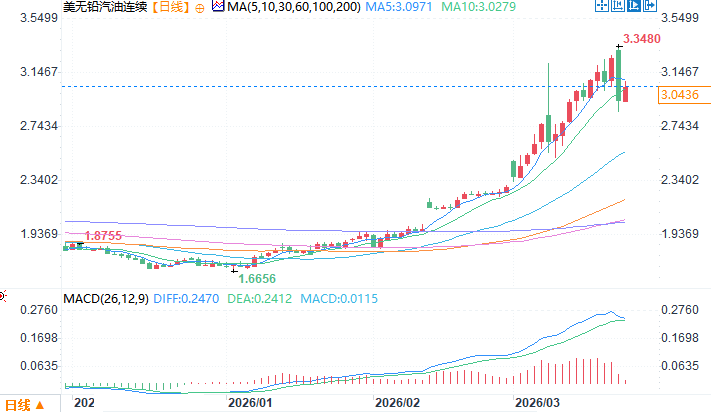
US Unleaded Gasoline Continuous Daily Chart Source: EasyTrade
At 15:12 Beijing time on March 24, the price of unleaded gasoline in the US was $3.0390 per gallon.
The primary reason is that crude oil prices account for the largest share of gasoline prices in the United States. And since the outbreak of the Middle East war, international crude oil prices have risen sharply in the past three weeks.
Secondly, despite historically high U.S. crude oil production, the U.S. still consumes more than 20 million barrels of oil per day, far exceeding domestic production.
In addition, U.S. refineries are designed to process heavier crude oil, which is not fully compatible with the light shale oil produced domestically, so a large amount of heavy crude oil still needs to be imported.
In other words, although the United States is the world's leading and largest crude oil producer, its gasoline prices remain highly dependent on international crude oil prices. If international oil prices surge, domestic gasoline prices in the United States will inevitably rise as well.
Crude oil prices account for more than half of the price of gasoline in the United States.
According to data from the U.S. Energy Information Administration (EIA), the national average retail price of gasoline in the United States in January 2026 was $2.81 per gallon, with crude oil costs accounting for 51%. Entering March, this weight remained unchanged, but due to a roughly 30% increase in crude oil prices, the current price of gasoline per gallon is more than $1 higher than before the outbreak of the Iran-Iraq War.
U.S. benchmark WTI crude oil prices surged from around $67 per barrel before the first U.S.-Israeli attack on Iran on February 27 to $99 per barrel in early Monday trading. International benchmark Brent crude saw an even larger increase, rising from $73 per barrel before the outbreak of war to $112 per barrel in early Monday trading.
Taxes account for 18% of gasoline prices, so even if state and federal governments consider reducing fuel taxes, their impact on the final gasoline price will be far less than the impact of a surge in crude oil prices.
A month ago, the national average price of gasoline in the United States was $2.929 per gallon.
Currently, the national average price has exceeded $3.90 and is expected to break the $4 mark within hours. This significant increase is largely due to the surge in crude oil prices. The Strait of Hormuz, the world's most important oil chokepoint, remains closed, disrupting over 15% of global oil transport. This has directly driven up the price of globally available heavy crude oil.
According to GasBuddy data, only 0.7% of gas stations across the U.S. had gasoline prices below $3 per gallon on Sunday, compared to 78% three weeks ago.
According to Patrick De Haan, head of oil analysis at GasBuddy, the national average price has reached $3.94 per gallon and is expected to break the $4 mark within 48 hours.
Not all crude oil is the same.
Although the United States is a net exporter of oil, its refineries still need to import a large amount of heavy crude oil because domestic shale oil production is mostly light crude oil, which cannot fully meet refining needs . According to EIA data, crude oil imports account for about three-quarters of total U.S. oil imports.
Nearly 70% of the U.S. refining capacity is most efficient at processing heavy crude oil . Therefore, the American Fuel and Petrochemical Manufacturers Association (AFPM) points out that 90% of the crude oil imported by the U.S. is heavier than domestically produced shale oil.
Even though the United States is the world's largest crude oil producer, its refining market and fuel prices are not isolated but deeply embedded in the global crude oil pricing system. Since the outbreak of the Iran-Iraq War, international crude oil prices have soared, and domestic gasoline prices in the United States have naturally been affected.
Overall , although the United States boasts the world's highest crude oil production, its domestic gasoline prices still fluctuate dramatically with global oil prices due to its refining structure, consumption scale, and dependence on international markets. The ongoing closure of the Strait of Hormuz is making this connection particularly direct and impactful.
US Unleaded Gasoline Continuous Daily Chart Source: EasyTrade
At 15:12 Beijing time on March 24, the price of unleaded gasoline in the US was $3.0390 per gallon.
- Risk Warning and Disclaimer
- The market involves risk, and trading may not be suitable for all investors. This article is for reference only and does not constitute personal investment advice, nor does it take into account certain users’ specific investment objectives, financial situation, or other needs. Any investment decisions made based on this information are at your own risk.