Geopolitical tensions have eased, and expectations for a European Central Bank interest rate hike have slowed.
2026-03-25 17:09:52
According to APP, European Central Bank President Christine Lagarde stated that the ECB could raise interest rates as early as April if the inflationary shock triggered by the war with Iran spirals out of control. Lagarde said at a conference, "We are prepared to adjust our policy at any meeting if necessary." However, she emphasized that it is "too early" to make any decisions on interest rates , as policymakers still need to "assess the nature, scale, and persistence of the expected sharp rise in inflation caused by rising energy prices." Lagarde told central bank observers at the conference that the impact of the conflict is not yet sufficient to prompt immediate action from the ECB . She stated, "If the current energy market shock can be contained, its impact on overall inflation is likely to be limited." She stressed that central bank officials "cannot lower energy prices," but must pay attention to their impact on "comprehensive" inflation and "second-round effects through wages and inflation expectations."

This latest statement signals that the European Central Bank (ECB) remains highly vigilant yet flexible in the current geopolitical environment. Recent data shows that the ECB's key interest rate is currently maintained at 2%, and market discussions about a rate hike at the April meeting have gradually intensified, but the final decision still depends on subsequent energy price and core inflation data. Lagarde 's cautious stance reflects both the central bank's lessons learned from historical energy crises and its close monitoring of second-round effects (such as the wage-price spiral) to avoid premature or excessive reactions.
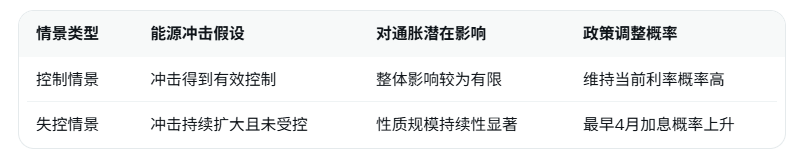
From a policy perspective, the Iran war directly pushes up short-term inflation through energy prices, but its sustainability and transmission path remain highly uncertain. If the energy shock is effectively controlled, the overall impact may be limited; conversely, if it evolves into a persistent supply disruption, the second-round effects could be amplified through wage increases and weakened inflation expectation anchoring. The ECB's current strategy is "data-dependent + well-prepared," reserving room for adjustments at any meeting. The following is a key comparison of the two energy shock scenarios described by Lagarde :
In-depth analysis reveals that Lagarde's emphasis that the central bank "cannot lower energy prices" essentially shifts the policy focus to demand-side management and expectation guidance. This poses a dual challenge to Eurozone economic growth: short-term upward risks to inflation and downward risks to growth coexist. For ordinary households, rising energy costs will directly reduce consumption capacity; for businesses, cost transmission may dampen investment intentions. Globally, the ECB 's flexible stance will also influence the pace of other major central banks, especially given the backdrop of demand recovery in major Asian countries, where the linkage effect of energy prices warrants continued attention. In the short term, market volatility may remain high, and investors need to closely monitor energy data and wage indicators ahead of the April meeting.
Editor's Summary
European Central Bank President Christine Lagarde's latest remarks clearly signaled policy flexibility, suggesting that interest rates could be raised as early as April if the inflationary shock triggered by the Iran war spirals out of control. However, it is still too early to assess this, and the key focus is on the nature and scale of the impact of energy prices on overall inflation and the second-round effect. The market needs to observe the subsequent policy path based on data.
This latest statement signals that the European Central Bank (ECB) remains highly vigilant yet flexible in the current geopolitical environment. Recent data shows that the ECB's key interest rate is currently maintained at 2%, and market discussions about a rate hike at the April meeting have gradually intensified, but the final decision still depends on subsequent energy price and core inflation data. Lagarde 's cautious stance reflects both the central bank's lessons learned from historical energy crises and its close monitoring of second-round effects (such as the wage-price spiral) to avoid premature or excessive reactions.
From a policy perspective, the Iran war directly pushes up short-term inflation through energy prices, but its sustainability and transmission path remain highly uncertain. If the energy shock is effectively controlled, the overall impact may be limited; conversely, if it evolves into a persistent supply disruption, the second-round effects could be amplified through wage increases and weakened inflation expectation anchoring. The ECB's current strategy is "data-dependent + well-prepared," reserving room for adjustments at any meeting. The following is a key comparison of the two energy shock scenarios described by Lagarde :
In-depth analysis reveals that Lagarde's emphasis that the central bank "cannot lower energy prices" essentially shifts the policy focus to demand-side management and expectation guidance. This poses a dual challenge to Eurozone economic growth: short-term upward risks to inflation and downward risks to growth coexist. For ordinary households, rising energy costs will directly reduce consumption capacity; for businesses, cost transmission may dampen investment intentions. Globally, the ECB 's flexible stance will also influence the pace of other major central banks, especially given the backdrop of demand recovery in major Asian countries, where the linkage effect of energy prices warrants continued attention. In the short term, market volatility may remain high, and investors need to closely monitor energy data and wage indicators ahead of the April meeting.
Editor's Summary
European Central Bank President Christine Lagarde's latest remarks clearly signaled policy flexibility, suggesting that interest rates could be raised as early as April if the inflationary shock triggered by the Iran war spirals out of control. However, it is still too early to assess this, and the key focus is on the nature and scale of the impact of energy prices on overall inflation and the second-round effect. The market needs to observe the subsequent policy path based on data.
- Risk Warning and Disclaimer
- The market involves risk, and trading may not be suitable for all investors. This article is for reference only and does not constitute personal investment advice, nor does it take into account certain users’ specific investment objectives, financial situation, or other needs. Any investment decisions made based on this information are at your own risk.