Crude oil trading reminder: Oil prices are trending upwards, but sideways movement is expected until the situation in the Middle East deteriorates.
2026-03-26 09:16:59
The escalating situation in the Middle East has become a key variable driving the sharp fluctuations in the international crude oil market. The US government has discussed extreme scenarios, including the potential for oil prices to surge to $200 in the event of a full-blown conflict. Although this was subsequently denied by the White House, it significantly amplified market concerns about the risk of supply disruptions.
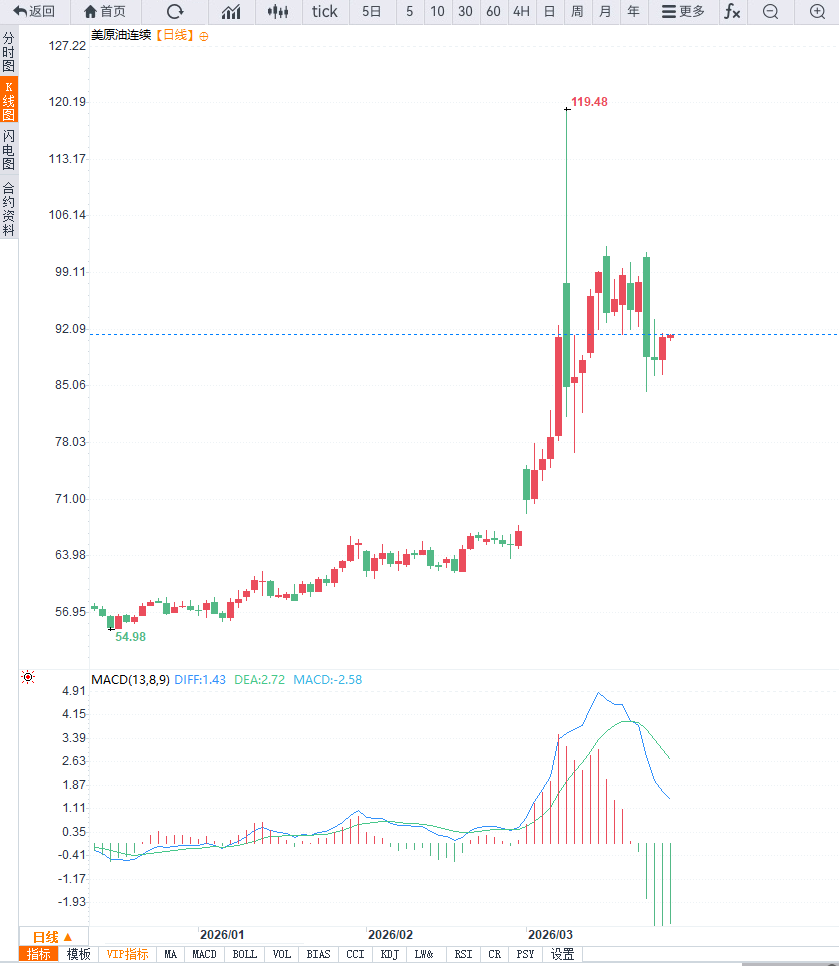
From a price perspective, international oil prices have risen significantly since the escalation of the conflict at the end of February. WTI crude oil has risen by about 30% to around $91 per barrel , while Brent crude oil has risen by nearly 40% to around $102 . The core driver of this round of price increases is market concerns about the security of key energy routes in the Middle East, especially the Strait of Hormuz, which handles about 20% of global seaborne crude oil transport . If these routes are disrupted, it will have a systemic impact on the global supply chain.
Despite official attempts to downplay the extreme expectation of "$200 oil prices," policy communications reveal that the US Treasury has repeatedly expressed concerns to the White House about rising energy prices, particularly their potential drag on economic growth and inflation. The market generally believes that even if oil prices do not reach extreme levels, if they remain in the $170 range for several months , it would still be enough to significantly push up inflation in Europe and the US, and suppress consumption and investment activity.
From a macroeconomic perspective, rising oil prices are rapidly transmitting to the global economic system. In the United States, the most direct impact is on energy consumption, with retail gasoline prices potentially rising by about 30% , eroding residents' real purchasing power and weakening the positive effects of previous inflation declines. In Europe and Japan, energy-imported inflationary pressures are also intensifying, making central bank policy paths more complex.
European Central Bank President Christine Lagarde stated that the current situation has significantly increased inflation risks, and monetary policy needs to remain vigilant.
Federal Reserve Chairman Jerome Powell pointed out that it is too early to assess the impact of the oil price shock on the economy, and policy uncertainty is rising.
At the same time, market sentiment has become clearly divided. On the one hand, some investors are still betting that the conflict may ease, thereby pushing oil prices down; on the other hand, some believe that the damage to the supply side is persistent, and even with a short-term ceasefire, infrastructure damage will still limit production recovery.
Former Goldman Sachs CEO Blankfein warned that even if the conflict ends quickly, its impact on the energy supply system will be long-lasting, and investors need to develop contingency plans in advance.
Against this backdrop, market volatility has intensified significantly, with funds frequently shifting between risky and safe-haven assets. JPMorgan's strategy team points out that the market is more likely to enter a period of consolidation, and its direction will depend on whether the situation escalates further or shows clear signs of de-escalation.
From a technical perspective, on the daily chart, WTI crude oil has broken through the upper edge of its previous trading range, shifting the overall trend from sideways to a slightly bullish structure. However, it has encountered significant resistance above $90, indicating that bullish momentum is beginning to slow. Key support levels are concentrated in the $85 and $80 range; a break below these levels could lead to a return to a sideways trading pattern. Looking at momentum indicators, the daily RSI is nearing overbought territory, suggesting a potential need for correction.
On the 4-hour chart, oil prices are exhibiting a high-level consolidation pattern, with short-term trading roughly between $88 and $93. The moving average system is gradually flattening, and the MACD indicator shows signs of bearish divergence, indicating weakening short-term upward momentum. If the price breaks through $93 effectively, it may open up a new round of upward potential; conversely, if it falls below $88, it will trigger a phase of correction, and the market will retest medium-term support.
Overall, the current oil price trend has shifted from a one-sided upward trend to a dual-driven phase of "geopolitical premium + fundamental game". Given the unclear prospects of the conflict, the probability of prices remaining at a high level has increased significantly.
Editor's Summary : The essence of this round of oil price increases lies in the rapid reassessment of supply-side risk premiums, rather than a substantial improvement in demand. Uncertainty surrounding the Middle East situation makes it difficult for the market to form a clear trend judgment, leading to repeated price fluctuations at high levels. In the medium term, the upward shift of the oil price center is a given, but further upward movement still requires a stronger supply shock as a driving force. Regarding risks, if the conflict eases, oil prices may fall rapidly; however, if key transportation routes are blocked, a renewed acceleration in price increases cannot be ruled out. For investors, a range-bound trading strategy is more suitable at this stage, closely monitoring geopolitical developments and policy signals.
From a price perspective, international oil prices have risen significantly since the escalation of the conflict at the end of February. WTI crude oil has risen by about 30% to around $91 per barrel , while Brent crude oil has risen by nearly 40% to around $102 . The core driver of this round of price increases is market concerns about the security of key energy routes in the Middle East, especially the Strait of Hormuz, which handles about 20% of global seaborne crude oil transport . If these routes are disrupted, it will have a systemic impact on the global supply chain.
Despite official attempts to downplay the extreme expectation of "$200 oil prices," policy communications reveal that the US Treasury has repeatedly expressed concerns to the White House about rising energy prices, particularly their potential drag on economic growth and inflation. The market generally believes that even if oil prices do not reach extreme levels, if they remain in the $170 range for several months , it would still be enough to significantly push up inflation in Europe and the US, and suppress consumption and investment activity.
From a macroeconomic perspective, rising oil prices are rapidly transmitting to the global economic system. In the United States, the most direct impact is on energy consumption, with retail gasoline prices potentially rising by about 30% , eroding residents' real purchasing power and weakening the positive effects of previous inflation declines. In Europe and Japan, energy-imported inflationary pressures are also intensifying, making central bank policy paths more complex.
European Central Bank President Christine Lagarde stated that the current situation has significantly increased inflation risks, and monetary policy needs to remain vigilant.
Federal Reserve Chairman Jerome Powell pointed out that it is too early to assess the impact of the oil price shock on the economy, and policy uncertainty is rising.
At the same time, market sentiment has become clearly divided. On the one hand, some investors are still betting that the conflict may ease, thereby pushing oil prices down; on the other hand, some believe that the damage to the supply side is persistent, and even with a short-term ceasefire, infrastructure damage will still limit production recovery.
Former Goldman Sachs CEO Blankfein warned that even if the conflict ends quickly, its impact on the energy supply system will be long-lasting, and investors need to develop contingency plans in advance.
Against this backdrop, market volatility has intensified significantly, with funds frequently shifting between risky and safe-haven assets. JPMorgan's strategy team points out that the market is more likely to enter a period of consolidation, and its direction will depend on whether the situation escalates further or shows clear signs of de-escalation.
From a technical perspective, on the daily chart, WTI crude oil has broken through the upper edge of its previous trading range, shifting the overall trend from sideways to a slightly bullish structure. However, it has encountered significant resistance above $90, indicating that bullish momentum is beginning to slow. Key support levels are concentrated in the $85 and $80 range; a break below these levels could lead to a return to a sideways trading pattern. Looking at momentum indicators, the daily RSI is nearing overbought territory, suggesting a potential need for correction.
On the 4-hour chart, oil prices are exhibiting a high-level consolidation pattern, with short-term trading roughly between $88 and $93. The moving average system is gradually flattening, and the MACD indicator shows signs of bearish divergence, indicating weakening short-term upward momentum. If the price breaks through $93 effectively, it may open up a new round of upward potential; conversely, if it falls below $88, it will trigger a phase of correction, and the market will retest medium-term support.
Overall, the current oil price trend has shifted from a one-sided upward trend to a dual-driven phase of "geopolitical premium + fundamental game". Given the unclear prospects of the conflict, the probability of prices remaining at a high level has increased significantly.
Editor's Summary : The essence of this round of oil price increases lies in the rapid reassessment of supply-side risk premiums, rather than a substantial improvement in demand. Uncertainty surrounding the Middle East situation makes it difficult for the market to form a clear trend judgment, leading to repeated price fluctuations at high levels. In the medium term, the upward shift of the oil price center is a given, but further upward movement still requires a stronger supply shock as a driving force. Regarding risks, if the conflict eases, oil prices may fall rapidly; however, if key transportation routes are blocked, a renewed acceleration in price increases cannot be ruled out. For investors, a range-bound trading strategy is more suitable at this stage, closely monitoring geopolitical developments and policy signals.
- Risk Warning and Disclaimer
- The market involves risk, and trading may not be suitable for all investors. This article is for reference only and does not constitute personal investment advice, nor does it take into account certain users’ specific investment objectives, financial situation, or other needs. Any investment decisions made based on this information are at your own risk.