A strong US dollar coupled with pressure on the Japanese yen has pushed the USD/JPY pair closer to the 159 level.
2026-03-26 10:44:16
After a recent sustained rise, the USD/JPY pair has entered a consolidation phase at higher levels, currently fluctuating around 159.50 , close to its previous high. The overall trend remains strong. The core market driver is the continued strength of the US dollar and the structural pressure on the yen's fundamentals, creating a significant interest rate and expectation gap.
From a fundamental perspective, the key factor driving the continued weakening of the yen lies in the impact of rising energy prices on the Japanese economy. As an economy highly dependent on resource imports, Japan faces the risk of deteriorating terms of trade during an energy price uptrend. The current uncertainty in the Middle East is keeping oil prices high, meaning that Japan's trade deficit pressure may further widen , thus weakening the yen's support. At the same time, rising energy prices may also push up inflation, but this "cost-push inflation" is not accompanied by economic growth and instead increases the risk of stagflation.

The market generally believes that rising energy prices may lead Japan into a stagflation environment, thereby further limiting the room for monetary policy normalization.
At the monetary policy level, the Bank of Japan still faces a dilemma. On the one hand, inflation has risen, theoretically supporting policy normalization; but on the other hand, insufficient economic growth momentum makes it difficult for the central bank to tighten policy quickly. This structural contradiction leaves the yen without policy support, making it one of the weakest currencies in the current foreign exchange market.
In contrast, the US dollar continues to be supported by hawkish expectations from the Federal Reserve. The market has largely ruled out a rate cut this year and has even begun to price in a small rate hike, strengthening the attractiveness of dollar assets. Meanwhile, against the backdrop of rising global uncertainty, the dollar's status as a reserve currency is further consolidated, providing additional support.
Despite some risk aversion in the market, the yen did not benefit significantly, mainly because its fundamentals are weaker than the dollar's, and interest rate differentials played a dominant role. Furthermore, the risk of escalation in the Middle East remains, with increased US military deployments in the region keeping the market wary of a protracted conflict, which continues to support the dollar's performance to some extent.
However, it should be noted that expectations of Japanese authorities intervening in the foreign exchange market are rising. As the exchange rate approaches the 160 mark, market vigilance regarding policy intervention has clearly increased, which to some extent has limited the willingness of bulls to push the price higher, causing the exchange rate to fluctuate repeatedly at high levels.
From a technical perspective, on the daily chart, USD/JPY maintains a clear upward trend, with both highs and lows rising, indicating the trend remains intact. The current price is trading above all key moving averages, suggesting bulls are in control. However, there is strong historical resistance around the 159.80-160.00 area , which is also a sensitive zone for potential policy intervention, forming a key resistance level. On the downside, 158.00 and 156.50 are important recent pullback support areas; a break below these levels could trigger a period of correction. From a momentum perspective, the RSI is high but not significantly overbought, indicating that while upward momentum has slowed, it has not completely exhausted itself.
On the 4-hour chart, the exchange rate is consolidating at high levels, with short-term fluctuations concentrated between 158.50 and 160.00 . The moving average system is gradually flattening, indicating weakening short-term trend momentum. The MACD indicator is repeatedly crossing at high levels, suggesting the market has entered a phase of tug-of-war between bulls and bears. If the price breaks through the 160 level effectively, it may open up new upward potential, targeting higher levels; conversely, if it falls below 158.50, it may trigger a technical pullback, further testing the support levels at 156.50 or even 155.00 .
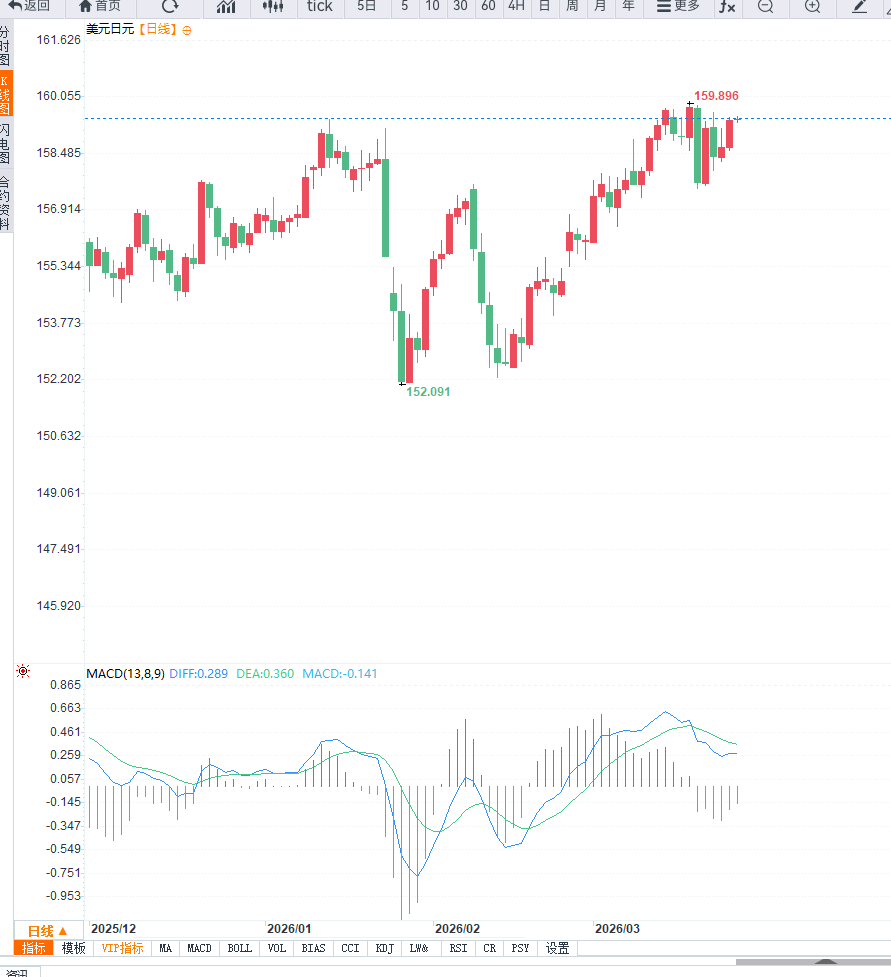
Overall, the USD/JPY pair is currently in a phase of "strong trend + high-level consolidation," maintaining an upward structure supported by fundamentals, but its short-term trend is more volatile due to expectations of policy intervention.
Editor's Summary : The core logic behind the USD/JPY exchange rate lies in interest rate differentials and fundamental divergence. The US dollar continues to strengthen, supported by a high-interest-rate environment and its safe-haven appeal, while the yen remains under pressure due to energy constraints and policy limitations. From a technical perspective, the upward trend remains intact, but volatility risk has increased significantly as it approaches key psychological levels. In the short term, close attention should be paid to whether the 160 level is breached or resisted, as well as potential intervention signals from the Japanese authorities. Until the overall trend changes, the bias remains bullish, but the risk of a pullback from these high levels should be carefully considered.
From a fundamental perspective, the key factor driving the continued weakening of the yen lies in the impact of rising energy prices on the Japanese economy. As an economy highly dependent on resource imports, Japan faces the risk of deteriorating terms of trade during an energy price uptrend. The current uncertainty in the Middle East is keeping oil prices high, meaning that Japan's trade deficit pressure may further widen , thus weakening the yen's support. At the same time, rising energy prices may also push up inflation, but this "cost-push inflation" is not accompanied by economic growth and instead increases the risk of stagflation.
The market generally believes that rising energy prices may lead Japan into a stagflation environment, thereby further limiting the room for monetary policy normalization.
At the monetary policy level, the Bank of Japan still faces a dilemma. On the one hand, inflation has risen, theoretically supporting policy normalization; but on the other hand, insufficient economic growth momentum makes it difficult for the central bank to tighten policy quickly. This structural contradiction leaves the yen without policy support, making it one of the weakest currencies in the current foreign exchange market.
In contrast, the US dollar continues to be supported by hawkish expectations from the Federal Reserve. The market has largely ruled out a rate cut this year and has even begun to price in a small rate hike, strengthening the attractiveness of dollar assets. Meanwhile, against the backdrop of rising global uncertainty, the dollar's status as a reserve currency is further consolidated, providing additional support.
Despite some risk aversion in the market, the yen did not benefit significantly, mainly because its fundamentals are weaker than the dollar's, and interest rate differentials played a dominant role. Furthermore, the risk of escalation in the Middle East remains, with increased US military deployments in the region keeping the market wary of a protracted conflict, which continues to support the dollar's performance to some extent.
However, it should be noted that expectations of Japanese authorities intervening in the foreign exchange market are rising. As the exchange rate approaches the 160 mark, market vigilance regarding policy intervention has clearly increased, which to some extent has limited the willingness of bulls to push the price higher, causing the exchange rate to fluctuate repeatedly at high levels.
From a technical perspective, on the daily chart, USD/JPY maintains a clear upward trend, with both highs and lows rising, indicating the trend remains intact. The current price is trading above all key moving averages, suggesting bulls are in control. However, there is strong historical resistance around the 159.80-160.00 area , which is also a sensitive zone for potential policy intervention, forming a key resistance level. On the downside, 158.00 and 156.50 are important recent pullback support areas; a break below these levels could trigger a period of correction. From a momentum perspective, the RSI is high but not significantly overbought, indicating that while upward momentum has slowed, it has not completely exhausted itself.
On the 4-hour chart, the exchange rate is consolidating at high levels, with short-term fluctuations concentrated between 158.50 and 160.00 . The moving average system is gradually flattening, indicating weakening short-term trend momentum. The MACD indicator is repeatedly crossing at high levels, suggesting the market has entered a phase of tug-of-war between bulls and bears. If the price breaks through the 160 level effectively, it may open up new upward potential, targeting higher levels; conversely, if it falls below 158.50, it may trigger a technical pullback, further testing the support levels at 156.50 or even 155.00 .
Overall, the USD/JPY pair is currently in a phase of "strong trend + high-level consolidation," maintaining an upward structure supported by fundamentals, but its short-term trend is more volatile due to expectations of policy intervention.
Editor's Summary : The core logic behind the USD/JPY exchange rate lies in interest rate differentials and fundamental divergence. The US dollar continues to strengthen, supported by a high-interest-rate environment and its safe-haven appeal, while the yen remains under pressure due to energy constraints and policy limitations. From a technical perspective, the upward trend remains intact, but volatility risk has increased significantly as it approaches key psychological levels. In the short term, close attention should be paid to whether the 160 level is breached or resisted, as well as potential intervention signals from the Japanese authorities. Until the overall trend changes, the bias remains bullish, but the risk of a pullback from these high levels should be carefully considered.
- Risk Warning and Disclaimer
- The market involves risk, and trading may not be suitable for all investors. This article is for reference only and does not constitute personal investment advice, nor does it take into account certain users’ specific investment objectives, financial situation, or other needs. Any investment decisions made based on this information are at your own risk.