New battery recycling policies, Norilsk's capacity expansion, and the Federal Reserve's high interest rates are all putting pressure on palladium.
2026-03-26 15:43:36
According to APP reports, palladium futures have recently experienced a significant decline, with the latest spot price falling back to around $1400/ounce. This can be mainly analyzed from three aspects: adjustments in new energy vehicle industry policies, capacity expansion by the world's largest producer, and strengthened expectations for macroeconomic monetary policy. This round of adjustment reflects the combined effect of a short-term imbalance in supply and demand and suppression by financial attributes, leading to a rapid shift in market sentiment towards caution.

First, policy adjustments in the new energy vehicle industry. The "Management Measures for the Recycling of Power Batteries for New Energy Vehicles," released in early 2026, explicitly requires increasing the recycling rate of nickel-metal hydride batteries to 90%. This measure directly weakens the expected demand for palladium in the automotive catalyst sector. According to the latest industry estimates, the new regulations may lead to a reduction of 12-15 tons in annual palladium demand. This policy not only accelerates battery recycling but also promotes the replacement of palladium in catalysts for traditional fuel and hybrid vehicles, further compressing the rigid demand in the medium and long term.
Second, Russia's Norilsk Nickel announced a production increase plan. As the world's largest palladium producer, the company disclosed on March 25 that it will expand its Arctic mining capacity, expecting palladium production to increase by 8% in 2026, equivalent to an additional 16 tons of supply. This new supply will directly exacerbate the oversupply pressure in the market, and coupled with the potential resumption of production in other mines around the world, the short-term supply elasticity will be significantly enhanced.
Third, expectations of a Fed rate hike have strengthened. The minutes of the March FOMC meeting indicated a possible extension of the high-interest-rate cycle, causing the dollar index to rise to 105.2, which continued to suppress the overall performance of precious metals, including palladium. Speculative long positions decreased by 23% in a single week. In a high-interest-rate environment, the opportunity cost of holding non-yielding assets increases, and the outflow of funds significantly amplifies downward pressure on prices.
The opinions of different institutions are clearly divergent. The following table provides a direct comparison of the latest assessments:
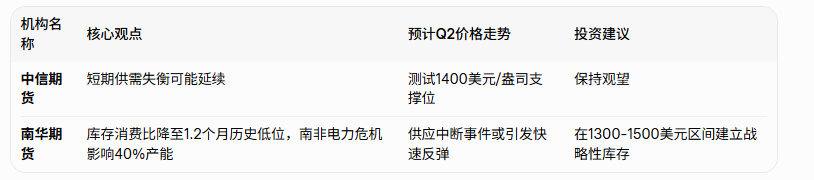
CITIC Futures believes that although demand for automotive catalysts is under pressure, demand for palladium in the electronics industry (especially for AI server PCB coatings) is up 18% year-on-year, which may lead to a new supply-demand balance in the third quarter. Nanhua Futures, however, holds a relatively optimistic view, emphasizing that the current low inventory levels combined with potential geopolitical supply risks mean that any disruption could trigger a strong price rebound.
Further analysis reveals a clear transmission path for this round of decline: a double whammy of contracting demand and expanding supply from the policy side, while a strong dollar amplifies volatility through financial leverage. Historical data shows that palladium, as a precious metal with strong industrial attributes, is extremely sensitive to marginal changes in supply and demand. While current low inventory levels provide some support, if the Federal Reserve's policy path tightens more than expected, prices still face the risk of further declines. Investors need to closely monitor the details of policy implementation, Norilsk's actual production figures, and subsequent interest rate signals from the Federal Reserve, as these variables will directly determine the bottoming pattern of prices in the second quarter.
Editor's Summary : The recent sharp decline in palladium futures contracts is a result of both deteriorating supply and demand fundamentals and macroeconomic and financial constraints. Divergent opinions among institutions highlight differing market predictions regarding the timing of a rebound. Short-term risks remain, but low inventory levels and potential supply disruptions provide some basis for a rebound. Market participants should respond flexibly based on their own risk appetite.
First, policy adjustments in the new energy vehicle industry. The "Management Measures for the Recycling of Power Batteries for New Energy Vehicles," released in early 2026, explicitly requires increasing the recycling rate of nickel-metal hydride batteries to 90%. This measure directly weakens the expected demand for palladium in the automotive catalyst sector. According to the latest industry estimates, the new regulations may lead to a reduction of 12-15 tons in annual palladium demand. This policy not only accelerates battery recycling but also promotes the replacement of palladium in catalysts for traditional fuel and hybrid vehicles, further compressing the rigid demand in the medium and long term.
Second, Russia's Norilsk Nickel announced a production increase plan. As the world's largest palladium producer, the company disclosed on March 25 that it will expand its Arctic mining capacity, expecting palladium production to increase by 8% in 2026, equivalent to an additional 16 tons of supply. This new supply will directly exacerbate the oversupply pressure in the market, and coupled with the potential resumption of production in other mines around the world, the short-term supply elasticity will be significantly enhanced.
Third, expectations of a Fed rate hike have strengthened. The minutes of the March FOMC meeting indicated a possible extension of the high-interest-rate cycle, causing the dollar index to rise to 105.2, which continued to suppress the overall performance of precious metals, including palladium. Speculative long positions decreased by 23% in a single week. In a high-interest-rate environment, the opportunity cost of holding non-yielding assets increases, and the outflow of funds significantly amplifies downward pressure on prices.
The opinions of different institutions are clearly divergent. The following table provides a direct comparison of the latest assessments:
CITIC Futures believes that although demand for automotive catalysts is under pressure, demand for palladium in the electronics industry (especially for AI server PCB coatings) is up 18% year-on-year, which may lead to a new supply-demand balance in the third quarter. Nanhua Futures, however, holds a relatively optimistic view, emphasizing that the current low inventory levels combined with potential geopolitical supply risks mean that any disruption could trigger a strong price rebound.
Further analysis reveals a clear transmission path for this round of decline: a double whammy of contracting demand and expanding supply from the policy side, while a strong dollar amplifies volatility through financial leverage. Historical data shows that palladium, as a precious metal with strong industrial attributes, is extremely sensitive to marginal changes in supply and demand. While current low inventory levels provide some support, if the Federal Reserve's policy path tightens more than expected, prices still face the risk of further declines. Investors need to closely monitor the details of policy implementation, Norilsk's actual production figures, and subsequent interest rate signals from the Federal Reserve, as these variables will directly determine the bottoming pattern of prices in the second quarter.
Editor's Summary : The recent sharp decline in palladium futures contracts is a result of both deteriorating supply and demand fundamentals and macroeconomic and financial constraints. Divergent opinions among institutions highlight differing market predictions regarding the timing of a rebound. Short-term risks remain, but low inventory levels and potential supply disruptions provide some basis for a rebound. Market participants should respond flexibly based on their own risk appetite.
- Risk Warning and Disclaimer
- The market involves risk, and trading may not be suitable for all investors. This article is for reference only and does not constitute personal investment advice, nor does it take into account certain users’ specific investment objectives, financial situation, or other needs. Any investment decisions made based on this information are at your own risk.