Gold Trading Alert: Significant US-Iran Disagreements and Tilted Inflation Risks Cause Gold Prices to Plunge Nearly 3%! Is a Fed Rate Hike Storm Imminent?
2026-03-27 07:42:05
On Thursday (March 26), US President Trump announced that, at Iran's request, the deadline for suspending strikes on Iranian energy facilities would be extended by 10 days to April 6, ostensibly a goodwill gesture indicating progress in peace negotiations. However, spot gold plummeted 2.8% to $4,377.85 per ounce that day, while April gold futures plunged even more sharply, falling 3.9% to $4,376.3 per ounce. Since the outbreak of the US-Israel war against Iran, gold has fallen by a cumulative 17%, completely shattering the traditional safe-haven logic under geopolitical conflict. In this "fog of war," soaring oil prices, rising inflation warnings, and the probability of a Fed rate hike this year rising to 40% have helped the US dollar index rise for three consecutive days, significantly putting downward pressure on gold prices.
On Thursday evening, Trump declared on Fox News that Iran had requested the extension, and he even agreed to grant three more days than Iran initially requested (seven days), arguing that Iran ultimately allowed 10 Pakistani-flagged oil tankers to pass through the Strait of Hormuz instead of the initial eight. He triumphantly stated, "In a sense, we've won." Secretary of State Rubio echoed this, saying that the information exchange with Iran "did indeed make some progress," but emphasized that it remained an "ongoing and uncertain process."
However, the voices from the mediators are quite different. The Wall Street Journal, citing intermediaries involved in the negotiations, revealed that Iran did not demand a halt to the US strikes on energy facilities, nor did it provide a final response to the 15-point plan to end the war. Iranian officials made it clear that they were interested in negotiations, but the leadership had not yet made a final decision. They demanded that the US significantly reduce its "excessive demands" before they would sit down to discuss a ceasefire, while firmly excluding the missile program from the starting point of negotiations and refusing to commit to a permanent halt to uranium enrichment. Senior Iranian officials went even further, stating that the US proposal was "unilateral and unfair," serving only the interests of the US and Israel.
This tug-of-war between Trump (playing the good cop) and Iran (playing the bad cop) instantly shattered investors' superficial optimism. The market, which had initially breathed a sigh of relief on Wednesday due to ceasefire expectations, completely reversed course on Thursday amid conflicting signals. Tom di Galoma of Mischler Financial Group pointed out that the rise in bond yields due to Middle East tensions was precisely because Brent crude oil had surged to $106, up $4 from Wednesday. Gold, as a safe-haven asset, should have shone brightly amidst this uncertainty, but the farce of "delayed peace talks" punctured its bubble—the market realized that a genuine ceasefire might be a long way off, and the fog of war would only thicken.
Federal Reserve Governor Tim Cook stated on Thursday at Yale School of Management that the Fed's risk balance between price stability and full employment has "tilted more towards inflation" due to the war with Iran. He pointed out that Trump's tariffs over the past year have disrupted the process of inflation returning to the 2% target, and the war "has taken us further away from that target." Another governor, Jerry Mirren, proposed a bold roadmap, suggesting a significant reduction of the $6.7 trillion balance sheet by $1-2 trillion through easing liquidity regulations and adjusting stress tests, thereby achieving a more accommodative interest rate environment without sacrificing policy space.
Data from the CME FedWatch Tool shows that the probability of at least one rate cut before the end of December has plummeted from 8.5% the previous day to 1.3%, while the probability of keeping rates unchanged is 54.2%, and the probability of at least a 25 basis point rate hike has surged from 20.9% to 44.6% . The bond market reacted most directly: the 10-year Treasury yield rose to 4.404%, the 2-year yield rose to 3.967%, and the yield curve spread narrowed to 43.64 basis points. Weak demand at the auction of the 7-year U.S. Treasury note further pushed up yields.
The US dollar index rose 0.3% to 99.92, marking its third consecutive day of strength. Kitco Metals senior analyst Jim Wyckoff succinctly summarized the gold market's predicament: "Interest rate hikes and inflation concerns are dragging down gold prices."
As a zero-yield asset, gold is naturally under pressure in a high-interest-rate environment. When oil prices climbed to $106 due to the potential disruption risk in the Strait of Hormuz, the second round of inflationary effects from rising energy prices quickly spread. The market no longer needed gold's "safe-haven" narrative, but was more concerned about the Federal Reserve using higher interest rates to combat inflation. Jane Foley, head of foreign exchange strategy at Rabobank, pointed out that as the negotiation deadline approached the weekend, anxiety dominated the market, and risk assets fell across the board, making it difficult for gold to remain unaffected.
The Nasdaq Composite plunged 2.38% on Thursday, confirming it has entered correction territory (down 10.7% from its October 29 high), while the S&P 500 fell 1.74% and the Dow Jones Industrial Average dropped 1.01%. Technology and communication services sectors led the decline, with the META falling nearly 8%, Alphabet dropping over 3%, and Nvidia also plunging more than 4%. The energy sector, however, rose 1.6%, and utilities edged up 0.2%, indicating that funds are flowing from overvalued growth stocks to defensive assets.
Wells Fargo global equity strategist Doug Beath attributes this to the "fog of war": Trump says negotiations are going "very well" one minute, and warns of continued heavy attacks if no agreement is reached the next; Iran, on the other hand, repeatedly emphasizes that the proposed solution is unfair but that diplomatic efforts are not over. This back-and-forth has left investors bewildered, ultimately leading them to sell stocks. Peter Tuz, president of Chase Investment Counsel, warns that the S&P 500 may soon follow the Nasdaq into a correction, and weak technical indicators will continue to dampen buying interest until the situation becomes clearer.
In this environment, gold's traditional safe-haven appeal has been completely overshadowed by the US dollar and bond yields. Silver and palladium even plummeted by nearly 5%, further confirming the overall sell-off sentiment in the market towards industrial and precious metals. Last week, the number of initial jobless claims in the US rose slightly to 210,000, in line with expectations. The stable labor market has actually strengthened the Federal Reserve's policy space of "fighting inflation first and then employment," leaving gold bulls completely speechless.
The current decline in gold prices is essentially a concentrated release of "expectation discrepancies." The market had bet on a rapid de-escalation of the war, a drop in oil prices, and the resumption of interest rate cuts. However, Trump's announcement of the postponement and Iran's strong response shattered these expectations instantly. Analyst Wyckoff provides clear boundaries: if the conflict continues, gold prices could fall below $4,000; if a ceasefire is achieved and hopes for interest rate cuts are rekindled, prices could potentially return to around $5,000.
However, in the medium to long term, the war with Iran has lasted for nearly four weeks, the shadow of disrupted shipping in the Strait of Hormuz has not been dispelled, and global energy supply pressures continue to accumulate. Federal Reserve governors have publicly acknowledged that the war is pushing up inflation, and discussions about balance sheet reduction suggest limited future policy space. If negotiations completely break down and attacks on energy facilities resume, a second surge in oil prices will push inflation risks to new highs, at which point gold's status as the ultimate safe-haven asset will be reaffirmed.
In conclusion, the postponement of the Trump-Iran peace talks is not a glimmer of peace, but rather another exposure of the complexity of the Middle East situation. It directly shattered market illusions of a quick ceasefire, triggering a triple reaction in oil prices, inflation expectations, and interest rate expectations, causing gold to suffer a "double whammy" in the short term—a stronger dollar coupled with high interest rates. In the short term, as long as the US-Iran negotiations do not achieve a substantial and verifiable breakthrough, and inflation and tightening expectations persist, gold prices may continue to face downward pressure, and may even fall below the $4,000 mark, as analysts have warned.
However, investors should also be aware that this situation is highly fragile. Any event leading to an escalation of the conflict could quickly reverse the current market logic, allowing gold's safe-haven appeal to shine once again. Simultaneously, once market expectations for the Fed's tightening reach their peak and begin to decline, gold will also have a chance to breathe. The future direction of gold prices will depend on the real progress at the US-Iran negotiating table, the next move in oil prices, and how the Fed balances controlling inflation with responding to potential economic shocks. Until all this becomes clear, gold's rollercoaster ride may continue.
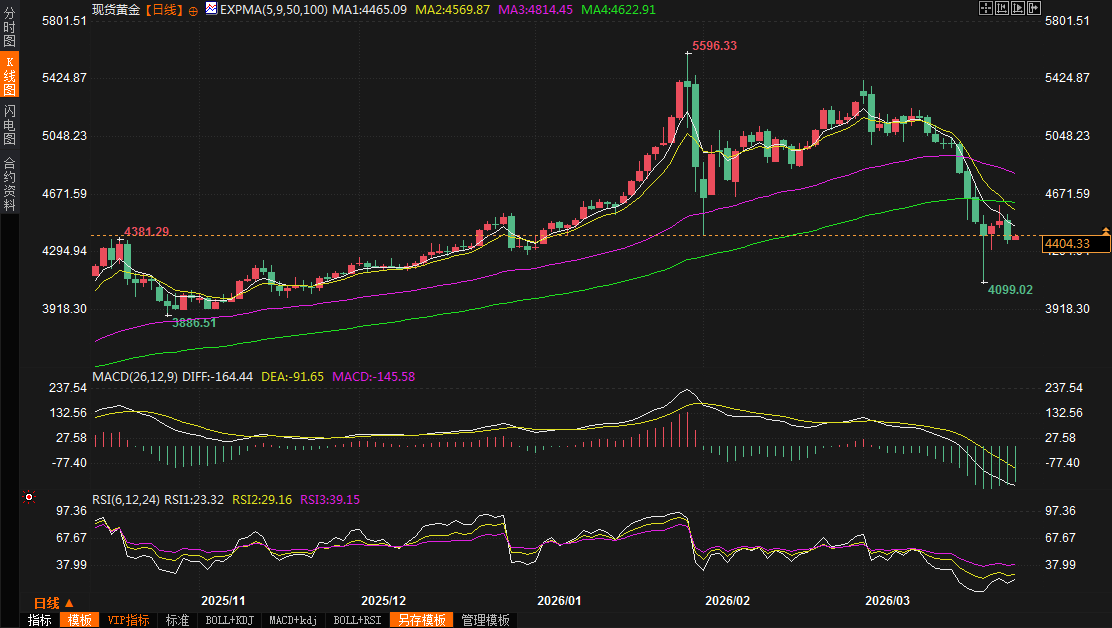
(Spot gold daily chart, source: FX678)
At 07:40 Beijing time, spot gold was trading at $4406.26 per ounce.
Trump's "goodwill extension" vs. Iran's tough response: The prospects for peace talks are uncertain, and market confidence collapses instantly.
On Thursday evening, Trump declared on Fox News that Iran had requested the extension, and he even agreed to grant three more days than Iran initially requested (seven days), arguing that Iran ultimately allowed 10 Pakistani-flagged oil tankers to pass through the Strait of Hormuz instead of the initial eight. He triumphantly stated, "In a sense, we've won." Secretary of State Rubio echoed this, saying that the information exchange with Iran "did indeed make some progress," but emphasized that it remained an "ongoing and uncertain process."
However, the voices from the mediators are quite different. The Wall Street Journal, citing intermediaries involved in the negotiations, revealed that Iran did not demand a halt to the US strikes on energy facilities, nor did it provide a final response to the 15-point plan to end the war. Iranian officials made it clear that they were interested in negotiations, but the leadership had not yet made a final decision. They demanded that the US significantly reduce its "excessive demands" before they would sit down to discuss a ceasefire, while firmly excluding the missile program from the starting point of negotiations and refusing to commit to a permanent halt to uranium enrichment. Senior Iranian officials went even further, stating that the US proposal was "unilateral and unfair," serving only the interests of the US and Israel.
This tug-of-war between Trump (playing the good cop) and Iran (playing the bad cop) instantly shattered investors' superficial optimism. The market, which had initially breathed a sigh of relief on Wednesday due to ceasefire expectations, completely reversed course on Thursday amid conflicting signals. Tom di Galoma of Mischler Financial Group pointed out that the rise in bond yields due to Middle East tensions was precisely because Brent crude oil had surged to $106, up $4 from Wednesday. Gold, as a safe-haven asset, should have shone brightly amidst this uncertainty, but the farce of "delayed peace talks" punctured its bubble—the market realized that a genuine ceasefire might be a long way off, and the fog of war would only thicken.
Oil prices remain strong, while inflation risks are tilting across the board: hawkish signals from the Federal Reserve overwhelm gold's safe-haven appeal.
Federal Reserve Governor Tim Cook stated on Thursday at Yale School of Management that the Fed's risk balance between price stability and full employment has "tilted more towards inflation" due to the war with Iran. He pointed out that Trump's tariffs over the past year have disrupted the process of inflation returning to the 2% target, and the war "has taken us further away from that target." Another governor, Jerry Mirren, proposed a bold roadmap, suggesting a significant reduction of the $6.7 trillion balance sheet by $1-2 trillion through easing liquidity regulations and adjusting stress tests, thereby achieving a more accommodative interest rate environment without sacrificing policy space.
Data from the CME FedWatch Tool shows that the probability of at least one rate cut before the end of December has plummeted from 8.5% the previous day to 1.3%, while the probability of keeping rates unchanged is 54.2%, and the probability of at least a 25 basis point rate hike has surged from 20.9% to 44.6% . The bond market reacted most directly: the 10-year Treasury yield rose to 4.404%, the 2-year yield rose to 3.967%, and the yield curve spread narrowed to 43.64 basis points. Weak demand at the auction of the 7-year U.S. Treasury note further pushed up yields.
The US dollar index rose 0.3% to 99.92, marking its third consecutive day of strength. Kitco Metals senior analyst Jim Wyckoff succinctly summarized the gold market's predicament: "Interest rate hikes and inflation concerns are dragging down gold prices."
As a zero-yield asset, gold is naturally under pressure in a high-interest-rate environment. When oil prices climbed to $106 due to the potential disruption risk in the Strait of Hormuz, the second round of inflationary effects from rising energy prices quickly spread. The market no longer needed gold's "safe-haven" narrative, but was more concerned about the Federal Reserve using higher interest rates to combat inflation. Jane Foley, head of foreign exchange strategy at Rabobank, pointed out that as the negotiation deadline approached the weekend, anxiety dominated the market, and risk assets fell across the board, making it difficult for gold to remain unaffected.
The stock market has confirmed its correction range, with defensive sectors experiencing a slight rebound: funds are shifting from gold to "real safe havens."
The Nasdaq Composite plunged 2.38% on Thursday, confirming it has entered correction territory (down 10.7% from its October 29 high), while the S&P 500 fell 1.74% and the Dow Jones Industrial Average dropped 1.01%. Technology and communication services sectors led the decline, with the META falling nearly 8%, Alphabet dropping over 3%, and Nvidia also plunging more than 4%. The energy sector, however, rose 1.6%, and utilities edged up 0.2%, indicating that funds are flowing from overvalued growth stocks to defensive assets.
Wells Fargo global equity strategist Doug Beath attributes this to the "fog of war": Trump says negotiations are going "very well" one minute, and warns of continued heavy attacks if no agreement is reached the next; Iran, on the other hand, repeatedly emphasizes that the proposed solution is unfair but that diplomatic efforts are not over. This back-and-forth has left investors bewildered, ultimately leading them to sell stocks. Peter Tuz, president of Chase Investment Counsel, warns that the S&P 500 may soon follow the Nasdaq into a correction, and weak technical indicators will continue to dampen buying interest until the situation becomes clearer.
In this environment, gold's traditional safe-haven appeal has been completely overshadowed by the US dollar and bond yields. Silver and palladium even plummeted by nearly 5%, further confirming the overall sell-off sentiment in the market towards industrial and precious metals. Last week, the number of initial jobless claims in the US rose slightly to 210,000, in line with expectations. The stable labor market has actually strengthened the Federal Reserve's policy space of "fighting inflation first and then employment," leaving gold bulls completely speechless.
Gold's Short-Term Pressure vs. Long-Term Reversal Logic: Failed Ceasefire Could Be the Biggest Catalyst
The current decline in gold prices is essentially a concentrated release of "expectation discrepancies." The market had bet on a rapid de-escalation of the war, a drop in oil prices, and the resumption of interest rate cuts. However, Trump's announcement of the postponement and Iran's strong response shattered these expectations instantly. Analyst Wyckoff provides clear boundaries: if the conflict continues, gold prices could fall below $4,000; if a ceasefire is achieved and hopes for interest rate cuts are rekindled, prices could potentially return to around $5,000.
However, in the medium to long term, the war with Iran has lasted for nearly four weeks, the shadow of disrupted shipping in the Strait of Hormuz has not been dispelled, and global energy supply pressures continue to accumulate. Federal Reserve governors have publicly acknowledged that the war is pushing up inflation, and discussions about balance sheet reduction suggest limited future policy space. If negotiations completely break down and attacks on energy facilities resume, a second surge in oil prices will push inflation risks to new highs, at which point gold's status as the ultimate safe-haven asset will be reaffirmed.
Gold's "Darkest Hour" May Be a Historic Investment Window: Investors Need to Be Wary of Two Major Variables
In conclusion, the postponement of the Trump-Iran peace talks is not a glimmer of peace, but rather another exposure of the complexity of the Middle East situation. It directly shattered market illusions of a quick ceasefire, triggering a triple reaction in oil prices, inflation expectations, and interest rate expectations, causing gold to suffer a "double whammy" in the short term—a stronger dollar coupled with high interest rates. In the short term, as long as the US-Iran negotiations do not achieve a substantial and verifiable breakthrough, and inflation and tightening expectations persist, gold prices may continue to face downward pressure, and may even fall below the $4,000 mark, as analysts have warned.
However, investors should also be aware that this situation is highly fragile. Any event leading to an escalation of the conflict could quickly reverse the current market logic, allowing gold's safe-haven appeal to shine once again. Simultaneously, once market expectations for the Fed's tightening reach their peak and begin to decline, gold will also have a chance to breathe. The future direction of gold prices will depend on the real progress at the US-Iran negotiating table, the next move in oil prices, and how the Fed balances controlling inflation with responding to potential economic shocks. Until all this becomes clear, gold's rollercoaster ride may continue.
(Spot gold daily chart, source: FX678)
At 07:40 Beijing time, spot gold was trading at $4406.26 per ounce.
- Risk Warning and Disclaimer
- The market involves risk, and trading may not be suitable for all investors. This article is for reference only and does not constitute personal investment advice, nor does it take into account certain users’ specific investment objectives, financial situation, or other needs. Any investment decisions made based on this information are at your own risk.