Bypassing Congress to inject funds? Trump signs executive order for emergency financial injection, could this break the shutdown deadlock?
2026-03-27 09:31:00
U.S. President Donald Trump announced on Thursday (March 26) that he would sign an executive order directing Homeland Security Secretary Mark Wayne Marin to immediately pay the salaries of Transportation Security Administration (TSA) staff in order to quickly alleviate airport security chaos caused by the DHS funding impasse.
This administrative intervention aims to stabilize air travel and prevent more passengers from suffering losses due to security delays. Currently, there is a large-scale absence of TSA security personnel due to unpaid work, resulting in long queues at airports across the United States.
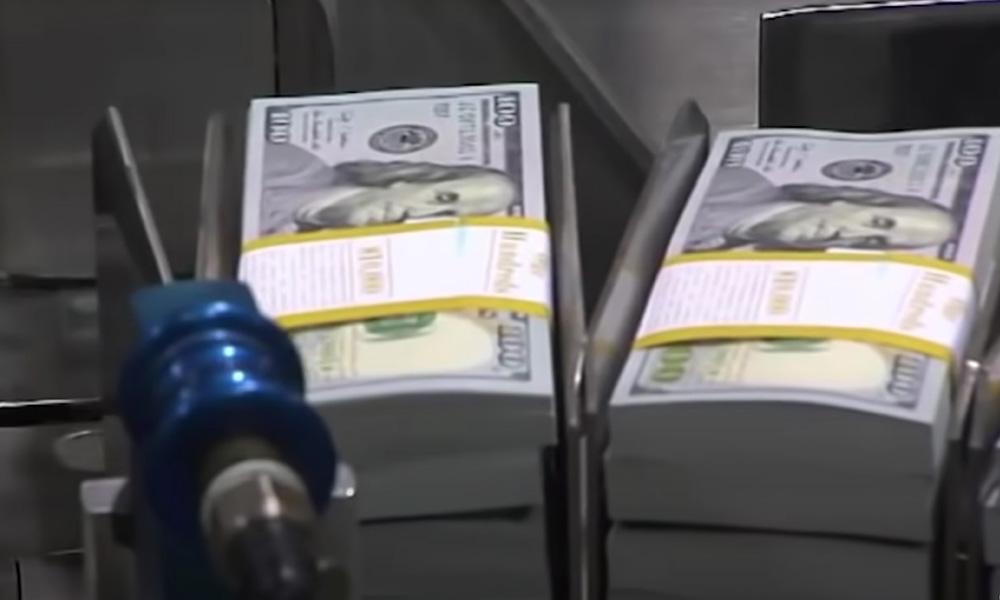
Trump stated that he will sign an executive order requiring Homeland Security Secretary Marin to immediately initiate the payroll process for TSA staff. This order bypasses the congressional appropriations impasse, directly guaranteeing the payment of wages to frontline security personnel through executive power.
Trump emphasized that this move was to end the "airport chaos caused by Democrats" as soon as possible and urged Congress to reach a comprehensive DHS funding agreement quickly. He pointed out that the long-term unpaid work of TSA employees has seriously affected aviation safety and passenger experience and must be addressed immediately.
Negotiations over funding for the DHS have stalled for 41 days . Democrats insist on reforming Immigration and Customs Enforcement (ICE) and have repeatedly pushed for separate funding for the TSA; Republicans, on the other hand, insist on passing a comprehensive DHS funding package and linking it to an election reform bill.
Due to the failure of negotiations to reach an agreement, non-immigrant law enforcement agencies such as the TSA have run out of funds, leaving many security personnel working without pay. This has led to a significant drop in airport security efficiency and frequent passenger delays. ICE, having previously secured $75 billion in funding, is still able to operate normally and pay salaries.
Senate Minority Leader Chuck Schumer accused Republicans of repeatedly refusing to allocate separate funding to the TSA, calling it the root of the chaos. Republicans countered that the Democratic proposals lacked sincerity and showed an unwillingness to compromise on ICE reform.
Trump's executive orders provide a short-term measure to stabilize the situation, but long-term funding issues still require Congress to pass a formal appropriations bill. With only one day left before Congress's two-week recess, the pressure to negotiate is further increasing.
Supported by the strengthening of the Federal Reserve's policy framework in the short term, the US dollar index remained volatile around 99.90 during the Asian session on Friday. In the medium term, it faces pressure from rising fiscal and political risks, and the credit foundation of the US dollar is showing a divergent pattern of "stabilizing monetary policy and tightening fiscal coordination".
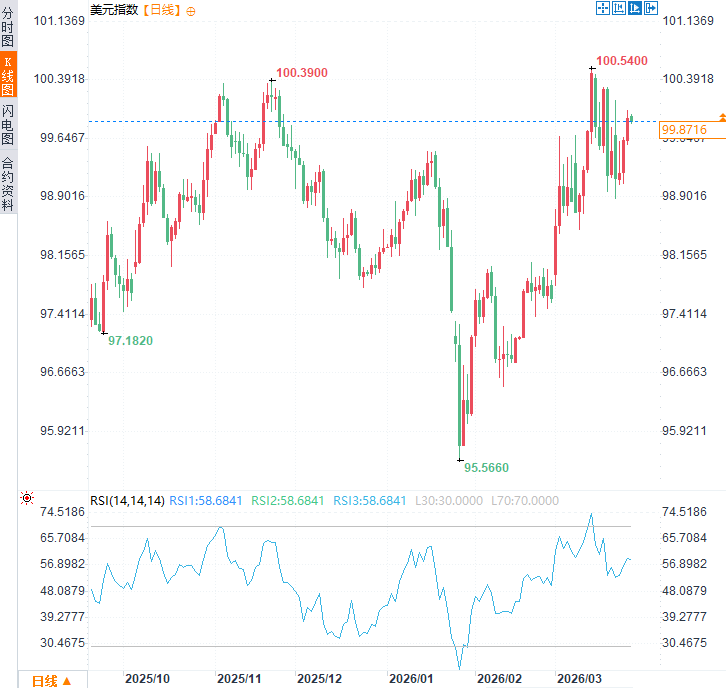
(US Dollar Index Daily Chart, Source: FX678)
In the short term, if Trump's executive order is implemented quickly, the issue of TSA security personnel salaries may be resolved, and the chaos at airports could be somewhat alleviated. However, if Congress fails to reach a comprehensive funding agreement before adjourning, the risk of similar shutdowns will continue to arise.
In the medium to long term, a fundamental solution to the DHS funding impasse depends on a compromise between the two parties on immigration enforcement reform and the overall funding package. The absence of any long-term agreement could continue to impact border security, emergency response, and air travel. Investors and the public should pay close attention to the progress of negotiations before the weekend and subsequent executive actions by Trump.
At 9:30 AM Beijing time, the US dollar index is currently at 99.87.
This administrative intervention aims to stabilize air travel and prevent more passengers from suffering losses due to security delays. Currently, there is a large-scale absence of TSA security personnel due to unpaid work, resulting in long queues at airports across the United States.
Core content of the administrative order
Trump stated that he will sign an executive order requiring Homeland Security Secretary Marin to immediately initiate the payroll process for TSA staff. This order bypasses the congressional appropriations impasse, directly guaranteeing the payment of wages to frontline security personnel through executive power.
Trump emphasized that this move was to end the "airport chaos caused by Democrats" as soon as possible and urged Congress to reach a comprehensive DHS funding agreement quickly. He pointed out that the long-term unpaid work of TSA employees has seriously affected aviation safety and passenger experience and must be addressed immediately.
DHS's funding deadlock
Negotiations over funding for the DHS have stalled for 41 days . Democrats insist on reforming Immigration and Customs Enforcement (ICE) and have repeatedly pushed for separate funding for the TSA; Republicans, on the other hand, insist on passing a comprehensive DHS funding package and linking it to an election reform bill.
Due to the failure of negotiations to reach an agreement, non-immigrant law enforcement agencies such as the TSA have run out of funds, leaving many security personnel working without pay. This has led to a significant drop in airport security efficiency and frequent passenger delays. ICE, having previously secured $75 billion in funding, is still able to operate normally and pay salaries.
Current status of bipartisan negotiations
Senate Minority Leader Chuck Schumer accused Republicans of repeatedly refusing to allocate separate funding to the TSA, calling it the root of the chaos. Republicans countered that the Democratic proposals lacked sincerity and showed an unwillingness to compromise on ICE reform.
Trump's executive orders provide a short-term measure to stabilize the situation, but long-term funding issues still require Congress to pass a formal appropriations bill. With only one day left before Congress's two-week recess, the pressure to negotiate is further increasing.
Analysis of the impact on the US dollar
Supported by the strengthening of the Federal Reserve's policy framework in the short term, the US dollar index remained volatile around 99.90 during the Asian session on Friday. In the medium term, it faces pressure from rising fiscal and political risks, and the credit foundation of the US dollar is showing a divergent pattern of "stabilizing monetary policy and tightening fiscal coordination".
(US Dollar Index Daily Chart, Source: FX678)
Market Outlook and Risks
In the short term, if Trump's executive order is implemented quickly, the issue of TSA security personnel salaries may be resolved, and the chaos at airports could be somewhat alleviated. However, if Congress fails to reach a comprehensive funding agreement before adjourning, the risk of similar shutdowns will continue to arise.
In the medium to long term, a fundamental solution to the DHS funding impasse depends on a compromise between the two parties on immigration enforcement reform and the overall funding package. The absence of any long-term agreement could continue to impact border security, emergency response, and air travel. Investors and the public should pay close attention to the progress of negotiations before the weekend and subsequent executive actions by Trump.
At 9:30 AM Beijing time, the US dollar index is currently at 99.87.
- Risk Warning and Disclaimer
- The market involves risk, and trading may not be suitable for all investors. This article is for reference only and does not constitute personal investment advice, nor does it take into account certain users’ specific investment objectives, financial situation, or other needs. Any investment decisions made based on this information are at your own risk.