BOJ interest rate hike expectations ignited volatility in the bond market, with the yield on 10-year Japanese government bonds surging to 2.36%.
2026-03-27 13:59:31
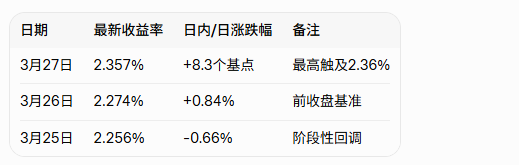
According to APP reports, on March 27, the yield on 10-year Japanese government bonds rose by approximately 9.0 basis points to around 2.360%. Latest data shows the yield on 10-year Japanese government bonds was 2.357%, up 8.3 basis points from the previous trading day's settlement price of 2.274%. The yield reached a high of 2.36% and a low of 2.295% during the day.

The rapid rise in Japanese 10-year government bond yields is primarily driven by increased market expectations of a near-term interest rate hike by the Bank of Japan (BOJ). Last week, the BOJ kept its policy rate unchanged, but Governor Kazuo Ueda clearly left room for a rate hike in April. Coupled with rising oil prices due to Middle East geopolitical conflicts and persistent inflationary pressures, investors adjusted their positions, leading to a decline in bond prices and a rise in yields. The short-term 2-year yield has reached a 30-year high, and the 5-year yield has also hit a record high, indicating that the bond market's pricing in the normalization of monetary policy is accelerating.
The following is a comparison of recent changes in the yield of 10-year Japanese government bonds:
The Bank of Japan governor recently stated explicitly on the topic, "Leaving open the possibility of an April rate hike," a statement that directly catalyzed market expectations. Analysts believe that imported inflation from rising oil prices, coupled with continued tightening signals from major central banks globally, is forcing Japan's monetary policy to break away from its long-term ultra-loose framework.
Rising yields have a significant transmission effect on the Japanese economy and financial markets. First, the yen is expected to strengthen in the short term, alleviating the carry trade pressure previously caused by low yields. Second, the stock market, especially bank stocks, may be under pressure, but export-oriented companies may face cost adjustments due to the yen's appreciation. Globally, the narrowing spread between the 10-year yields in the US and Japan may affect cross-border capital flows and increase volatility risks in emerging markets.
However, high yields also come with uncertainty. If the situation in the Middle East eases or inflation data falls short of expectations, the pace of interest rate hikes may slow, and the bond market may experience a correction. Investors need to continue to monitor the Bank of Japan's April meeting minutes, core CPI data, and global oil price trends.
Editor's Summary : The significant rise in the yield on 10-year Japanese government bonds indicates that the market is accelerating its pricing in policy tightening. Short-term bond market volatility is likely to remain high, while the medium- to long-term outlook depends on the alignment between the resilience of the actual economy and the inflation path. Market participants should consider their own risk tolerance, pay close attention to marginal changes in policy signals, and rationally manage cross-border risks.
The rapid rise in Japanese 10-year government bond yields is primarily driven by increased market expectations of a near-term interest rate hike by the Bank of Japan (BOJ). Last week, the BOJ kept its policy rate unchanged, but Governor Kazuo Ueda clearly left room for a rate hike in April. Coupled with rising oil prices due to Middle East geopolitical conflicts and persistent inflationary pressures, investors adjusted their positions, leading to a decline in bond prices and a rise in yields. The short-term 2-year yield has reached a 30-year high, and the 5-year yield has also hit a record high, indicating that the bond market's pricing in the normalization of monetary policy is accelerating.
The following is a comparison of recent changes in the yield of 10-year Japanese government bonds:
The Bank of Japan governor recently stated explicitly on the topic, "Leaving open the possibility of an April rate hike," a statement that directly catalyzed market expectations. Analysts believe that imported inflation from rising oil prices, coupled with continued tightening signals from major central banks globally, is forcing Japan's monetary policy to break away from its long-term ultra-loose framework.
Rising yields have a significant transmission effect on the Japanese economy and financial markets. First, the yen is expected to strengthen in the short term, alleviating the carry trade pressure previously caused by low yields. Second, the stock market, especially bank stocks, may be under pressure, but export-oriented companies may face cost adjustments due to the yen's appreciation. Globally, the narrowing spread between the 10-year yields in the US and Japan may affect cross-border capital flows and increase volatility risks in emerging markets.
However, high yields also come with uncertainty. If the situation in the Middle East eases or inflation data falls short of expectations, the pace of interest rate hikes may slow, and the bond market may experience a correction. Investors need to continue to monitor the Bank of Japan's April meeting minutes, core CPI data, and global oil price trends.
Editor's Summary : The significant rise in the yield on 10-year Japanese government bonds indicates that the market is accelerating its pricing in policy tightening. Short-term bond market volatility is likely to remain high, while the medium- to long-term outlook depends on the alignment between the resilience of the actual economy and the inflation path. Market participants should consider their own risk tolerance, pay close attention to marginal changes in policy signals, and rationally manage cross-border risks.
- Risk Warning and Disclaimer
- The market involves risk, and trading may not be suitable for all investors. This article is for reference only and does not constitute personal investment advice, nor does it take into account certain users’ specific investment objectives, financial situation, or other needs. Any investment decisions made based on this information are at your own risk.