Crude oil trading alert: The spillover effects of the Middle East situation and escalating shipping risks have pushed oil prices above their resistance levels; be wary of further increases in volatility.
2026-03-30 09:14:40
International crude oil prices continued their strong performance during Monday's Asian trading session, with the US benchmark WTI crude oil rising for the fourth consecutive trading day and regaining the important psychological level of $100 per barrel . The core driver of this rally was the further escalation of the situation in the Middle East, particularly the increased security risks in the Red Sea, which has raised new concerns about the stability of global energy supplies.

Recent developments indicate that the Houthi rebels in Yemen have begun to expand the scope of the conflict, launching a new round of attacks against Israel. Market research suggests this move signifies the regional conflict is spreading from a localized area to a wider scale. Meanwhile, the previous US-Israeli strikes against Iran have triggered a chain reaction, creating a more complex security environment for the entire Middle East energy corridor. Against this backdrop, the risks associated with Red Sea shipping routes have increased significantly, while the disruption to shipping through the Strait of Hormuz has not yet been fully resolved. The combined risks of these two key energy corridors further amplify market tensions.
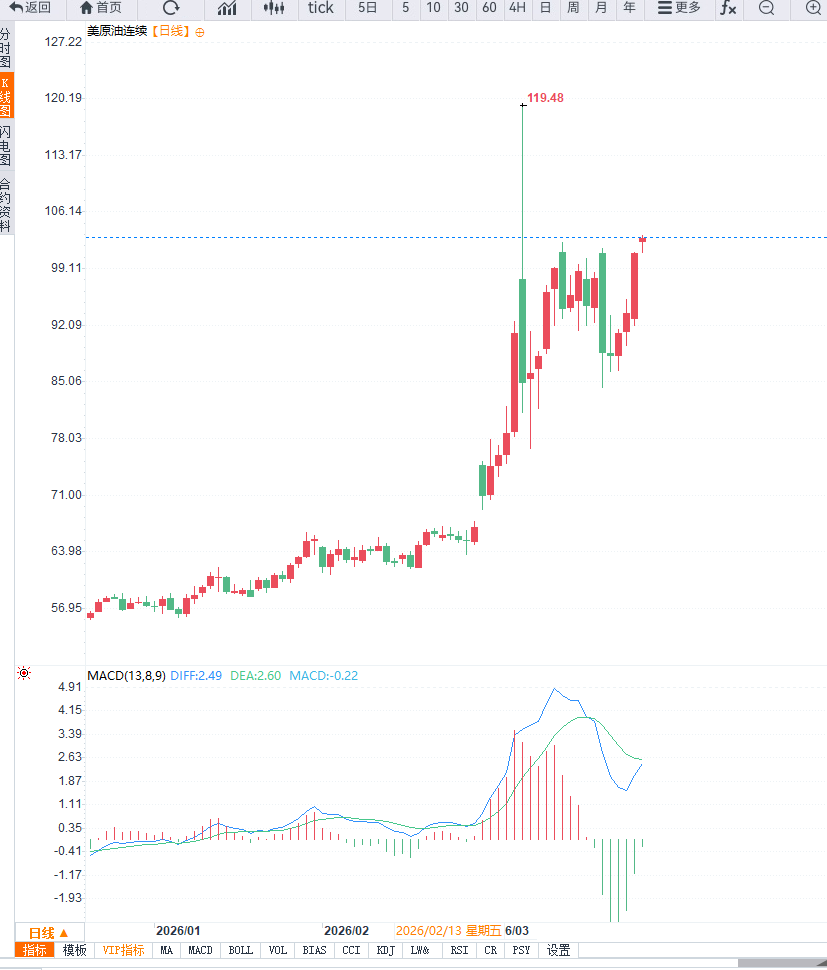
Judging from market reactions, funds continued to flow into the crude oil market to hedge against potential supply disruptions. WTI prices briefly touched above $100 and approached the previous three-year high of $113.28 . Although the upward trend continued, the price movement rhythm changed. Compared to the previous rapid rise, the current increase is more of a "volatile upward movement after a shift in the central range," indicating that the market is gradually digesting the positive factors at high levels.
From a global market perspective, rising energy prices are reigniting inflation expectations and disrupting the monetary policy paths of major economies. Rising oil prices mean increased transportation and production costs, potentially further suppressing the pace of global demand recovery. Furthermore, the rising energy risk premium strengthens the safe-haven appeal of the US dollar, creating a ripple effect on the foreign exchange market.
From a market sentiment perspective, investors are currently pricing in geopolitical risks more rationally, with volatility significantly lower than before, indicating that the market has partially digested the impact of the conflict. However, if the situation escalates further, such as a potential US ground military operation against Iran or the Houthi rebels expanding their attacks, oil price volatility could be reactivated, leading to periods of sharp fluctuations. Current market focus is on the developments in the Red Sea, the passage through the Strait of Hormuz, and whether de-escalation negotiations between the US and Iran will begin.
From a technical perspective, on the daily chart, WTI crude oil maintains a strong upward structure. After breaking through $100 , a new platform support has formed, with key support around $96 . Resistance levels to watch are $105 and the previous high of $113.28. While overall momentum has slowed somewhat, the overall trend remains unchanged. On the 4-hour chart, oil prices are exhibiting a high-level consolidation and upward pattern. The short-term moving average system remains bullish, but momentum indicators show signs of weakening. A pullback below $98 could test the $96 support area; a break above $105 could open up further upside potential.
Editor's Summary : The core driver of the current oil price increase remains the continued disruption to the supply side caused by geopolitical tensions, rather than a substantial improvement in demand. With risks to key Middle East transportation routes still unresolved, oil prices are likely to remain high. However, it's worth noting that volatility has shown signs of decline as the market gradually digests the impact of the conflict, indicating a slowdown in the upward pace. If the situation does not deteriorate further, oil prices may enter a period of high-level fluctuation; however, if the conflict escalates or supply disruptions worsen, the possibility of another rapid price surge cannot be ruled out. Investors should pay close attention to unforeseen risks driven by events.
Recent developments indicate that the Houthi rebels in Yemen have begun to expand the scope of the conflict, launching a new round of attacks against Israel. Market research suggests this move signifies the regional conflict is spreading from a localized area to a wider scale. Meanwhile, the previous US-Israeli strikes against Iran have triggered a chain reaction, creating a more complex security environment for the entire Middle East energy corridor. Against this backdrop, the risks associated with Red Sea shipping routes have increased significantly, while the disruption to shipping through the Strait of Hormuz has not yet been fully resolved. The combined risks of these two key energy corridors further amplify market tensions.
Judging from market reactions, funds continued to flow into the crude oil market to hedge against potential supply disruptions. WTI prices briefly touched above $100 and approached the previous three-year high of $113.28 . Although the upward trend continued, the price movement rhythm changed. Compared to the previous rapid rise, the current increase is more of a "volatile upward movement after a shift in the central range," indicating that the market is gradually digesting the positive factors at high levels.
From a global market perspective, rising energy prices are reigniting inflation expectations and disrupting the monetary policy paths of major economies. Rising oil prices mean increased transportation and production costs, potentially further suppressing the pace of global demand recovery. Furthermore, the rising energy risk premium strengthens the safe-haven appeal of the US dollar, creating a ripple effect on the foreign exchange market.
From a market sentiment perspective, investors are currently pricing in geopolitical risks more rationally, with volatility significantly lower than before, indicating that the market has partially digested the impact of the conflict. However, if the situation escalates further, such as a potential US ground military operation against Iran or the Houthi rebels expanding their attacks, oil price volatility could be reactivated, leading to periods of sharp fluctuations. Current market focus is on the developments in the Red Sea, the passage through the Strait of Hormuz, and whether de-escalation negotiations between the US and Iran will begin.
From a technical perspective, on the daily chart, WTI crude oil maintains a strong upward structure. After breaking through $100 , a new platform support has formed, with key support around $96 . Resistance levels to watch are $105 and the previous high of $113.28. While overall momentum has slowed somewhat, the overall trend remains unchanged. On the 4-hour chart, oil prices are exhibiting a high-level consolidation and upward pattern. The short-term moving average system remains bullish, but momentum indicators show signs of weakening. A pullback below $98 could test the $96 support area; a break above $105 could open up further upside potential.
Editor's Summary : The core driver of the current oil price increase remains the continued disruption to the supply side caused by geopolitical tensions, rather than a substantial improvement in demand. With risks to key Middle East transportation routes still unresolved, oil prices are likely to remain high. However, it's worth noting that volatility has shown signs of decline as the market gradually digests the impact of the conflict, indicating a slowdown in the upward pace. If the situation does not deteriorate further, oil prices may enter a period of high-level fluctuation; however, if the conflict escalates or supply disruptions worsen, the possibility of another rapid price surge cannot be ruled out. Investors should pay close attention to unforeseen risks driven by events.
- Risk Warning and Disclaimer
- The market involves risk, and trading may not be suitable for all investors. This article is for reference only and does not constitute personal investment advice, nor does it take into account certain users’ specific investment objectives, financial situation, or other needs. Any investment decisions made based on this information are at your own risk.