Global risk premiums decline: Bond market reverses overnight
2026-03-30 15:18:24
In an interview, U.S. Vice President Vance stated that the United States has no intention of maintaining a long-term presence in Iran and will withdraw quickly once the current issues are resolved.
He further stated that there are ample reasons to believe that the United States has achieved all its military objectives and that the current military operation is not yet over, stemming from President Trump's desire to ensure that Iran completely loses its ability to threaten the United States.
Regarding the rise in domestic oil prices in the United States, Vance stated that this is merely a very short-lived market reaction to the conflict between the US, Israel, and Iran, and that oil prices will fall back once the US military withdraws from Iran.
Geopolitical conflicts triggered significant volatility in the bond market: in just one weekend, the bond market shifted from intensive selling to capital inflows, and global assets began to rebound. However, some institutions warned that the risk of economic recession is still being underestimated by the market.
Geopolitical conflicts trigger a rollercoaster ride in the bond market: global assets rebounded after just one weekend, following extreme sell-offs, but some institutions warned that the risk of recession is still underestimated.

The ongoing conflict in Iran has triggered severe turmoil in global financial markets. As the anchor for global asset pricing, the government bond market has recently experienced a dramatic reversal from extreme sell-offs to capital inflows.
Last Friday, US Treasury yields surged to a recent high, putting pressure on various asset classes.
Today, market sentiment has shifted significantly, with safe-haven funds flowing back into the sovereign bond market, driving a collective rise in global government bonds and highlighting the rapid evolution of investor risk appetite amid geopolitical tensions.
Last Friday, a combination of negative factors led to an accelerated rise in US Treasury yields.
Driven by inflation concerns stemming from rising crude oil prices and the double whammy of a series of failed U.S. Treasury auctions, the yield on 10-year U.S. Treasury bonds rose 4.9 basis points to 4.439% by the close of trading that day, surging by about 50 basis points in a single month, with volatility far exceeding the typical limited range of fluctuations in the bond market.
This dramatic volatility occurred in an extremely unusual market environment: the ICE Bank of America MOVE Index, which measures expected volatility in the U.S. Treasury market, has recently surged to its highest point since April of last year.
Historically, the last time this index was at a high level was when President Trump withdrew several "Liberation Day" tariff policies, triggering turmoil in the bond market. Now, this indicator once again highlights the market's fear of geopolitical conflicts.
The sharp rise in government bond yields has exerted significant downward pressure on various global assets.
Gold, a traditional safe-haven asset, has not been immune to the impact of high interest rate expectations and a strengthening US dollar. Spot gold recently plummeted to 4099 points, almost entering a technical bear market. Its safe-haven properties have completely failed in the trading logic of "high oil prices - high inflation - high interest rates".
Risk assets also came under severe pressure, with equity assets continuing to decline. The S&P 500 index recorded its longest losing streak since May 2022, and credit spreads also began to widen.
Guy LeBass, chief fixed income strategist at Jenny Montgomery Scott, explained that against the backdrop of the oil crisis, a "dollar shortage" occurred in the global market, forcing energy-importing countries to sell various assets to raise dollars to snap up scarce energy, ultimately leading to the rare situation of simultaneous declines in stocks, bonds, and gold.
The Chicago Board Options Exchange Volatility Index (VIX) closed above 30 for the week, further confirming the market's state of panic.
Today, concerns that the Middle East conflict would drag down global economic growth dominated, leading to a significant slowdown in investor risk appetite. Safe-haven funds flowed back into previously heavily sold-off government bonds, pushing global sovereign bond prices up in tandem.
During Asian trading hours, US, Australian, and Japanese bonds rose in tandem, with the market betting that soaring oil prices could trigger a long-term global fuel shortage, thereby suppressing economic growth.
The yield on the two-year U.S. Treasury note, which is most sensitive to monetary policy adjustments, fell another 3 basis points to 3.88% today, after dropping 7 basis points on Friday; the benchmark 10-year U.S. Treasury yield fell 4 basis points to 4.39%, moving away from its recent high.
In addition, the yield on Australian three-year government bonds fell by as much as 9 basis points to 4.71%, and the yield on Japanese two-year government bonds fell by 2 basis points to 1.36%, with major global government bond markets showing a general upward trend.
This round of bond market rebound ended the continuous sell-off driven by soaring oil prices and expectations of central bank interest rate hikes in the previous weeks. The core trading logic has undergone a fundamental shift—from "inflation expectations driven by the price war" to "concerns about slowing economic growth." Market concerns about the central bank's aggressive hawkish policies have also cooled down.
Investment bank strategists point out that with the shift in logic, the steepening of the bond market bull run is likely to continue.
However, prominent institutions such as Pimco and Goldman Sachs have stated that the financial market still seriously underestimates the risk of a sharp economic slowdown caused by the Middle East conflict.
Goldman Sachs has raised its estimate of the probability of a global economic recession in the next year to around 30%, while Pimco estimates the probability of a recession in the United States to be more than one-third.
From a valuation perspective, the current government bond market has shown clear investment value.
Wall Street senior analyst Ed Yardeni pointed out that after the outbreak of the conflict, short-selling forces in the bond market have become excessively concentrated, and some bonds have fallen into an overbought state. The short end of the US Treasury yield curve has already priced in the expectation of a very low probability of monetary policy tightening and is in a clearly oversold state.
Apollo Global Management's calculations also provide support: the reasonable central level for the yield on 10-year US Treasury bonds is only around 3.90%, which is 55 basis points higher than the current actual level of above 4.40%.
In a client report, the company’s chief economist, Torsten Slok, emphasized that this significant divergence is attracting bargain hunters and becoming a major driver of the rebound in Treasury bond prices.
The dramatic reversal in the global government bond market reflects an evolving understanding among investors of the impact of the Middle East conflict.
In the future, the government bond market will continue to be affected by multiple factors, including geopolitical situations, inflation data, and central bank policies. The current trend of capital inflows and valuation repair may further reshape the risk appetite of the global financial market.
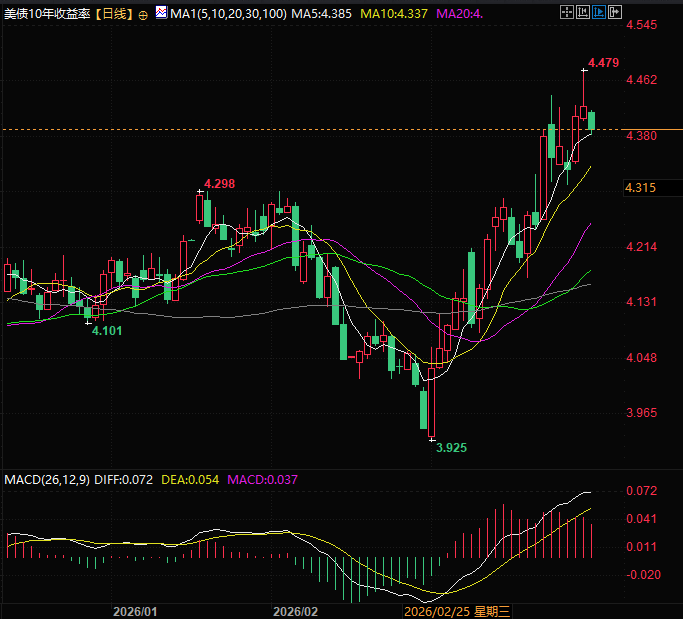
(Daily chart of the 10-year US Treasury yield, source: EasyForex)
He further stated that there are ample reasons to believe that the United States has achieved all its military objectives and that the current military operation is not yet over, stemming from President Trump's desire to ensure that Iran completely loses its ability to threaten the United States.
Regarding the rise in domestic oil prices in the United States, Vance stated that this is merely a very short-lived market reaction to the conflict between the US, Israel, and Iran, and that oil prices will fall back once the US military withdraws from Iran.
Geopolitical conflicts triggered significant volatility in the bond market: in just one weekend, the bond market shifted from intensive selling to capital inflows, and global assets began to rebound. However, some institutions warned that the risk of economic recession is still being underestimated by the market.
Geopolitical conflicts trigger a rollercoaster ride in the bond market: global assets rebounded after just one weekend, following extreme sell-offs, but some institutions warned that the risk of recession is still underestimated.
The ongoing conflict in Iran has triggered severe turmoil in global financial markets. As the anchor for global asset pricing, the government bond market has recently experienced a dramatic reversal from extreme sell-offs to capital inflows.
Last Friday, US Treasury yields surged to a recent high, putting pressure on various asset classes.
Today, market sentiment has shifted significantly, with safe-haven funds flowing back into the sovereign bond market, driving a collective rise in global government bonds and highlighting the rapid evolution of investor risk appetite amid geopolitical tensions.
Last Friday, US Treasury yields surged to an extreme level with volatility exceeding normal levels.
Last Friday, a combination of negative factors led to an accelerated rise in US Treasury yields.
Driven by inflation concerns stemming from rising crude oil prices and the double whammy of a series of failed U.S. Treasury auctions, the yield on 10-year U.S. Treasury bonds rose 4.9 basis points to 4.439% by the close of trading that day, surging by about 50 basis points in a single month, with volatility far exceeding the typical limited range of fluctuations in the bond market.
This dramatic volatility occurred in an extremely unusual market environment: the ICE Bank of America MOVE Index, which measures expected volatility in the U.S. Treasury market, has recently surged to its highest point since April of last year.
Historically, the last time this index was at a high level was when President Trump withdrew several "Liberation Day" tariff policies, triggering turmoil in the bond market. Now, this indicator once again highlights the market's fear of geopolitical conflicts.
High yields have rendered the traditional safe-haven attributes of various assets ineffective.
The sharp rise in government bond yields has exerted significant downward pressure on various global assets.
Gold, a traditional safe-haven asset, has not been immune to the impact of high interest rate expectations and a strengthening US dollar. Spot gold recently plummeted to 4099 points, almost entering a technical bear market. Its safe-haven properties have completely failed in the trading logic of "high oil prices - high inflation - high interest rates".
Risk assets also came under severe pressure, with equity assets continuing to decline. The S&P 500 index recorded its longest losing streak since May 2022, and credit spreads also began to widen.
Guy LeBass, chief fixed income strategist at Jenny Montgomery Scott, explained that against the backdrop of the oil crisis, a "dollar shortage" occurred in the global market, forcing energy-importing countries to sell various assets to raise dollars to snap up scarce energy, ultimately leading to the rare situation of simultaneous declines in stocks, bonds, and gold.
The Chicago Board Options Exchange Volatility Index (VIX) closed above 30 for the week, further confirming the market's state of panic.
A shift in sentiment towards risk aversion led to a surge in global government bonds today, resulting in a dramatic reversal in market sentiment in the short term.
Today, concerns that the Middle East conflict would drag down global economic growth dominated, leading to a significant slowdown in investor risk appetite. Safe-haven funds flowed back into previously heavily sold-off government bonds, pushing global sovereign bond prices up in tandem.
During Asian trading hours, US, Australian, and Japanese bonds rose in tandem, with the market betting that soaring oil prices could trigger a long-term global fuel shortage, thereby suppressing economic growth.
The yield on the two-year U.S. Treasury note, which is most sensitive to monetary policy adjustments, fell another 3 basis points to 3.88% today, after dropping 7 basis points on Friday; the benchmark 10-year U.S. Treasury yield fell 4 basis points to 4.39%, moving away from its recent high.
In addition, the yield on Australian three-year government bonds fell by as much as 9 basis points to 4.71%, and the yield on Japanese two-year government bonds fell by 2 basis points to 1.36%, with major global government bond markets showing a general upward trend.
Shift in trading logic: from inflation and interest rate hikes to recession fears
This round of bond market rebound ended the continuous sell-off driven by soaring oil prices and expectations of central bank interest rate hikes in the previous weeks. The core trading logic has undergone a fundamental shift—from "inflation expectations driven by the price war" to "concerns about slowing economic growth." Market concerns about the central bank's aggressive hawkish policies have also cooled down.
Investment bank strategists point out that with the shift in logic, the steepening of the bond market bull run is likely to continue.
However, prominent institutions such as Pimco and Goldman Sachs have stated that the financial market still seriously underestimates the risk of a sharp economic slowdown caused by the Middle East conflict.
Goldman Sachs has raised its estimate of the probability of a global economic recession in the next year to around 30%, while Pimco estimates the probability of a recession in the United States to be more than one-third.
Valuation recovery potential is evident; institutions are optimistic about the allocation value of government bonds.
From a valuation perspective, the current government bond market has shown clear investment value.
Wall Street senior analyst Ed Yardeni pointed out that after the outbreak of the conflict, short-selling forces in the bond market have become excessively concentrated, and some bonds have fallen into an overbought state. The short end of the US Treasury yield curve has already priced in the expectation of a very low probability of monetary policy tightening and is in a clearly oversold state.
Apollo Global Management's calculations also provide support: the reasonable central level for the yield on 10-year US Treasury bonds is only around 3.90%, which is 55 basis points higher than the current actual level of above 4.40%.
In a client report, the company’s chief economist, Torsten Slok, emphasized that this significant divergence is attracting bargain hunters and becoming a major driver of the rebound in Treasury bond prices.
The dramatic reversal in the global government bond market reflects an evolving understanding among investors of the impact of the Middle East conflict.
In the future, the government bond market will continue to be affected by multiple factors, including geopolitical situations, inflation data, and central bank policies. The current trend of capital inflows and valuation repair may further reshape the risk appetite of the global financial market.
(Daily chart of the 10-year US Treasury yield, source: EasyForex)
- Risk Warning and Disclaimer
- The market involves risk, and trading may not be suitable for all investors. This article is for reference only and does not constitute personal investment advice, nor does it take into account certain users’ specific investment objectives, financial situation, or other needs. Any investment decisions made based on this information are at your own risk.