Gold rebounds and corrects; be wary of a pullback from its highs.
2026-03-30 15:35:27
Gold prices rebounded sharply during Monday's Asian trading session after briefly falling to around $4,420 , regaining the $4,500 mark and extending last week's gains of over 2.5% . The immediate driver of this rebound was a slight pullback in the US dollar index, which underwent a technical correction after approaching its recent highs, thus providing short-term support for gold.

However, from a macroeconomic perspective, the upside potential for gold remains significantly limited. The escalating tensions in the Middle East, particularly the disruptions to shipping in the Red Sea and the Strait of Hormuz, are keeping oil prices high and further reinforcing global inflation expectations. The market widely anticipates that, against the backdrop of rising energy prices, major central banks may maintain high interest rate policies for an extended period, and even further tightening of monetary conditions cannot be ruled out. This logic exerts significant downward pressure on gold, as a high-interest-rate environment increases the opportunity cost of holding gold.
From an event-driven perspective, the Middle East conflict is entering a more complex phase. Market research indicates that the US is considering ground action against Iran, while the Houthi rebels are intensifying their attacks, further expanding the scope of the conflict. This situation not only drives up energy prices but also impacts the global economy and increases market uncertainty. Theoretically, such geopolitical risks should support gold prices, but the current market is more focused on their transmission effects on inflation and interest rates, thus weakening gold's safe-haven appeal.
Meanwhile, economic data reinforced market expectations for tightening policies. The OECD raised its US inflation forecast to approximately 4.2% , significantly higher than previous estimates, and anticipates that interest rates may remain high for an extended period. Market pricing suggests that the Federal Reserve may still raise interest rates in the future, which supports the dollar and to some extent limits the upside potential for gold.
From a market perspective, gold is currently in a state of mixed bullish and bearish factors. On the one hand, the weakening dollar and safe-haven demand provide a floor for gold prices; on the other hand, high interest rate expectations and inflationary pressures limit its upside potential. Therefore, prices are exhibiting a volatile and corrective pattern, lacking a clear trend.
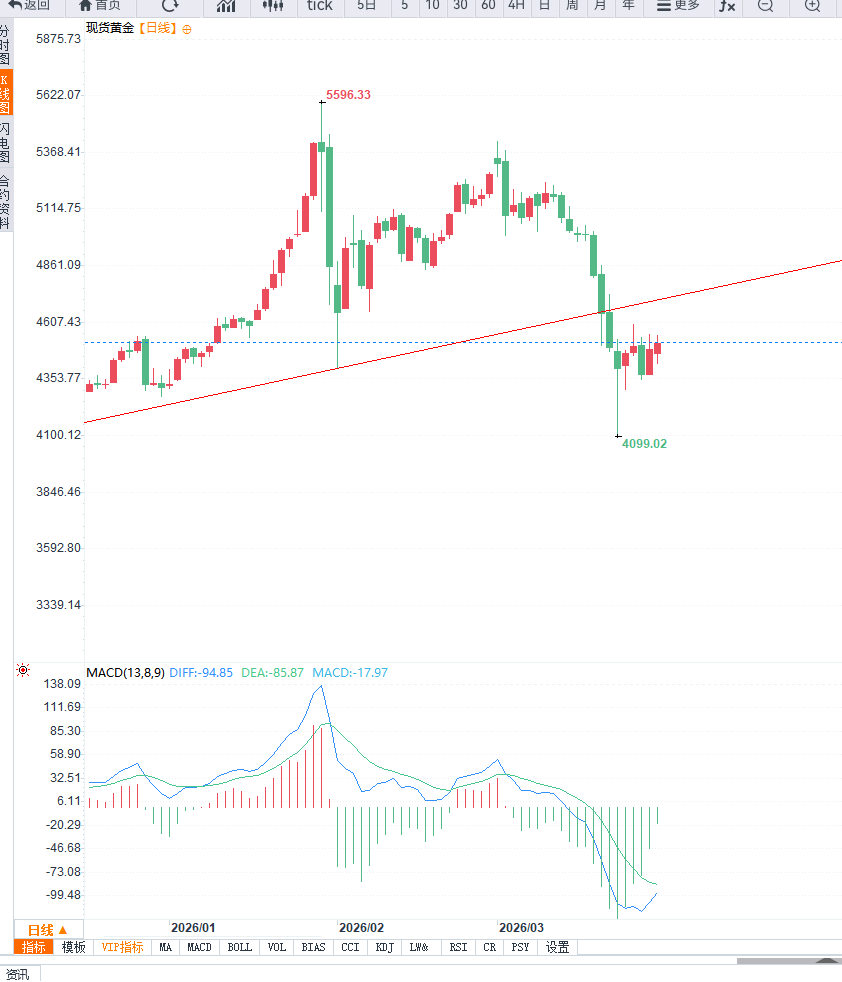
From a technical perspective, on the daily chart, gold entered a correction phase after breaking below the 100-day moving average. The overall structure remains bearish, and the short-term rebound is more of a technical correction. Although the price found support near the 200-day moving average, a valid reversal signal has not yet formed. The key resistance level is currently at $4630 (100-day moving average); a break above this level could open up further upside potential to the $4880 area. Support levels are at $4380 and $4300 ; a break below these levels would reconfirm the downtrend. In terms of momentum, the MACD remains below the zero line and in negative territory, indicating that bearish momentum has not yet fully dissipated. While the RSI has rebounded from oversold territory to above 30, it remains in a weak zone, suggesting limited upside potential. Overall, the short-term trend remains weak and volatile, and the risk of a pullback after a rebound should be carefully monitored.
Editor's Summary : The current gold market is in a typical "battle between bulls and bears" phase. A weaker dollar and geopolitical risks are providing support for gold prices, but rising oil prices and inflationary pressures, along with high interest rate expectations, continue to suppress its upside potential. In the short term, gold is more likely to maintain a range-bound trading pattern, awaiting new driving factors. If inflation continues to rise and strengthens tightening expectations, gold prices may come under pressure again; conversely, if the dollar weakens or risk sentiment significantly improves, it could potentially drive a further rebound in gold prices.
However, from a macroeconomic perspective, the upside potential for gold remains significantly limited. The escalating tensions in the Middle East, particularly the disruptions to shipping in the Red Sea and the Strait of Hormuz, are keeping oil prices high and further reinforcing global inflation expectations. The market widely anticipates that, against the backdrop of rising energy prices, major central banks may maintain high interest rate policies for an extended period, and even further tightening of monetary conditions cannot be ruled out. This logic exerts significant downward pressure on gold, as a high-interest-rate environment increases the opportunity cost of holding gold.
From an event-driven perspective, the Middle East conflict is entering a more complex phase. Market research indicates that the US is considering ground action against Iran, while the Houthi rebels are intensifying their attacks, further expanding the scope of the conflict. This situation not only drives up energy prices but also impacts the global economy and increases market uncertainty. Theoretically, such geopolitical risks should support gold prices, but the current market is more focused on their transmission effects on inflation and interest rates, thus weakening gold's safe-haven appeal.
Meanwhile, economic data reinforced market expectations for tightening policies. The OECD raised its US inflation forecast to approximately 4.2% , significantly higher than previous estimates, and anticipates that interest rates may remain high for an extended period. Market pricing suggests that the Federal Reserve may still raise interest rates in the future, which supports the dollar and to some extent limits the upside potential for gold.
From a market perspective, gold is currently in a state of mixed bullish and bearish factors. On the one hand, the weakening dollar and safe-haven demand provide a floor for gold prices; on the other hand, high interest rate expectations and inflationary pressures limit its upside potential. Therefore, prices are exhibiting a volatile and corrective pattern, lacking a clear trend.
From a technical perspective, on the daily chart, gold entered a correction phase after breaking below the 100-day moving average. The overall structure remains bearish, and the short-term rebound is more of a technical correction. Although the price found support near the 200-day moving average, a valid reversal signal has not yet formed. The key resistance level is currently at $4630 (100-day moving average); a break above this level could open up further upside potential to the $4880 area. Support levels are at $4380 and $4300 ; a break below these levels would reconfirm the downtrend. In terms of momentum, the MACD remains below the zero line and in negative territory, indicating that bearish momentum has not yet fully dissipated. While the RSI has rebounded from oversold territory to above 30, it remains in a weak zone, suggesting limited upside potential. Overall, the short-term trend remains weak and volatile, and the risk of a pullback after a rebound should be carefully monitored.
Editor's Summary : The current gold market is in a typical "battle between bulls and bears" phase. A weaker dollar and geopolitical risks are providing support for gold prices, but rising oil prices and inflationary pressures, along with high interest rate expectations, continue to suppress its upside potential. In the short term, gold is more likely to maintain a range-bound trading pattern, awaiting new driving factors. If inflation continues to rise and strengthens tightening expectations, gold prices may come under pressure again; conversely, if the dollar weakens or risk sentiment significantly improves, it could potentially drive a further rebound in gold prices.
- Risk Warning and Disclaimer
- The market involves risk, and trading may not be suitable for all investors. This article is for reference only and does not constitute personal investment advice, nor does it take into account certain users’ specific investment objectives, financial situation, or other needs. Any investment decisions made based on this information are at your own risk.