Dovish signals from the Federal Reserve support a gold price rebound and correction; is a rapid bull market return imminent?
2026-03-31 10:07:40
Gold prices surged during Tuesday's Asian trading session, testing the $4,600 mark. Fueled by safe-haven demand and changing policy expectations, gold prices initially rebounded to high levels, but momentum subsequently weakened. Currently, spot gold is trading within a key range, and the market is entering a period of correction, with a cautious short-term outlook.
From an institutional perspective, Commerzbank recently raised its gold price forecast, predicting that gold will rise to $5,000 per ounce by the end of this year, up from its previous forecast of $4,900 . It also expects gold to rise further to $5,200 per ounce by 2027. This long-term bullish outlook is primarily based on factors such as global uncertainty, central bank gold purchases, and changes in the monetary environment, which have strengthened gold's strategic position as a safe-haven asset.

On the fundamental front, the Middle East conflict continues, but its marginal impact on the market is diminishing. As the conflict enters its fifth week, the market has gradually priced in extreme risks, and safe-haven demand has failed to sustain further upward pressure on gold prices. Meanwhile, expectations of a pullback in oil prices from their highs have also reduced concerns about a rapid resurgence of inflation, weakening short-term support for gold.
The policy signals released by the Federal Reserve have become a crucial variable influencing the market. In his latest speech, Fed Chairman Powell stated that the current inflation outlook is generally manageable, and there is no immediate need to raise interest rates. This statement, clearly dovish, eased market concerns about further policy tightening and provided support to the previously pressured bond market.
Some market analysts pointed out: "Powell's dovish remarks are reshaping market expectations. The easing of upward pressure on interest rates is providing some support for gold, but it is also weakening the sustainability of the safe-haven drive."
Meanwhile, interest rate pricing has changed significantly. Market surveys show that CME Group tools indicate only a 2.6% probability of the Federal Reserve raising interest rates by 25 basis points in April, almost entirely ruled out by the market. This change means that the downward pressure of interest rates on gold has weakened significantly in the short term, but it also reflects a recovery in market risk appetite.
From a market sentiment perspective, the current trading logic has gradually shifted from "risk aversion-driven" to "correction and repricing." After the significant rise in the previous period, funds began to take profits, and the upward momentum of gold weakened. At the same time, with the marginal decline in geopolitical risks, the market is more inclined to wait for new driving factors to emerge.
From a technical perspective, on the daily chart, gold remains in an overall uptrend, but has entered a consolidation phase at higher levels in the short term. The key resistance level is around $4660 , a level that has repeatedly suppressed price increases, forming significant technical resistance. Support is seen at the psychological level of $4500 ; a break below this level could trigger further pullback. On the 4-hour chart, the price rebound has been accompanied by weakening momentum, and technical indicators show signs of bearish divergence, suggesting a short-term need for correction. If gold fails to break through $4660 effectively, it may maintain a weak and volatile trend, or even test key support areas downwards.
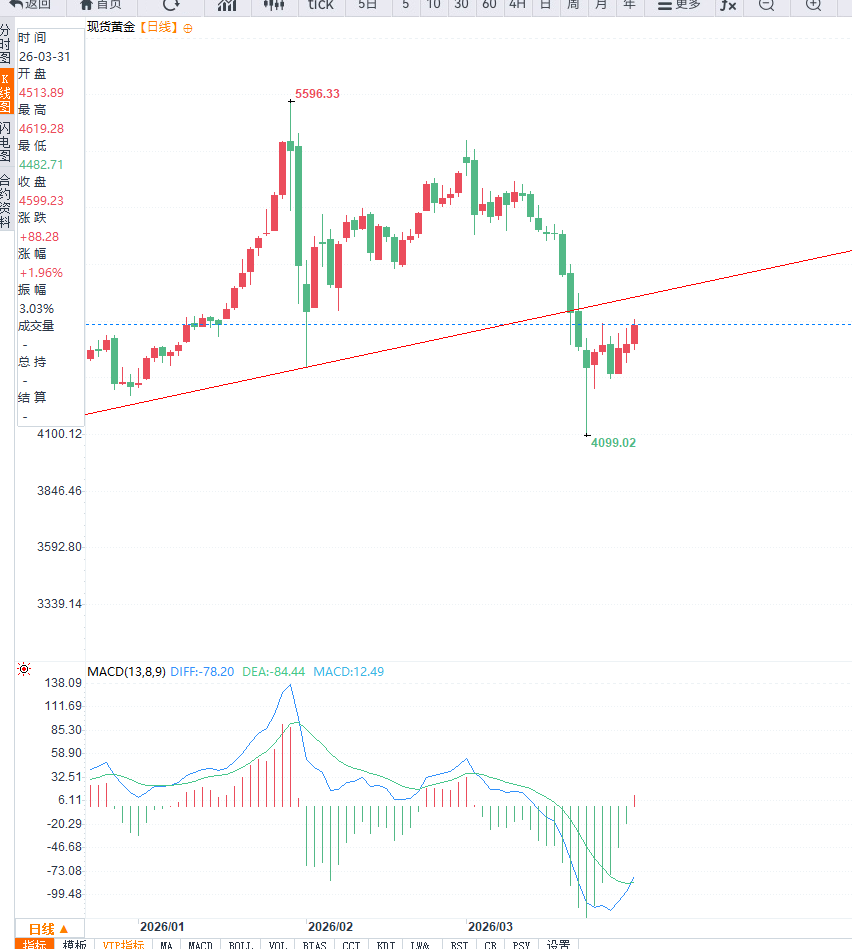
Editor's Summary <br/>Overall, the gold market is currently caught in a tug-of-war between long-term bullish sentiment and short-term corrective pressure. Institutional upward revisions of price expectations provide support for the medium- to long-term trend, but the marginal easing of geopolitical risks and the recovery of market sentiment in the short term have resulted in a lack of sustained upward momentum for gold prices. Future trends will depend on new macroeconomic drivers, including changes in inflation, the path of monetary policy, and geopolitical developments. Against this backdrop, gold is more likely to maintain high-level fluctuations with periodic pullbacks. Investors should pay attention to key technical levels and changes in market expectations.
From an institutional perspective, Commerzbank recently raised its gold price forecast, predicting that gold will rise to $5,000 per ounce by the end of this year, up from its previous forecast of $4,900 . It also expects gold to rise further to $5,200 per ounce by 2027. This long-term bullish outlook is primarily based on factors such as global uncertainty, central bank gold purchases, and changes in the monetary environment, which have strengthened gold's strategic position as a safe-haven asset.
On the fundamental front, the Middle East conflict continues, but its marginal impact on the market is diminishing. As the conflict enters its fifth week, the market has gradually priced in extreme risks, and safe-haven demand has failed to sustain further upward pressure on gold prices. Meanwhile, expectations of a pullback in oil prices from their highs have also reduced concerns about a rapid resurgence of inflation, weakening short-term support for gold.
The policy signals released by the Federal Reserve have become a crucial variable influencing the market. In his latest speech, Fed Chairman Powell stated that the current inflation outlook is generally manageable, and there is no immediate need to raise interest rates. This statement, clearly dovish, eased market concerns about further policy tightening and provided support to the previously pressured bond market.
Some market analysts pointed out: "Powell's dovish remarks are reshaping market expectations. The easing of upward pressure on interest rates is providing some support for gold, but it is also weakening the sustainability of the safe-haven drive."
Meanwhile, interest rate pricing has changed significantly. Market surveys show that CME Group tools indicate only a 2.6% probability of the Federal Reserve raising interest rates by 25 basis points in April, almost entirely ruled out by the market. This change means that the downward pressure of interest rates on gold has weakened significantly in the short term, but it also reflects a recovery in market risk appetite.
From a market sentiment perspective, the current trading logic has gradually shifted from "risk aversion-driven" to "correction and repricing." After the significant rise in the previous period, funds began to take profits, and the upward momentum of gold weakened. At the same time, with the marginal decline in geopolitical risks, the market is more inclined to wait for new driving factors to emerge.
From a technical perspective, on the daily chart, gold remains in an overall uptrend, but has entered a consolidation phase at higher levels in the short term. The key resistance level is around $4660 , a level that has repeatedly suppressed price increases, forming significant technical resistance. Support is seen at the psychological level of $4500 ; a break below this level could trigger further pullback. On the 4-hour chart, the price rebound has been accompanied by weakening momentum, and technical indicators show signs of bearish divergence, suggesting a short-term need for correction. If gold fails to break through $4660 effectively, it may maintain a weak and volatile trend, or even test key support areas downwards.
Editor's Summary <br/>Overall, the gold market is currently caught in a tug-of-war between long-term bullish sentiment and short-term corrective pressure. Institutional upward revisions of price expectations provide support for the medium- to long-term trend, but the marginal easing of geopolitical risks and the recovery of market sentiment in the short term have resulted in a lack of sustained upward momentum for gold prices. Future trends will depend on new macroeconomic drivers, including changes in inflation, the path of monetary policy, and geopolitical developments. Against this backdrop, gold is more likely to maintain high-level fluctuations with periodic pullbacks. Investors should pay attention to key technical levels and changes in market expectations.
- Risk Warning and Disclaimer
- The market involves risk, and trading may not be suitable for all investors. This article is for reference only and does not constitute personal investment advice, nor does it take into account certain users’ specific investment objectives, financial situation, or other needs. Any investment decisions made based on this information are at your own risk.