The dollar index fell slightly as expectations of easing tensions in the Middle East clashed with inflation concerns.
2026-03-31 13:22:31
The US dollar index showed signs of correction after rising for five consecutive trading days, retreating from its recent high during the Asian session and currently trading in the 100.40-100.45 range . The previous strength of the dollar was mainly driven by safe-haven demand and expectations of interest rate hikes, while the current pullback reflects a more temporary recovery in market sentiment.
From a market perspective, the situation in the Middle East remains the core variable dominating current market trends. Recent news indicates that the US is more open to ending military operations and may consider reaching an agreement even if the Strait of Hormuz is not fully open to navigation. This statement has, to some extent, boosted market risk appetite and weakened the safe-haven appeal of the US dollar.

However, significant uncertainty remains. The US has warned that it may take strong action against critical energy infrastructure if an agreement is not reached, while Iran remains cautious about direct negotiations. Coupled with the continued deployment of US military forces to the Middle East, market expectations for a rapid de-escalation of the situation have been limited.
Against this backdrop, oil prices experienced a certain degree of correction, easing inflation expectations. As energy prices fell, US Treasury yields came under pressure, weakening the interest rate support for the US dollar. This is also one of the important reasons why the US dollar index has retreated from its highs.
Some analysts have pointed out that "the current trend of the US dollar depends on the dynamic balance between risk sentiment and inflation expectations, and it is difficult to form a one-sided trend in the short term."
However, from a medium-term perspective, the US dollar still has some support. On the one hand, if geopolitical risks escalate again, safe-haven demand will flow back into the dollar; on the other hand, high oil prices may still push up inflation expectations in the future, keeping the market betting on the Federal Reserve tightening its policy. This potential risk of "reflation" limits the downside potential of the dollar.
The market has now shifted its focus to upcoming U.S. economic data, including the JOLTS job openings and consumer confidence index. This data will provide important clues to assess the resilience of the U.S. economy and could directly impact expectations for Federal Reserve policy.
From a technical perspective, on the daily chart, the US dollar index continued its upward trend after breaking through the 100 mark , but retreated after reaching a recent high, indicating some selling pressure above. The overall structure remains bullish, but short-term momentum has weakened. Resistance levels to watch are the 100.80 and 101.30 areas ; a break above these levels could open up further upside potential. Support levels are at the psychological level of 100.00 and the 99.60 area ; a break below these levels could trigger a deeper correction.
On the 4-hour chart, prices have entered a consolidation phase after falling from their highs, with the moving average system flattening out, indicating an unclear short-term trend. The RSI has fallen from the overbought zone to the neutral zone, with momentum clearly cooling; the MACD has formed a death cross and is gradually approaching the zero line, suggesting a risk of further pullback in the short term. If it breaks below 100.00 , it may test the 99.60 support level; conversely, if it regains its footing above 100.80 , the bulls may regain control.
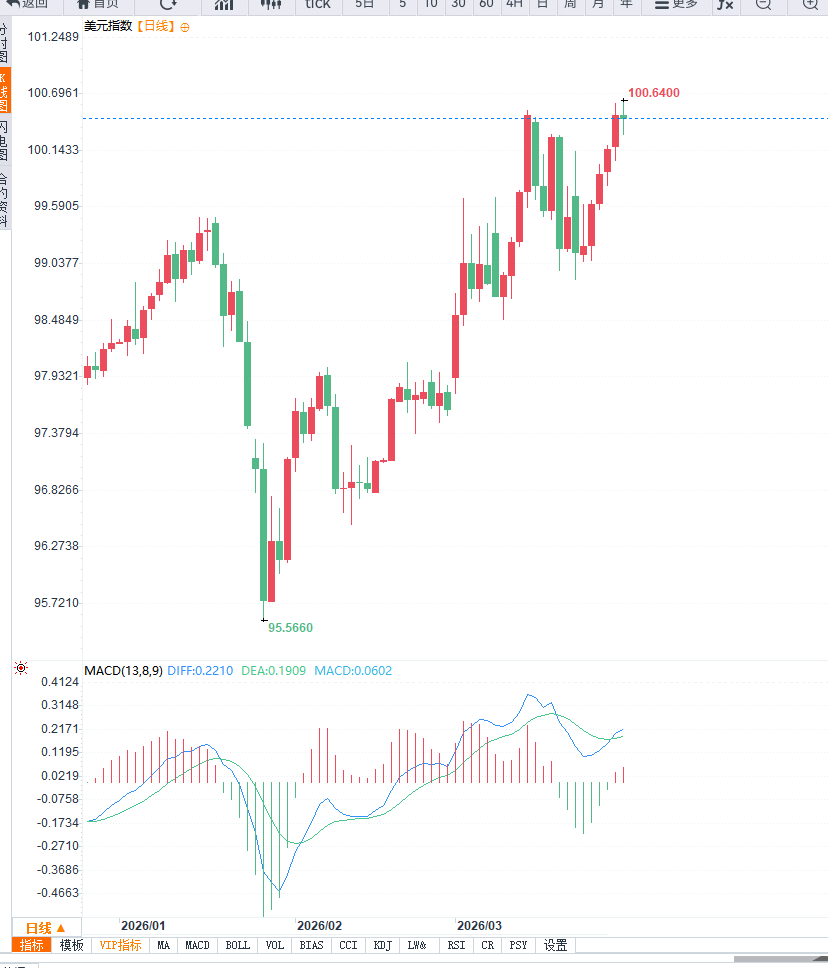
From a comprehensive technical perspective, the US dollar index is currently in a consolidation phase at a high level, with both bullish and bearish factors intertwined, and it is more likely to maintain a volatile trend in the short term.
Editor's Summary : Overall, the US dollar index has experienced a technical correction after a period of continuous gains, but its fundamental support has not weakened significantly. Uncertainty surrounding the Middle East situation and changing inflation expectations are the core driving factors in the current market. From a technical perspective, the daily trend remains bullish, but short-term momentum is weakening, and the 4-hour chart has entered a consolidation phase. In general, the US dollar is more likely to maintain a high-level consolidation pattern in the short term. Investors should pay attention to key support and resistance levels and the impact of changes in macroeconomic data on market expectations.
From a market perspective, the situation in the Middle East remains the core variable dominating current market trends. Recent news indicates that the US is more open to ending military operations and may consider reaching an agreement even if the Strait of Hormuz is not fully open to navigation. This statement has, to some extent, boosted market risk appetite and weakened the safe-haven appeal of the US dollar.
However, significant uncertainty remains. The US has warned that it may take strong action against critical energy infrastructure if an agreement is not reached, while Iran remains cautious about direct negotiations. Coupled with the continued deployment of US military forces to the Middle East, market expectations for a rapid de-escalation of the situation have been limited.
Against this backdrop, oil prices experienced a certain degree of correction, easing inflation expectations. As energy prices fell, US Treasury yields came under pressure, weakening the interest rate support for the US dollar. This is also one of the important reasons why the US dollar index has retreated from its highs.
Some analysts have pointed out that "the current trend of the US dollar depends on the dynamic balance between risk sentiment and inflation expectations, and it is difficult to form a one-sided trend in the short term."
However, from a medium-term perspective, the US dollar still has some support. On the one hand, if geopolitical risks escalate again, safe-haven demand will flow back into the dollar; on the other hand, high oil prices may still push up inflation expectations in the future, keeping the market betting on the Federal Reserve tightening its policy. This potential risk of "reflation" limits the downside potential of the dollar.
The market has now shifted its focus to upcoming U.S. economic data, including the JOLTS job openings and consumer confidence index. This data will provide important clues to assess the resilience of the U.S. economy and could directly impact expectations for Federal Reserve policy.
From a technical perspective, on the daily chart, the US dollar index continued its upward trend after breaking through the 100 mark , but retreated after reaching a recent high, indicating some selling pressure above. The overall structure remains bullish, but short-term momentum has weakened. Resistance levels to watch are the 100.80 and 101.30 areas ; a break above these levels could open up further upside potential. Support levels are at the psychological level of 100.00 and the 99.60 area ; a break below these levels could trigger a deeper correction.
On the 4-hour chart, prices have entered a consolidation phase after falling from their highs, with the moving average system flattening out, indicating an unclear short-term trend. The RSI has fallen from the overbought zone to the neutral zone, with momentum clearly cooling; the MACD has formed a death cross and is gradually approaching the zero line, suggesting a risk of further pullback in the short term. If it breaks below 100.00 , it may test the 99.60 support level; conversely, if it regains its footing above 100.80 , the bulls may regain control.
From a comprehensive technical perspective, the US dollar index is currently in a consolidation phase at a high level, with both bullish and bearish factors intertwined, and it is more likely to maintain a volatile trend in the short term.
Editor's Summary : Overall, the US dollar index has experienced a technical correction after a period of continuous gains, but its fundamental support has not weakened significantly. Uncertainty surrounding the Middle East situation and changing inflation expectations are the core driving factors in the current market. From a technical perspective, the daily trend remains bullish, but short-term momentum is weakening, and the 4-hour chart has entered a consolidation phase. In general, the US dollar is more likely to maintain a high-level consolidation pattern in the short term. Investors should pay attention to key support and resistance levels and the impact of changes in macroeconomic data on market expectations.
- Risk Warning and Disclaimer
- The market involves risk, and trading may not be suitable for all investors. This article is for reference only and does not constitute personal investment advice, nor does it take into account certain users’ specific investment objectives, financial situation, or other needs. Any investment decisions made based on this information are at your own risk.