The interplay between risk aversion and expectations of interest rate hikes has stalled gold's rebound at $4,600.
2026-03-31 13:33:01
Gold prices continued their rebound, rising for the third consecutive trading day and reaching a near one-and-a-half-week high in Asian trading, approaching the $4,600 mark . Previously, gold prices rebounded from a low near $4,100 , mainly supported by a weaker dollar and declining yields, but faced significant pressure near key resistance levels, indicating that bullish momentum remains insufficient.
From a fundamental perspective, market sentiment has been significantly impacted by changes in the Middle East situation. Recent news indicates that the US may be signaling a gradual end to its military operations, even though the Strait of Hormuz has not yet fully reopened to navigation. This expectation has driven a corrective decline in oil prices, thereby easing inflationary pressures and lowering US Treasury yields, providing some support for gold.

However, uncertainty remains high. Iran's cautious stance on direct negotiations, coupled with the continued deployment of US military forces to the region, limits market expectations for a rapid de-escalation of the conflict. This uncertainty, to some extent, supports oil prices and maintains inflation risk expectations, thereby reinforcing the likelihood that global central banks will maintain tight monetary policies.
One analyst said, "The current gold market is caught in a tug-of-war between policy expectations and safe-haven demand, and short-term trends depend more on changes in interest rate expectations."
From a monetary policy perspective, the market has largely ruled out the possibility of further interest rate cuts by the Federal Reserve and has begun to increase expectations for a rate hike this year. This change has put significant downward pressure on gold. As the dollar remains attractive after its pullback, bargain hunting supports the dollar, which also limits the upside potential for gold to some extent.
In addition, the market is focused on upcoming US economic data, including job openings and consumer confidence index. This data will provide important insights into assessing economic resilience and could influence the Federal Reserve's future policy path, thus directly impacting gold prices.
From a technical perspective, gold remains in a long-term uptrend on the daily chart, but is currently undergoing a short-term correction. The price is currently trading below the 38.2% Fibonacci retracement level and is also pressured by the 100-day moving average , indicating strong resistance above. A decisive break above this area on the daily chart could potentially lead to a further test of $4747 (the 50% retracement level) . However, until a breakout occurs, the overall trend remains sideways. In terms of momentum indicators, the RSI has rebounded from oversold territory to around 41 , suggesting some easing of selling pressure, but upward momentum remains limited. The MACD remains below the zero line with negative momentum, indicating that the rebound has not yet formed a trend reversal signal.
On the 4-hour chart, after a rebound, the price gradually approached the resistance zone, but was repeatedly blocked near $4600 , indicating a lack of upward momentum in the short term. The moving average system is showing downward pressure, and the short-term trend remains weak and volatile. If it falls back, the initial support level to watch is $4470 , with further support at $4401 (23.6% Fibonacci retracement) . A break below this level could open up room for a pullback to the $4200-$4150 area and test the key trend support of the 200-day moving average (approximately $4129) .
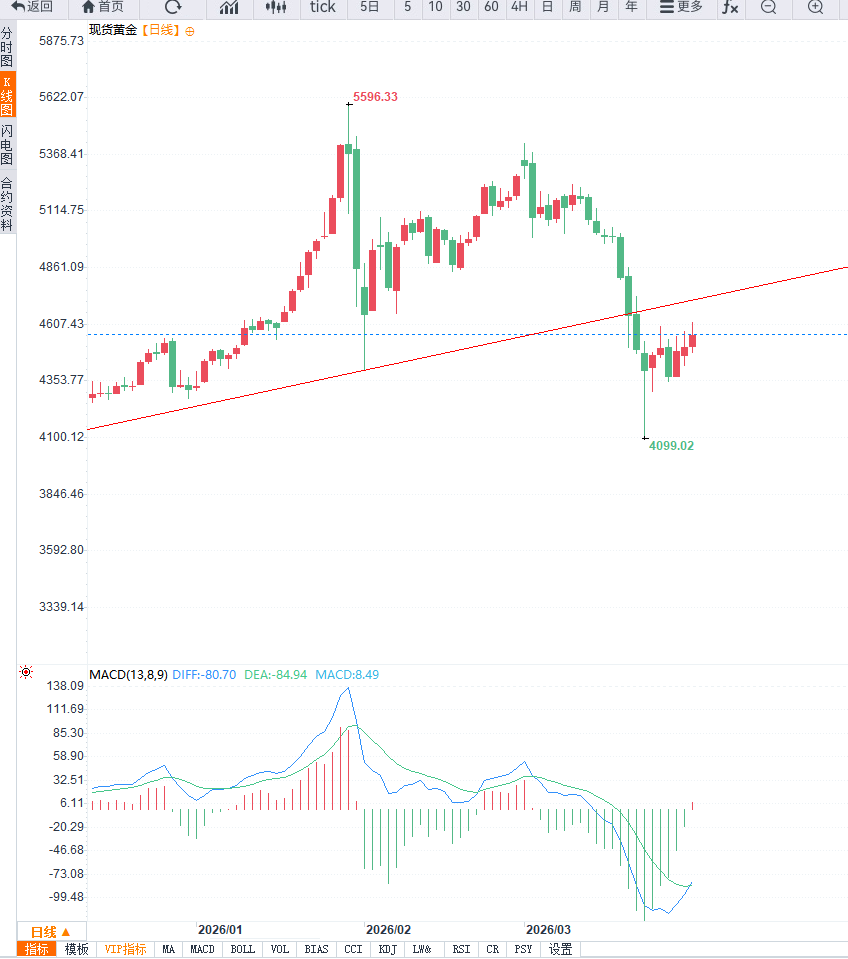
From a comprehensive technical perspective, as long as the price remains above the 200-day moving average , the long-term bullish structure remains intact. However, the short-term trend is still cautious, with the risk of fluctuations and pullbacks.
Editor's Summary : Overall, gold is currently caught in a dual struggle between a rebound and policy suppression. Falling oil prices and declining yields are providing support for gold, but rising expectations of a Fed rate hike and a resilient dollar are limiting upside potential. From a technical perspective, the daily trend remains bullish, but key resistance levels have not been broken, and momentum is insufficient on the 4-hour chart. In general, gold is more likely to maintain a range-bound pattern in the short term, and attention should be paid to whether the $4600 resistance and $4400 support levels are breached.
From a fundamental perspective, market sentiment has been significantly impacted by changes in the Middle East situation. Recent news indicates that the US may be signaling a gradual end to its military operations, even though the Strait of Hormuz has not yet fully reopened to navigation. This expectation has driven a corrective decline in oil prices, thereby easing inflationary pressures and lowering US Treasury yields, providing some support for gold.
However, uncertainty remains high. Iran's cautious stance on direct negotiations, coupled with the continued deployment of US military forces to the region, limits market expectations for a rapid de-escalation of the conflict. This uncertainty, to some extent, supports oil prices and maintains inflation risk expectations, thereby reinforcing the likelihood that global central banks will maintain tight monetary policies.
One analyst said, "The current gold market is caught in a tug-of-war between policy expectations and safe-haven demand, and short-term trends depend more on changes in interest rate expectations."
From a monetary policy perspective, the market has largely ruled out the possibility of further interest rate cuts by the Federal Reserve and has begun to increase expectations for a rate hike this year. This change has put significant downward pressure on gold. As the dollar remains attractive after its pullback, bargain hunting supports the dollar, which also limits the upside potential for gold to some extent.
In addition, the market is focused on upcoming US economic data, including job openings and consumer confidence index. This data will provide important insights into assessing economic resilience and could influence the Federal Reserve's future policy path, thus directly impacting gold prices.
From a technical perspective, gold remains in a long-term uptrend on the daily chart, but is currently undergoing a short-term correction. The price is currently trading below the 38.2% Fibonacci retracement level and is also pressured by the 100-day moving average , indicating strong resistance above. A decisive break above this area on the daily chart could potentially lead to a further test of $4747 (the 50% retracement level) . However, until a breakout occurs, the overall trend remains sideways. In terms of momentum indicators, the RSI has rebounded from oversold territory to around 41 , suggesting some easing of selling pressure, but upward momentum remains limited. The MACD remains below the zero line with negative momentum, indicating that the rebound has not yet formed a trend reversal signal.
On the 4-hour chart, after a rebound, the price gradually approached the resistance zone, but was repeatedly blocked near $4600 , indicating a lack of upward momentum in the short term. The moving average system is showing downward pressure, and the short-term trend remains weak and volatile. If it falls back, the initial support level to watch is $4470 , with further support at $4401 (23.6% Fibonacci retracement) . A break below this level could open up room for a pullback to the $4200-$4150 area and test the key trend support of the 200-day moving average (approximately $4129) .
From a comprehensive technical perspective, as long as the price remains above the 200-day moving average , the long-term bullish structure remains intact. However, the short-term trend is still cautious, with the risk of fluctuations and pullbacks.
Editor's Summary : Overall, gold is currently caught in a dual struggle between a rebound and policy suppression. Falling oil prices and declining yields are providing support for gold, but rising expectations of a Fed rate hike and a resilient dollar are limiting upside potential. From a technical perspective, the daily trend remains bullish, but key resistance levels have not been broken, and momentum is insufficient on the 4-hour chart. In general, gold is more likely to maintain a range-bound pattern in the short term, and attention should be paid to whether the $4600 resistance and $4400 support levels are breached.
- Risk Warning and Disclaimer
- The market involves risk, and trading may not be suitable for all investors. This article is for reference only and does not constitute personal investment advice, nor does it take into account certain users’ specific investment objectives, financial situation, or other needs. Any investment decisions made based on this information are at your own risk.