The yield on 40-year Japanese government bonds fell sharply, leading to a surge in demand for safe-haven assets in the long-term bond market.
2026-03-31 14:16:11
According to APP reports, the yield on Japan's 40-year government bonds fell 12 basis points to the key level of 3.91% , hitting a recent low. It touched a low of around 3.923% during the session, a daily drop of 2.66%. This trend contrasts sharply with the previous sustained upward movement. Currently, the yield is fluctuating around 3.92%, a significant drop of approximately 10.7-12 basis points from the previous trading day's close, indicating an overall pullback from high levels.

The recent rapid decline in yields was primarily driven by a concentrated inflow of safe-haven funds into the long-term bond market. Facing uncertainty regarding the Japanese economy's inflation path, coupled with escalating global geopolitical risks, investors are inclined to increase their holdings of long-duration assets to lock in higher yields and hedge against potential economic slowdown. This, combined with relatively dovish expectations for the Bank of Japan's policy, has led the market to believe that the pace of monetary normalization may slow, further stimulating buying. From a macroeconomic perspective, fluctuations in the US dollar index and changes in the interest rate environment of major economies have also provided additional support for Japanese government bonds. Technically, the 40-year government bond yield has repeatedly tested highs above 4.0% before experiencing profit-taking, with the lower edge of the 52-week range once approaching 2.48%, indicating a temporary easing of bearish momentum. In the short term, the area around 3.90% has become a new support level.
To more clearly illustrate the performance differences between 40-year Japanese government bonds and other maturities, the following table compares the recent yields of key Japanese government bonds:
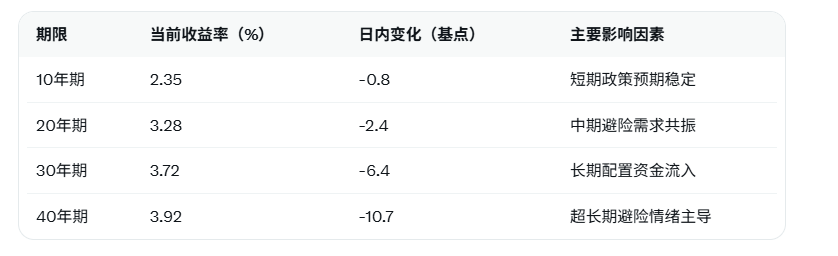
Data shows that the yield on 40-year Treasury bonds fell significantly more than that of short- and medium-term bonds during this correction, highlighting the higher sensitivity of long-term bonds to risk aversion.
Further analysis reveals that the Japanese long-term government bond market is playing an increasingly prominent role. Its declining yields not only reflect domestic investors' concerns about economic resilience but also resonate with global asset allocation trends. The global macroeconomic environment is complex: on the one hand, energy price volatility is pushing up inflation expectations; on the other hand, major central banks remain divergent in their pace of policy shifts. These factors combined make long-term government bonds an important defensive asset allocation tool in an environment of uncertainty.
Editor's Summary : The significant decline in the yield on 40-year Japanese government bonds reflects a dynamic balance between safe-haven demand and policy expectations. Changes in global risk appetite provide strong support for the long-term bond market, but improving economic data or signals of monetary policy tightening may limit further downside. The flattening yield curve indicates that the market is in a period of adjustment, awaiting new catalysts. Investors need to continue to pay attention to the latest statements from the Bank of Japan and the release of key economic indicators.
The recent rapid decline in yields was primarily driven by a concentrated inflow of safe-haven funds into the long-term bond market. Facing uncertainty regarding the Japanese economy's inflation path, coupled with escalating global geopolitical risks, investors are inclined to increase their holdings of long-duration assets to lock in higher yields and hedge against potential economic slowdown. This, combined with relatively dovish expectations for the Bank of Japan's policy, has led the market to believe that the pace of monetary normalization may slow, further stimulating buying. From a macroeconomic perspective, fluctuations in the US dollar index and changes in the interest rate environment of major economies have also provided additional support for Japanese government bonds. Technically, the 40-year government bond yield has repeatedly tested highs above 4.0% before experiencing profit-taking, with the lower edge of the 52-week range once approaching 2.48%, indicating a temporary easing of bearish momentum. In the short term, the area around 3.90% has become a new support level.
To more clearly illustrate the performance differences between 40-year Japanese government bonds and other maturities, the following table compares the recent yields of key Japanese government bonds:
Data shows that the yield on 40-year Treasury bonds fell significantly more than that of short- and medium-term bonds during this correction, highlighting the higher sensitivity of long-term bonds to risk aversion.
Further analysis reveals that the Japanese long-term government bond market is playing an increasingly prominent role. Its declining yields not only reflect domestic investors' concerns about economic resilience but also resonate with global asset allocation trends. The global macroeconomic environment is complex: on the one hand, energy price volatility is pushing up inflation expectations; on the other hand, major central banks remain divergent in their pace of policy shifts. These factors combined make long-term government bonds an important defensive asset allocation tool in an environment of uncertainty.
Editor's Summary : The significant decline in the yield on 40-year Japanese government bonds reflects a dynamic balance between safe-haven demand and policy expectations. Changes in global risk appetite provide strong support for the long-term bond market, but improving economic data or signals of monetary policy tightening may limit further downside. The flattening yield curve indicates that the market is in a period of adjustment, awaiting new catalysts. Investors need to continue to pay attention to the latest statements from the Bank of Japan and the release of key economic indicators.
- Risk Warning and Disclaimer
- The market involves risk, and trading may not be suitable for all investors. This article is for reference only and does not constitute personal investment advice, nor does it take into account certain users’ specific investment objectives, financial situation, or other needs. Any investment decisions made based on this information are at your own risk.