High oil prices are destabilizing the global market! Middle East conflict ignites; the second quarter presents a critical juncture for stock and bond markets.
2026-03-31 14:18:16
The ongoing conflict in the Middle East, particularly in Iran, has left global financial markets entering the second quarter of 2026 with a high degree of uncertainty. Investors generally believe that even if a short-term easing of the conflict provides a temporary boost to market sentiment, damage to energy infrastructure and high oil prices will continue to drag down economic growth and increase inflationary pressures, potentially triggering further stock market corrections. If the conflict persists, concerns about economic growth may outweigh anxieties about inflation, potentially attracting funds back to the bond market.
Geopolitical risks have become the dominant factor, leading to a significant increase in market volatility. Market analysts point out that the duration of supply disruptions and the extent of conflict escalation may directly determine asset performance in the second quarter .

Crude oil has become the best-performing asset this quarter, with Brent crude rising more than 50% since the outbreak of the conflict. On Tuesday (March 31), Brent crude prices fluctuated downwards during the Asian and European sessions, currently trading around $107 per barrel, down about 1.5% on the day.
Analysts surveyed predict that as long as supply disruptions in the Strait of Hormuz continue, oil prices will fluctuate between $100 and $190 per barrel, with an average forecast of around $134.
The surge in oil prices has fundamentally altered monetary policy expectations. Traders are no longer optimistic about a Federal Reserve rate cut before the end of the year, the Eurozone and the UK have shifted to a path of rate hikes, and the easing of monetary policy in emerging markets has been forced to a halt. High oil prices are directly pushing up global inflation risks, with the Organization for Economic Cooperation and Development (OECD) warning that if oil prices rise to $135 per barrel, global inflation could increase by an additional 0.7 percentage points.
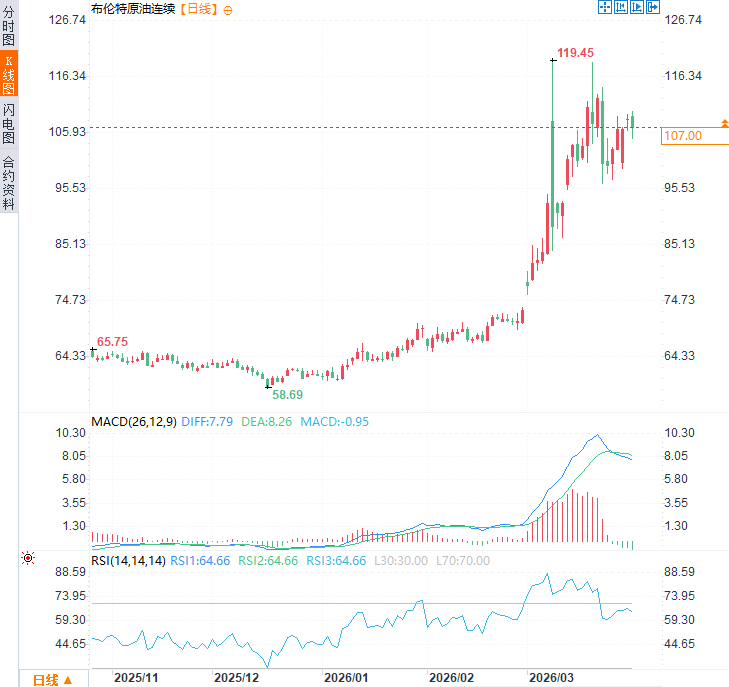
(Brent crude oil daily chart, source: EasyForex)
In the bond market, some investors have begun to find bonds attractive after yields rose sharply. Amundi has increased its exposure to short-term Eurozone government bonds, and Russell Investments also stated that bonds are becoming relatively more attractive.
Analysts believe that if the conflict drags on, concerns about economic growth will dominate the market, and funds may shift from risky assets to fixed-income products .
Stock markets were under pressure, with the S&P 500, Stoxx Europe 600, and Nikkei all falling 9% to 13% from their recent highs. Zurich Insurance has downgraded its equity holdings from "overweight" to "underweight," reflecting the institution's cautious attitude towards risks in the second quarter.
Principal Global Strategist’s chief global strategist pointed out that in the current noisy geopolitical environment, investors are still maintaining exposure to international and US markets, but overall risk appetite has decreased significantly.
The latest economic indicators show a decline in confidence, with the US consumer confidence index falling more than expected in March, German investor sentiment deteriorating significantly, and both the Eurozone and US PMIs falling to multi-month lows.
The OECD has issued a new warning that the global economy has deviated from a path of stronger growth, with global GDP growth projected to slow to 2.9% in 2026 and inflationary pressures rising significantly.
High oil prices are being passed on to the real economy through energy costs, with European chemical and steel industries already experiencing significant cost increases, and companies beginning to pass on the pressure.
Geopolitical conflicts in the Middle East have become the core source of risk for financial markets in the second quarter of 2026. The surge in oil prices has directly pushed up inflation expectations and disrupted monetary policy. The coexistence of stock market corrections and rising bond yields reflects investors' balancing act between growth concerns and inflationary pressures. Deteriorating economic data further amplifies uncertainty, and future market trends will be highly dependent on the duration of the conflict, the recovery of supply chains, and the policy responses of major central banks.
At 14:18 Beijing time, Brent crude oil futures were trading at $107.39 per barrel.
Geopolitical risks have become the dominant factor, leading to a significant increase in market volatility. Market analysts point out that the duration of supply disruptions and the extent of conflict escalation may directly determine asset performance in the second quarter .
Crude oil prices rose sharply
Crude oil has become the best-performing asset this quarter, with Brent crude rising more than 50% since the outbreak of the conflict. On Tuesday (March 31), Brent crude prices fluctuated downwards during the Asian and European sessions, currently trading around $107 per barrel, down about 1.5% on the day.
Analysts surveyed predict that as long as supply disruptions in the Strait of Hormuz continue, oil prices will fluctuate between $100 and $190 per barrel, with an average forecast of around $134.
The surge in oil prices has fundamentally altered monetary policy expectations. Traders are no longer optimistic about a Federal Reserve rate cut before the end of the year, the Eurozone and the UK have shifted to a path of rate hikes, and the easing of monetary policy in emerging markets has been forced to a halt. High oil prices are directly pushing up global inflation risks, with the Organization for Economic Cooperation and Development (OECD) warning that if oil prices rise to $135 per barrel, global inflation could increase by an additional 0.7 percentage points.
(Brent crude oil daily chart, source: EasyForex)
The attractiveness of the bond market has increased.
In the bond market, some investors have begun to find bonds attractive after yields rose sharply. Amundi has increased its exposure to short-term Eurozone government bonds, and Russell Investments also stated that bonds are becoming relatively more attractive.
Analysts believe that if the conflict drags on, concerns about economic growth will dominate the market, and funds may shift from risky assets to fixed-income products .
Stock market generally corrected
Stock markets were under pressure, with the S&P 500, Stoxx Europe 600, and Nikkei all falling 9% to 13% from their recent highs. Zurich Insurance has downgraded its equity holdings from "overweight" to "underweight," reflecting the institution's cautious attitude towards risks in the second quarter.
Principal Global Strategist’s chief global strategist pointed out that in the current noisy geopolitical environment, investors are still maintaining exposure to international and US markets, but overall risk appetite has decreased significantly.
Deteriorating economic data
The latest economic indicators show a decline in confidence, with the US consumer confidence index falling more than expected in March, German investor sentiment deteriorating significantly, and both the Eurozone and US PMIs falling to multi-month lows.
The OECD has issued a new warning that the global economy has deviated from a path of stronger growth, with global GDP growth projected to slow to 2.9% in 2026 and inflationary pressures rising significantly.
High oil prices are being passed on to the real economy through energy costs, with European chemical and steel industries already experiencing significant cost increases, and companies beginning to pass on the pressure.
Editor's Summary
Geopolitical conflicts in the Middle East have become the core source of risk for financial markets in the second quarter of 2026. The surge in oil prices has directly pushed up inflation expectations and disrupted monetary policy. The coexistence of stock market corrections and rising bond yields reflects investors' balancing act between growth concerns and inflationary pressures. Deteriorating economic data further amplifies uncertainty, and future market trends will be highly dependent on the duration of the conflict, the recovery of supply chains, and the policy responses of major central banks.
At 14:18 Beijing time, Brent crude oil futures were trading at $107.39 per barrel.
- Risk Warning and Disclaimer
- The market involves risk, and trading may not be suitable for all investors. This article is for reference only and does not constitute personal investment advice, nor does it take into account certain users’ specific investment objectives, financial situation, or other needs. Any investment decisions made based on this information are at your own risk.