Easing tensions in the Middle East reduced safe-haven demand, and the Federal Reserve downplayed inflation risks, causing the dollar index to fall below the 100 mark.
2026-04-01 13:24:37
On Wednesday during Asian trading hours, the US dollar index continued its downward trend, trading around 99.80 , marking its second consecutive day of weakness and breaking below the key psychological level of 100 again. The core drivers of the current dollar's movement are declining safe-haven demand and changes in monetary policy expectations.
From a geopolitical perspective, the situation in the Middle East has shown signs of temporary easing. US President Trump stated that the US will gradually withdraw from military operations against Iran over the next two to three weeks, implying that strategic objectives have been largely achieved. This statement reinforced market expectations that the conflict might end quickly, leading to a significant recovery in global risk sentiment. The decline in risk aversion has directly weakened the attractiveness of the US dollar, a key reason for this round of decline.
Iran, on the other hand, sent relatively complex signals. President Peschizian indicated a willingness to de-escalate the situation if certain conditions were met, but the Foreign Minister emphasized the need for a complete end to the conflict and the attainment of security guarantees and reparations. This difference in stance means that the conflict remains uncertain, causing market sentiment to fluctuate between optimism and caution.
On the monetary policy front, Federal Reserve Chairman Jerome Powell's remarks further pressured the dollar. Powell pointed out that long-term inflation expectations remain stable and have not spiraled out of control due to rising energy prices. The fact that inflation expectations remain anchored means that there is no need to adjust the policy path in the short term due to rising oil prices. This statement lowered market expectations for interest rate hikes and pushed interest rate expectations towards a more accommodative direction.
Against this backdrop, US Treasury yields have stabilized or even declined slightly, weakening the dollar's interest rate advantage. Meanwhile, market expectations for future interest rate cuts are gradually rising, becoming a significant factor suppressing the dollar.
From a market structure perspective, the current logic behind the dollar's decline is relatively clear: on the one hand, reduced geopolitical risks weaken safe-haven demand; on the other hand, more moderate policy expectations reduce interest rate support. The dollar is experiencing a double decline in both the safe-haven premium and the interest rate premium .
From a technical perspective, the US dollar index has broken below the 100 level on the daily chart, indicating weakened medium-term support and a gradual shift towards a bearish structure. Key support lies around 99.50 ; a break below this level could lead to further testing of the 98 area. Resistance is at 100.50 , which is the midpoint of the previous consolidation range. Momentum indicators show increasing bearish pressure, with the MACD diverging downwards and the RSI falling below 50, suggesting a growing bearish sentiment in the market.
From a 4-hour chart perspective, the short-term trend shows a downward oscillating structure, with the price gradually declining along the short-term moving average system. The MACD is running below the zero line and has not shown a clear reversal signal, while the RSI remains in the 40-50 range, indicating limited rebound momentum. If the price fails to regain the 100 level in the short term, the downward trend may continue; conversely, if a technical rebound occurs, the resistance around 100.50 should be monitored.
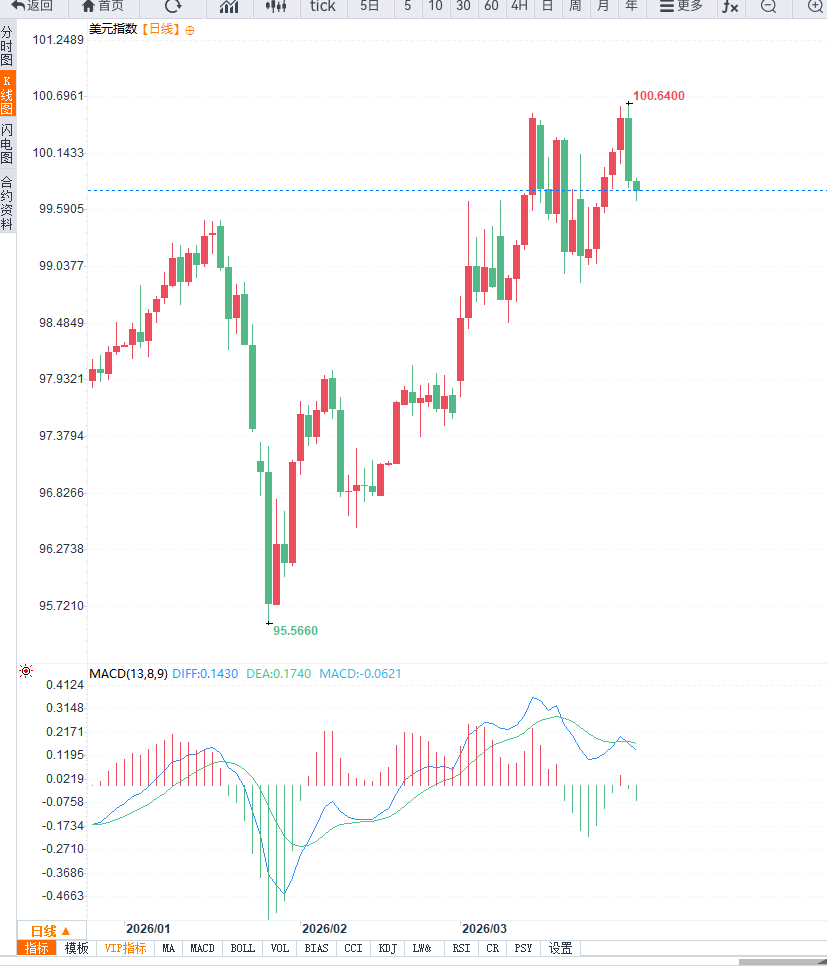
Overall, the US dollar index is currently in a weak and volatile downward phase , and lacks a strong rebound driver in the short term.
Editor's Summary : The weakening of the US dollar index is mainly due to two factors: first, the easing of tensions in the Middle East has reduced demand for safe-haven assets; second, the Federal Reserve's downplaying of inflation risks has led to a more moderate policy outlook. Under the combined influence of these two factors, the dollar faces downward pressure in the short term. Its future trajectory will still depend on changes in the geopolitical situation and the performance of US economic data. If risks continue to ease and expectations of interest rate cuts strengthen further, the dollar may continue its weakness; however, if tensions escalate again or data strengthens, a short-term rebound is possible.
From a geopolitical perspective, the situation in the Middle East has shown signs of temporary easing. US President Trump stated that the US will gradually withdraw from military operations against Iran over the next two to three weeks, implying that strategic objectives have been largely achieved. This statement reinforced market expectations that the conflict might end quickly, leading to a significant recovery in global risk sentiment. The decline in risk aversion has directly weakened the attractiveness of the US dollar, a key reason for this round of decline.
Iran, on the other hand, sent relatively complex signals. President Peschizian indicated a willingness to de-escalate the situation if certain conditions were met, but the Foreign Minister emphasized the need for a complete end to the conflict and the attainment of security guarantees and reparations. This difference in stance means that the conflict remains uncertain, causing market sentiment to fluctuate between optimism and caution.
On the monetary policy front, Federal Reserve Chairman Jerome Powell's remarks further pressured the dollar. Powell pointed out that long-term inflation expectations remain stable and have not spiraled out of control due to rising energy prices. The fact that inflation expectations remain anchored means that there is no need to adjust the policy path in the short term due to rising oil prices. This statement lowered market expectations for interest rate hikes and pushed interest rate expectations towards a more accommodative direction.
Against this backdrop, US Treasury yields have stabilized or even declined slightly, weakening the dollar's interest rate advantage. Meanwhile, market expectations for future interest rate cuts are gradually rising, becoming a significant factor suppressing the dollar.
From a market structure perspective, the current logic behind the dollar's decline is relatively clear: on the one hand, reduced geopolitical risks weaken safe-haven demand; on the other hand, more moderate policy expectations reduce interest rate support. The dollar is experiencing a double decline in both the safe-haven premium and the interest rate premium .
From a technical perspective, the US dollar index has broken below the 100 level on the daily chart, indicating weakened medium-term support and a gradual shift towards a bearish structure. Key support lies around 99.50 ; a break below this level could lead to further testing of the 98 area. Resistance is at 100.50 , which is the midpoint of the previous consolidation range. Momentum indicators show increasing bearish pressure, with the MACD diverging downwards and the RSI falling below 50, suggesting a growing bearish sentiment in the market.
From a 4-hour chart perspective, the short-term trend shows a downward oscillating structure, with the price gradually declining along the short-term moving average system. The MACD is running below the zero line and has not shown a clear reversal signal, while the RSI remains in the 40-50 range, indicating limited rebound momentum. If the price fails to regain the 100 level in the short term, the downward trend may continue; conversely, if a technical rebound occurs, the resistance around 100.50 should be monitored.
Overall, the US dollar index is currently in a weak and volatile downward phase , and lacks a strong rebound driver in the short term.
Editor's Summary : The weakening of the US dollar index is mainly due to two factors: first, the easing of tensions in the Middle East has reduced demand for safe-haven assets; second, the Federal Reserve's downplaying of inflation risks has led to a more moderate policy outlook. Under the combined influence of these two factors, the dollar faces downward pressure in the short term. Its future trajectory will still depend on changes in the geopolitical situation and the performance of US economic data. If risks continue to ease and expectations of interest rate cuts strengthen further, the dollar may continue its weakness; however, if tensions escalate again or data strengthens, a short-term rebound is possible.
- Risk Warning and Disclaimer
- The market involves risk, and trading may not be suitable for all investors. This article is for reference only and does not constitute personal investment advice, nor does it take into account certain users’ specific investment objectives, financial situation, or other needs. Any investment decisions made based on this information are at your own risk.