The Bank of Japan is likely to keep interest rates unchanged, and the USD/JPY pair is expected to continue its volatile trading pattern.
2026-04-01 14:21:19
Recent market opinions suggest that the Bank of Japan is highly likely to maintain its current monetary policy at its April meeting, primarily due to the potential impact of rising energy prices and geopolitical uncertainties on the economy. Against the backdrop of the Middle East conflict, constraints on oil supply are pushing up energy costs, and Japan, as an energy-import-dependent economy, faces more direct imported inflationary pressures.

While rising energy prices may push up inflation in the short term, policymakers are more concerned about the sustainability of core inflation. Currently, Japanese inflation expectations are not firmly anchored at the 2% target , meaning the central bank must remain cautious in its policy normalization path. The fragile inflation base remains a significant factor limiting interest rate hikes.
At the same time, signs of a slowdown in Japan's economic fundamentals have emerged. The latest Tankan survey shows that businesses are cautious about their future prospects, reflecting continued weak business confidence amid rising external uncertainties. Particularly given the unresolved situation in the Middle East, energy price volatility could further dampen corporate profits and investment intentions.
From a policy perspective, the Bank of Japan currently faces a dilemma: on the one hand, rising energy prices could push up inflation; on the other hand, the economic fundamentals remain relatively fragile, and raising interest rates too early could dampen the recovery momentum. Therefore, maintaining a wait-and-see approach is currently the best policy choice .
This policy expectation has a certain impact on the yen's exchange rate. Normally, continued loose monetary policy would suppress the yen, but the current environment is more complex. On the one hand, the lack of tightening policy limits the yen's appreciation potential; on the other hand, geopolitical risks and market demand for safe-haven assets may provide temporary support for the yen. Furthermore, the expectation that Japanese authorities may intervene in the foreign exchange market also limits the yen's depreciation to some extent.
From a technical perspective, the USD/JPY pair is maintaining a high-level consolidation structure on the daily chart, with the price repeatedly encountering resistance in the 159-160 range , indicating significant upward pressure. Initial support is around 158 , and a break below this level could lead to a further test of the 156 area. The MACD momentum is gradually converging, and the RSI has fallen back to the neutral zone, suggesting weakening trend momentum.
From a 4-hour chart perspective, the short-term trend shows a consolidation structure, with prices fluctuating repeatedly within a range, and the moving average system trending flat. The MACD is oscillating around the zero line, and the RSI remains around 50, reflecting a balance between bullish and bearish forces. If the price fails to break through the 160 resistance level in the short term, it may continue to fluctuate within the range; if it breaks below the 158 support level, the short-term trend may turn bearish.
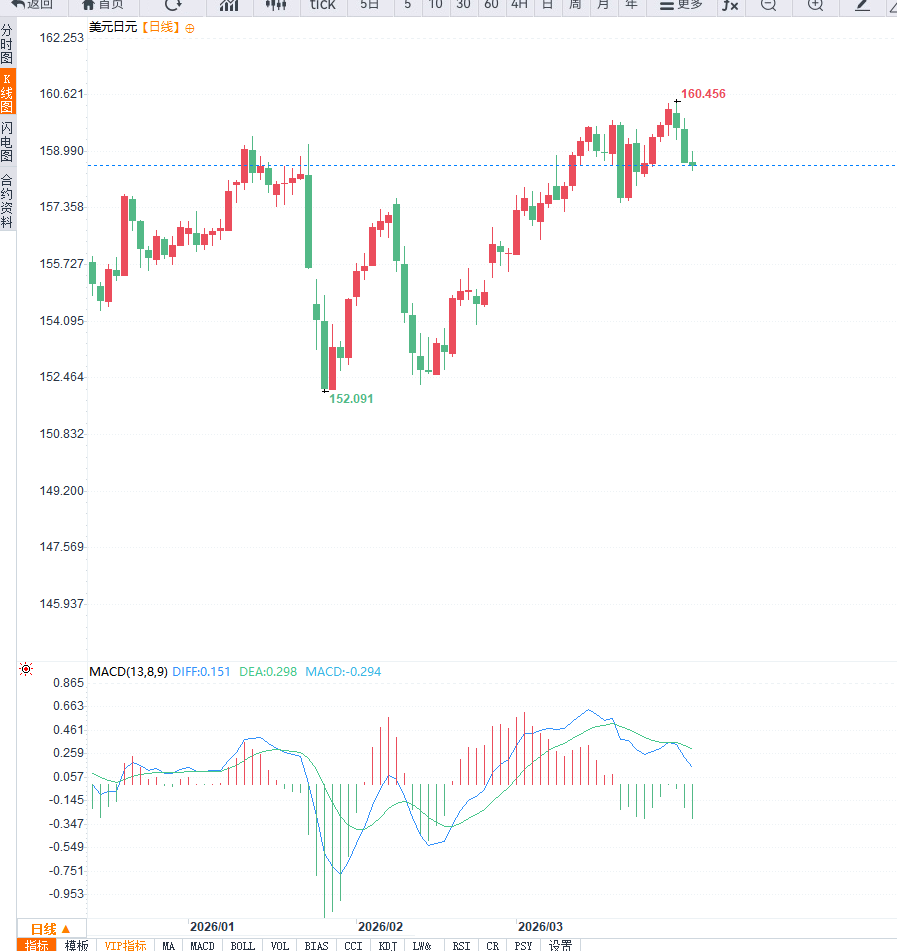
Overall, USD/JPY is in a fluctuating structure of "policy observation + geopolitical uncertainty" , lacking a clear direction in the short term.
Editor's Summary : Given the still fragile inflation base and volatile economic recovery, the Bank of Japan is expected to maintain its current policy to monitor further developments in energy prices and geopolitical situations. This cautious stance limits the yen's trend performance, keeping it volatile under the influence of multiple factors. Future exchange rate direction will continue to depend on developments in the Middle East, oil price trends, and the differences in monetary policy between the US and Japan. Investors need to remain cautious and pay close attention to key events.
While rising energy prices may push up inflation in the short term, policymakers are more concerned about the sustainability of core inflation. Currently, Japanese inflation expectations are not firmly anchored at the 2% target , meaning the central bank must remain cautious in its policy normalization path. The fragile inflation base remains a significant factor limiting interest rate hikes.
At the same time, signs of a slowdown in Japan's economic fundamentals have emerged. The latest Tankan survey shows that businesses are cautious about their future prospects, reflecting continued weak business confidence amid rising external uncertainties. Particularly given the unresolved situation in the Middle East, energy price volatility could further dampen corporate profits and investment intentions.
From a policy perspective, the Bank of Japan currently faces a dilemma: on the one hand, rising energy prices could push up inflation; on the other hand, the economic fundamentals remain relatively fragile, and raising interest rates too early could dampen the recovery momentum. Therefore, maintaining a wait-and-see approach is currently the best policy choice .
This policy expectation has a certain impact on the yen's exchange rate. Normally, continued loose monetary policy would suppress the yen, but the current environment is more complex. On the one hand, the lack of tightening policy limits the yen's appreciation potential; on the other hand, geopolitical risks and market demand for safe-haven assets may provide temporary support for the yen. Furthermore, the expectation that Japanese authorities may intervene in the foreign exchange market also limits the yen's depreciation to some extent.
From a technical perspective, the USD/JPY pair is maintaining a high-level consolidation structure on the daily chart, with the price repeatedly encountering resistance in the 159-160 range , indicating significant upward pressure. Initial support is around 158 , and a break below this level could lead to a further test of the 156 area. The MACD momentum is gradually converging, and the RSI has fallen back to the neutral zone, suggesting weakening trend momentum.
From a 4-hour chart perspective, the short-term trend shows a consolidation structure, with prices fluctuating repeatedly within a range, and the moving average system trending flat. The MACD is oscillating around the zero line, and the RSI remains around 50, reflecting a balance between bullish and bearish forces. If the price fails to break through the 160 resistance level in the short term, it may continue to fluctuate within the range; if it breaks below the 158 support level, the short-term trend may turn bearish.
Overall, USD/JPY is in a fluctuating structure of "policy observation + geopolitical uncertainty" , lacking a clear direction in the short term.
Editor's Summary : Given the still fragile inflation base and volatile economic recovery, the Bank of Japan is expected to maintain its current policy to monitor further developments in energy prices and geopolitical situations. This cautious stance limits the yen's trend performance, keeping it volatile under the influence of multiple factors. Future exchange rate direction will continue to depend on developments in the Middle East, oil price trends, and the differences in monetary policy between the US and Japan. Investors need to remain cautious and pay close attention to key events.
- Risk Warning and Disclaimer
- The market involves risk, and trading may not be suitable for all investors. This article is for reference only and does not constitute personal investment advice, nor does it take into account certain users’ specific investment objectives, financial situation, or other needs. Any investment decisions made based on this information are at your own risk.