Is the dollar's safe-haven appeal fading ahead of Trump's speech?
2026-04-01 17:56:11
On Wednesday, April 1st, the US dollar index retreated across the board during the European session, currently trading around 99.60, down approximately 0.3% on the day. This movement was accompanied by a significant improvement in risk sentiment, primarily stemming from rising market expectations of a potential easing of tensions in the Middle East. The 10-year US Treasury yield fell 4 basis points to around 4.27%, while WTI crude oil prices retreated to around $100 per barrel, hitting a daily low of $96.50 per barrel. Traders are focusing on the US president's speech scheduled for tomorrow, which is expected to provide an updated assessment of the current situation, with some traders already pricing in a "mission accomplished" optimistic signal. The recent upward momentum of the dollar has stalled, and technical charts also suggest a possible shift in the short-term bias.

Global risk assets rebounded significantly amid signs of potential easing tensions in the Middle East. Strong performance in stock index futures and European equities reflects investors shifting away from safe-haven assets and towards higher-beta instruments. The US dollar, a traditional safe-haven currency, faced selling pressure as a result. The dollar index retreated from recent highs, depreciating to varying degrees against major currencies such as the euro, pound, and yen. This shift is not an isolated event but a direct reflection of improved risk appetite. The decline in oil prices further weakened the dollar's commodity-linked support, as lower energy prices typically reduce inflation expectations, thus easing the need for the Federal Reserve to maintain a higher interest rate path. Traders are closely monitoring changes in volatility indicators; implied volatility, previously driven by geopolitical factors, is gradually declining, providing a window for cross-asset allocation adjustments.
The potential easing of tensions in the Middle East has directly impacted commodity pricing logic. The rapid decline in crude oil prices indicates that the market is digesting the possibility of reduced supply disruption risks, and the premium previously driven by concerns related to the Strait of Hormuz has been significantly compressed. The bond market reacted in tandem, with the decline in the 10-year US Treasury yield reflecting a temporary easing of growth concerns and a marginal cooling of inflation expectations.
The short end of the yield curve is relatively stable, while the downward shift in long-term yields suggests a market recalibration of the long-term growth path. Traders need to weigh the potential impact of oil price fluctuations on earnings expectations for related sectors when allocating assets, while also paying attention to the stress test that changes in bond yields will have on interest rate-sensitive assets.
The recent rise in the US dollar has primarily stemmed from accumulated safe-haven demand, but this support has weakened as risk sentiment has improved. Technically, the dollar index chart shows a bearish MACD crossover. Fundamentally, the Federal Reserve's policy path remains driven by inflation data, and the decline in oil prices helps alleviate imported inflationary pressures, marginally weakening the dollar's expected interest rate advantage. The policy stances of other major central banks, such as the European Central Bank and the Bank of England, also need to be considered; if global growth expectations improve simultaneously, the dollar's relative attractiveness may further decline. Overall, the short-term shift in the dollar's bias reflects a market transition from a defensive mode to expectations of a cyclical recovery, but geopolitical uncertainties could still lead to fluctuations.
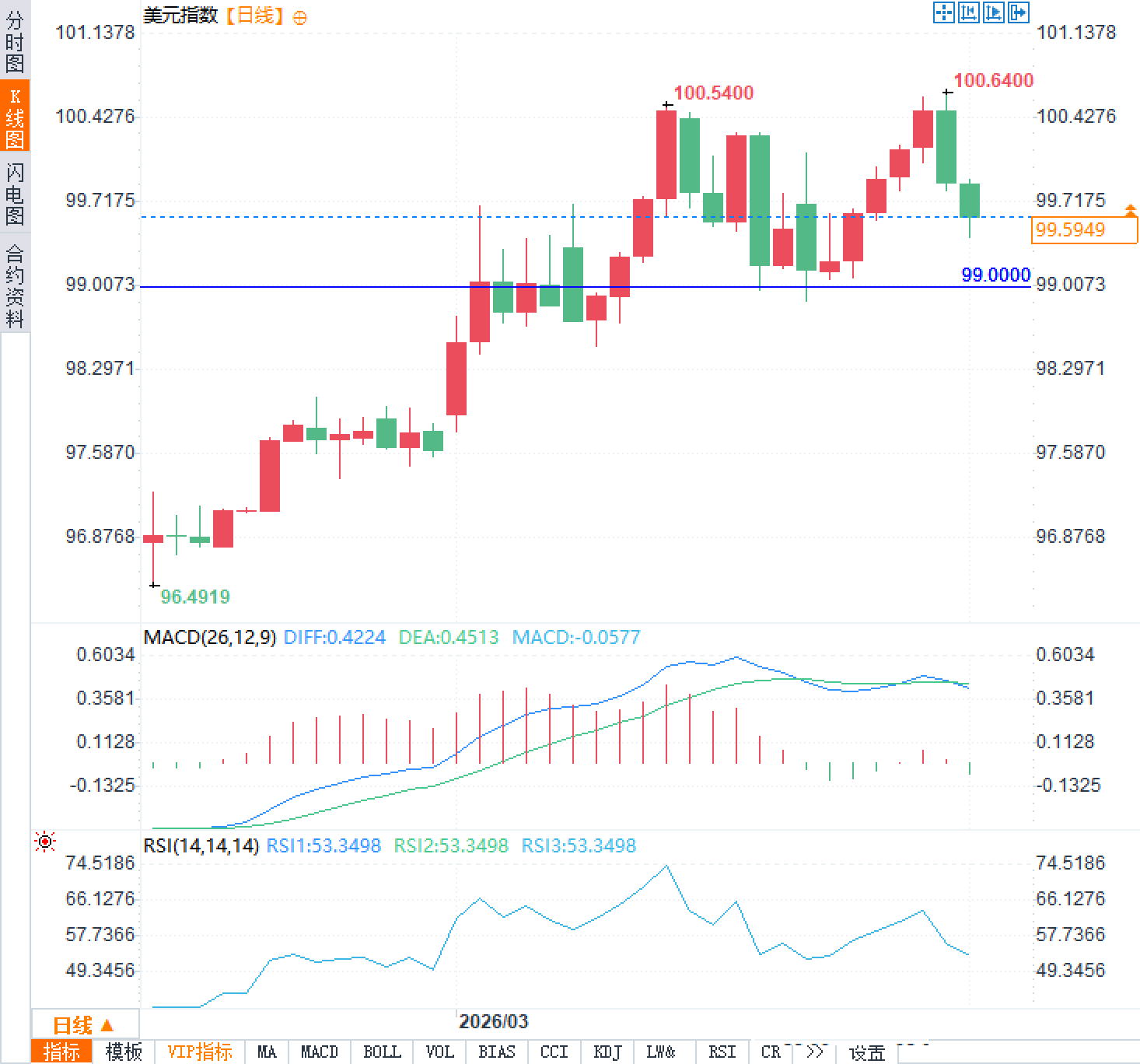
Improved risk sentiment drove the dollar lower.
Global risk assets rebounded significantly amid signs of potential easing tensions in the Middle East. Strong performance in stock index futures and European equities reflects investors shifting away from safe-haven assets and towards higher-beta instruments. The US dollar, a traditional safe-haven currency, faced selling pressure as a result. The dollar index retreated from recent highs, depreciating to varying degrees against major currencies such as the euro, pound, and yen. This shift is not an isolated event but a direct reflection of improved risk appetite. The decline in oil prices further weakened the dollar's commodity-linked support, as lower energy prices typically reduce inflation expectations, thus easing the need for the Federal Reserve to maintain a higher interest rate path. Traders are closely monitoring changes in volatility indicators; implied volatility, previously driven by geopolitical factors, is gradually declining, providing a window for cross-asset allocation adjustments.
The transmission of geopolitical factors to commodity and bond markets
The potential easing of tensions in the Middle East has directly impacted commodity pricing logic. The rapid decline in crude oil prices indicates that the market is digesting the possibility of reduced supply disruption risks, and the premium previously driven by concerns related to the Strait of Hormuz has been significantly compressed. The bond market reacted in tandem, with the decline in the 10-year US Treasury yield reflecting a temporary easing of growth concerns and a marginal cooling of inflation expectations.
The short end of the yield curve is relatively stable, while the downward shift in long-term yields suggests a market recalibration of the long-term growth path. Traders need to weigh the potential impact of oil price fluctuations on earnings expectations for related sectors when allocating assets, while also paying attention to the stress test that changes in bond yields will have on interest rate-sensitive assets.
Technical and fundamental analysis of the weakening short-term momentum of the US dollar.
The recent rise in the US dollar has primarily stemmed from accumulated safe-haven demand, but this support has weakened as risk sentiment has improved. Technically, the dollar index chart shows a bearish MACD crossover. Fundamentally, the Federal Reserve's policy path remains driven by inflation data, and the decline in oil prices helps alleviate imported inflationary pressures, marginally weakening the dollar's expected interest rate advantage. The policy stances of other major central banks, such as the European Central Bank and the Bank of England, also need to be considered; if global growth expectations improve simultaneously, the dollar's relative attractiveness may further decline. Overall, the short-term shift in the dollar's bias reflects a market transition from a defensive mode to expectations of a cyclical recovery, but geopolitical uncertainties could still lead to fluctuations.
Frequently Asked Questions
Question 1: What are the main factors driving the current decline in the US dollar?
A: The dollar's decline was primarily driven by improved risk sentiment. Rising stock index futures and European stock markets indicated that investors were reducing safe-haven positions and shifting towards riskier assets. Simultaneously, the pullback in oil prices from their highs alleviated concerns about energy-related inflation, marginally reducing demand for the dollar as a safe-haven currency. Technical charts also showed weakening short-term upward momentum, coupled with optimistic pricing in upcoming policy speeches, jointly driving the exchange rate adjustment. This process aligns with the typical rebalancing logic of the market during periods of easing uncertainty.
Question 2: What impact will the expectation of easing geopolitical tensions have on the commodity and bond markets?
A: Easing expectations directly led to a decline in crude oil prices, which touched a low of $96.50 per barrel in the morning session, reflecting a compression of the supply risk premium. Bond yields also declined in tandem, with the 10-year Treasury yield falling to around 4.27%, reflecting a temporary easing of growth concerns and a marginal cooling of inflation expectations.
Question 3: How should traders interpret changes in the short-term momentum of the US dollar?
A: The weakening short-term momentum of the US dollar is a natural consequence of improved risk appetite, but it does not signify the establishment of a one-sided trend. Fundamental factors still require observation of the Federal Reserve's assessment of the inflation path and the policy divergence among other major economies. Technical indicators provide supplementary signals, while the decline in volatility creates conditions for dynamic hedging.
- Risk Warning and Disclaimer
- The market involves risk, and trading may not be suitable for all investors. This article is for reference only and does not constitute personal investment advice, nor does it take into account certain users’ specific investment objectives, financial situation, or other needs. Any investment decisions made based on this information are at your own risk.