Is gold undergoing a technical correction, and have recent gains already been overextended?
2026-04-02 02:49:30
The international gold market has recently experienced significant volatility, with prices fluctuating wildly. The core driving factor is the alternating manifestation of inflationary and recessionary logics. When oil prices remain high due to geopolitical conflicts and inflationary pressures rise, the market tends to price in the possibility of a Federal Reserve interest rate hike, leading to higher real interest rates and a stronger dollar, putting pressure on gold as a non-interest-bearing asset. Conversely, when recession fears intensify or monetary policy expectations shift towards easing, gold gains support due to its safe-haven properties. This cyclical shift in logic has significantly increased market uncertainty.
On April 1, 2026, gold prices saw a significant rebound. COMEX April gold futures (GCJ26) opened at $4,668.40 per ounce, reaching a high of $4,785.90 and a low of $4,668.00 during the day, with an intraday gain of over 2.7%, trading in the $4,770-$4,790 per ounce range, a significant recovery from the previous trading day's closing price.
This rebound was primarily driven by two factors: First, news regarding a ceasefire in the Middle East. The US released optimistic signals, and although Iran quickly denied the claims as "false and unfounded," the market interpreted this as an improvement in risk appetite. Brent crude oil fell back to the $100.4-$101.7 per barrel range, a drop of about 3%. Second, Federal Reserve Chairman Powell's remarks at Harvard University on March 30th. He pointed out that the Fed's current policy is in a "good position," allowing for a wait-and-see approach. He favored "seeing through" the impact of supply shocks such as oil price fluctuations on the economy and inflation, and stated that long-term inflation expectations remain generally controllable, making immediate aggressive interest rate hikes unnecessary. This statement reversed some market expectations, pushing down the dollar index and US Treasury yields, providing direct support for gold prices.
Recent trends and logic confirm
In early 2026, gold prices climbed to a historical high of around $5,595-$5,626 per ounce, supported by escalating geopolitical risks and central bank gold purchases. Entering March, intensified conflicts in the Middle East pushed up oil prices, with Brent crude rising above $110-$119 per barrel. Inflationary logic once again dominated the market, increasing the pricing probability of a Fed rate hike in 2026. Gold prices experienced a maximum monthly drop of over 13%, marking one of the worst monthly performances since the 2008 financial crisis. Some analysts believe that the slight recovery after the late March lows was more like a "dead cat bounce," with insufficient trading volume and overbought technical indicators, limiting the sustainability of the upward movement. If oil prices remain high, renewed expectations of rate hikes could lead to a renewed weakening of gold prices. The current ceasefire news only brings short-term emotional relief; the prospects for negotiations remain uncertain, and the actual trajectory of the geopolitical situation remains the core variable.
Potential risks of renewed interest rate hike expectations
The market's pricing in interest rate hike expectations has significantly declined, with Fed funds futures indicating a less than 10% probability of a substantial rate hike in 2026. However, this expectation is highly sensitive and could reverse rapidly. If ceasefire negotiations break down and Brent crude oil rises above $110 again, energy costs will continue to push up CPI and PPI, and inflation logic will once again dominate, potentially leading to a rapid repricing of the probability of rate hikes. The upcoming US CPI, PPI, and employment data in April will be crucial for verification. If the energy component makes a significant contribution, inflation expectations risk becoming decoupled. High oil prices may also push up nominal inflation, driving a rebound in the 10-year US Treasury yield. Higher real interest rates will directly suppress gold prices; historical data shows that the negative correlation between gold and real interest rates exceeds -0.7. The rise in oil prices in 2022 triggered aggressive rate hikes by the Fed. If the current supply shock continues to exceed expectations, the probability of a policy shift will increase significantly. This uncertainty is the core test of the sustainability of the current gold price rebound: in the short term, the rise is driven by events, but in the medium to long term, if rate hike expectations intensify, the pressure logic of gold as a non-interest-bearing asset will regain its dominance.
Divergent opinions among institutions
Goldman Sachs: Strongly Bullish <br />Goldman Sachs raised its year-end gold price target from $4,900 to $5,400 per ounce as early as January 2026, and has maintained this assessment in subsequent reports. The bank believes that the rise in gold is not solely driven by short-term events, but is supported by long-term structural demand: emerging market central banks continue to diversify their gold purchases, with global central bank net gold purchases exceeding 1,000 tons in the past two years; private sector demand for safe-haven assets is increasing; and the trend of de-dollarization continues against the backdrop of widening global fiscal deficits. These factors together constitute a solid bottom for gold prices, and even if geopolitical conflicts ease temporarily, buying interest is unlikely to subside quickly. Goldman Sachs further points out that even if gold prices pull back by about 15% from their highs to around $4,580 in the short term, structural support remains robust. Current global uncertainties have not been fundamentally eliminated; fiscal risks, geopolitical premiums, and the demand for monetary system diversification continue to accumulate, and the long-term trend is expected to outweigh short-term fluctuations, giving gold the momentum to break through above $5,400.
CityIndex: Take it with a grain of salt; define it as a "dead cat bounce".
British brokerage CityIndex characterized the current rebound as a "dead cat bounce." Their analysis suggests that the recovery since the late March lows lacked volume support, with the daily and 4-hour RSI indicators entering overbought territory. Multiple attempts to break above the EMA50 failed to establish a firm foothold, indicating the rebound was driven more by short covering and short-term profit-taking than by new buying, suggesting weak sustainability. From a fundamental perspective, if the ceasefire expectation materializes and oil prices fall below $100, risk appetite will continue to recover, weakening the inflationary logic. Gold will lose its dual drivers of safe-haven appeal and inflation protection, and prices may retest the key support level of $4400-$4500. The current market movement is essentially a technical correction driven by events. Once the catalysts fade, a rebound lacking solid fundamental support is prone to rapid decline, and caution is advised against chasing highs.
Short-term technical analysis
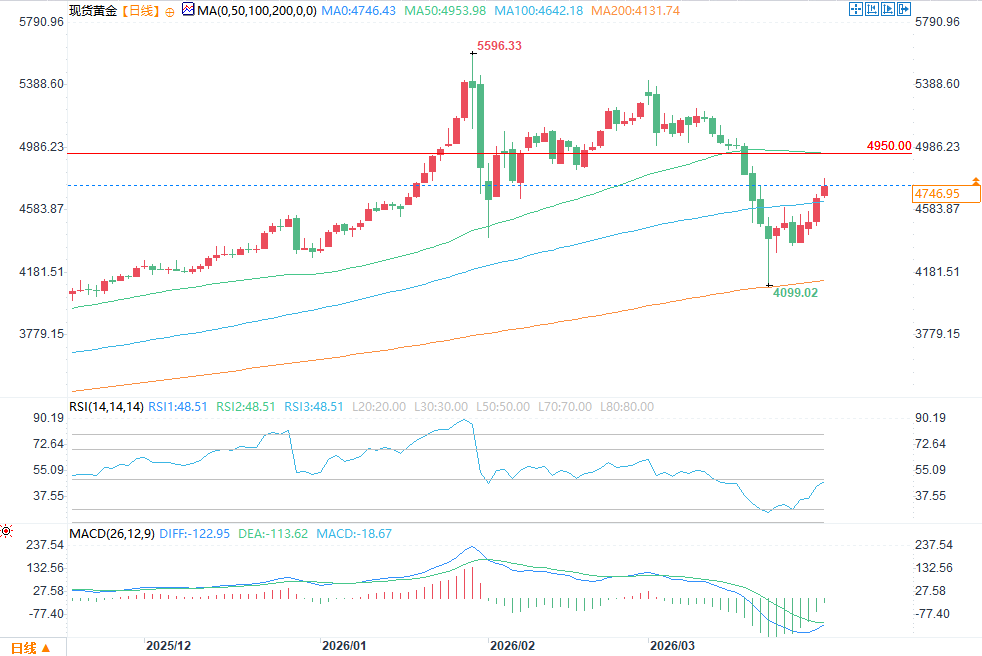
(Spot gold daily chart source: FX678)
The author believes that the recent gold price increase has already been somewhat overextended, and breaking through the 50-day moving average in the coming days will be difficult. Although gold prices have been trading above the EMA100 during this rebound, they have risen for several consecutive days, and the 4-hour RSI is in overbought territory. The 50-day moving average, as an important medium-term trend indicator, is currently still above the gold price. Without sustained new fundamental catalysts, it will be difficult for prices to continue rising to the 50-day moving average; consolidation or profit-taking pressure is likely. In a highly volatile environment, caution is advised, and blindly chasing the rally should be avoided.
Outlook and Risk Warning
In the short term (within April), gold price movements will remain highly dependent on event-driven factors. In an optimistic scenario of easing geopolitical tensions, the upside potential may be relatively limited, with profit-taking and consolidation likely. If negotiations fall short of expectations and oil prices return to high levels, the return of inflationary logic will exacerbate market volatility, making the trend of real interest rates worth close monitoring.
In the medium term (full year 2026), structural bullish factors such as central bank gold purchases and de-dollarization remain, making Goldman Sachs' target of over $5,400 somewhat reasonable. However, the repeated shifts between inflation and recessionary logics, coupled with geopolitical uncertainties, mean that gold is likely to maintain high volatility and is unlikely to form a clear one-sided trend.
In summary, gold is more suitable as a hedging component in a diversified investment portfolio and is not advisable for one-sided, heavy-position trading. Investors need to continuously monitor the Federal Reserve's policy statements, crude oil market inventory data, and the progress of Middle East negotiations, and strictly manage their positions and control risks.
On April 1, 2026, gold prices saw a significant rebound. COMEX April gold futures (GCJ26) opened at $4,668.40 per ounce, reaching a high of $4,785.90 and a low of $4,668.00 during the day, with an intraday gain of over 2.7%, trading in the $4,770-$4,790 per ounce range, a significant recovery from the previous trading day's closing price.
This rebound was primarily driven by two factors: First, news regarding a ceasefire in the Middle East. The US released optimistic signals, and although Iran quickly denied the claims as "false and unfounded," the market interpreted this as an improvement in risk appetite. Brent crude oil fell back to the $100.4-$101.7 per barrel range, a drop of about 3%. Second, Federal Reserve Chairman Powell's remarks at Harvard University on March 30th. He pointed out that the Fed's current policy is in a "good position," allowing for a wait-and-see approach. He favored "seeing through" the impact of supply shocks such as oil price fluctuations on the economy and inflation, and stated that long-term inflation expectations remain generally controllable, making immediate aggressive interest rate hikes unnecessary. This statement reversed some market expectations, pushing down the dollar index and US Treasury yields, providing direct support for gold prices.
Recent trends and logic confirm
In early 2026, gold prices climbed to a historical high of around $5,595-$5,626 per ounce, supported by escalating geopolitical risks and central bank gold purchases. Entering March, intensified conflicts in the Middle East pushed up oil prices, with Brent crude rising above $110-$119 per barrel. Inflationary logic once again dominated the market, increasing the pricing probability of a Fed rate hike in 2026. Gold prices experienced a maximum monthly drop of over 13%, marking one of the worst monthly performances since the 2008 financial crisis. Some analysts believe that the slight recovery after the late March lows was more like a "dead cat bounce," with insufficient trading volume and overbought technical indicators, limiting the sustainability of the upward movement. If oil prices remain high, renewed expectations of rate hikes could lead to a renewed weakening of gold prices. The current ceasefire news only brings short-term emotional relief; the prospects for negotiations remain uncertain, and the actual trajectory of the geopolitical situation remains the core variable.
Potential risks of renewed interest rate hike expectations
The market's pricing in interest rate hike expectations has significantly declined, with Fed funds futures indicating a less than 10% probability of a substantial rate hike in 2026. However, this expectation is highly sensitive and could reverse rapidly. If ceasefire negotiations break down and Brent crude oil rises above $110 again, energy costs will continue to push up CPI and PPI, and inflation logic will once again dominate, potentially leading to a rapid repricing of the probability of rate hikes. The upcoming US CPI, PPI, and employment data in April will be crucial for verification. If the energy component makes a significant contribution, inflation expectations risk becoming decoupled. High oil prices may also push up nominal inflation, driving a rebound in the 10-year US Treasury yield. Higher real interest rates will directly suppress gold prices; historical data shows that the negative correlation between gold and real interest rates exceeds -0.7. The rise in oil prices in 2022 triggered aggressive rate hikes by the Fed. If the current supply shock continues to exceed expectations, the probability of a policy shift will increase significantly. This uncertainty is the core test of the sustainability of the current gold price rebound: in the short term, the rise is driven by events, but in the medium to long term, if rate hike expectations intensify, the pressure logic of gold as a non-interest-bearing asset will regain its dominance.
Divergent opinions among institutions
Goldman Sachs: Strongly Bullish <br />Goldman Sachs raised its year-end gold price target from $4,900 to $5,400 per ounce as early as January 2026, and has maintained this assessment in subsequent reports. The bank believes that the rise in gold is not solely driven by short-term events, but is supported by long-term structural demand: emerging market central banks continue to diversify their gold purchases, with global central bank net gold purchases exceeding 1,000 tons in the past two years; private sector demand for safe-haven assets is increasing; and the trend of de-dollarization continues against the backdrop of widening global fiscal deficits. These factors together constitute a solid bottom for gold prices, and even if geopolitical conflicts ease temporarily, buying interest is unlikely to subside quickly. Goldman Sachs further points out that even if gold prices pull back by about 15% from their highs to around $4,580 in the short term, structural support remains robust. Current global uncertainties have not been fundamentally eliminated; fiscal risks, geopolitical premiums, and the demand for monetary system diversification continue to accumulate, and the long-term trend is expected to outweigh short-term fluctuations, giving gold the momentum to break through above $5,400.
CityIndex: Take it with a grain of salt; define it as a "dead cat bounce".
British brokerage CityIndex characterized the current rebound as a "dead cat bounce." Their analysis suggests that the recovery since the late March lows lacked volume support, with the daily and 4-hour RSI indicators entering overbought territory. Multiple attempts to break above the EMA50 failed to establish a firm foothold, indicating the rebound was driven more by short covering and short-term profit-taking than by new buying, suggesting weak sustainability. From a fundamental perspective, if the ceasefire expectation materializes and oil prices fall below $100, risk appetite will continue to recover, weakening the inflationary logic. Gold will lose its dual drivers of safe-haven appeal and inflation protection, and prices may retest the key support level of $4400-$4500. The current market movement is essentially a technical correction driven by events. Once the catalysts fade, a rebound lacking solid fundamental support is prone to rapid decline, and caution is advised against chasing highs.
Short-term technical analysis
(Spot gold daily chart source: FX678)
The author believes that the recent gold price increase has already been somewhat overextended, and breaking through the 50-day moving average in the coming days will be difficult. Although gold prices have been trading above the EMA100 during this rebound, they have risen for several consecutive days, and the 4-hour RSI is in overbought territory. The 50-day moving average, as an important medium-term trend indicator, is currently still above the gold price. Without sustained new fundamental catalysts, it will be difficult for prices to continue rising to the 50-day moving average; consolidation or profit-taking pressure is likely. In a highly volatile environment, caution is advised, and blindly chasing the rally should be avoided.
Outlook and Risk Warning
In the short term (within April), gold price movements will remain highly dependent on event-driven factors. In an optimistic scenario of easing geopolitical tensions, the upside potential may be relatively limited, with profit-taking and consolidation likely. If negotiations fall short of expectations and oil prices return to high levels, the return of inflationary logic will exacerbate market volatility, making the trend of real interest rates worth close monitoring.
In the medium term (full year 2026), structural bullish factors such as central bank gold purchases and de-dollarization remain, making Goldman Sachs' target of over $5,400 somewhat reasonable. However, the repeated shifts between inflation and recessionary logics, coupled with geopolitical uncertainties, mean that gold is likely to maintain high volatility and is unlikely to form a clear one-sided trend.
In summary, gold is more suitable as a hedging component in a diversified investment portfolio and is not advisable for one-sided, heavy-position trading. Investors need to continuously monitor the Federal Reserve's policy statements, crude oil market inventory data, and the progress of Middle East negotiations, and strictly manage their positions and control risks.
- Risk Warning and Disclaimer
- The market involves risk, and trading may not be suitable for all investors. This article is for reference only and does not constitute personal investment advice, nor does it take into account certain users’ specific investment objectives, financial situation, or other needs. Any investment decisions made based on this information are at your own risk.