Trump's remarks fueled risk aversion, and coupled with a rise in US Treasury yields, the US dollar continued to rebound against the Canadian dollar.
2026-04-02 13:44:46
The US dollar rebounded against the Canadian dollar during the Asian session, rising to around 1.3900 and ending a two-day decline. Changes in market sentiment were the core driver of this rebound. US President Donald Trump's latest remarks failed to offer clear signals of geopolitical easing, leading to renewed risk aversion and supporting a stronger dollar.

In his speech, Trump emphasized that Iran's military capabilities had been significantly weakened, including limited missile and drone capabilities. He also pointed out that Iran's navy and air force had suffered heavy losses and stated that the United States planned to end the conflict within the next two to three weeks . While this statement showed a phased achievement, it did not alleviate market concerns about the uncertainty of the situation. Instead, it amplified risk appetite volatility and drove funds into dollar assets.
Meanwhile, the US interest rate environment continued to support the dollar. The Federal Reserve maintained its interest rate at 3.50%–3.75% at its March 2026 meeting. Although the dot plot indicated a possible 25 basis point rate cut this year, some officials have shifted to a "no rate cut" expectation. Against this backdrop, US Treasury yields rebounded, with both 2-year and 10-year Treasury yields rising in tandem, reflecting a strengthening market expectation of "high interest rates lasting longer." This change enhanced the attractiveness of dollar assets, becoming a significant factor supporting the exchange rate.
However, the fundamentals of the Canadian dollar cannot be ignored. As the largest supplier of crude oil to the United States, the Canadian economy is highly correlated with oil price movements. Recently, crude oil prices have rebounded significantly, with WTI crude rising nearly 5% to around $98.90 per barrel . Higher oil prices typically strengthen the Canadian dollar, thus putting downward pressure on the USD/CAD exchange rate. Therefore, under the combined effect of a stronger US dollar and supportive oil prices for the Canadian dollar, the upside potential of the exchange rate is somewhat limited.
From an overall structural perspective, the current USD/CAD exchange rate exhibits a clear "hedging logic": the US dollar benefits from risk aversion and interest rate expectations, while the Canadian dollar benefits from rising energy prices. This interplay of bullish and bearish factors makes the exchange rate more likely to remain range-bound in the short term.
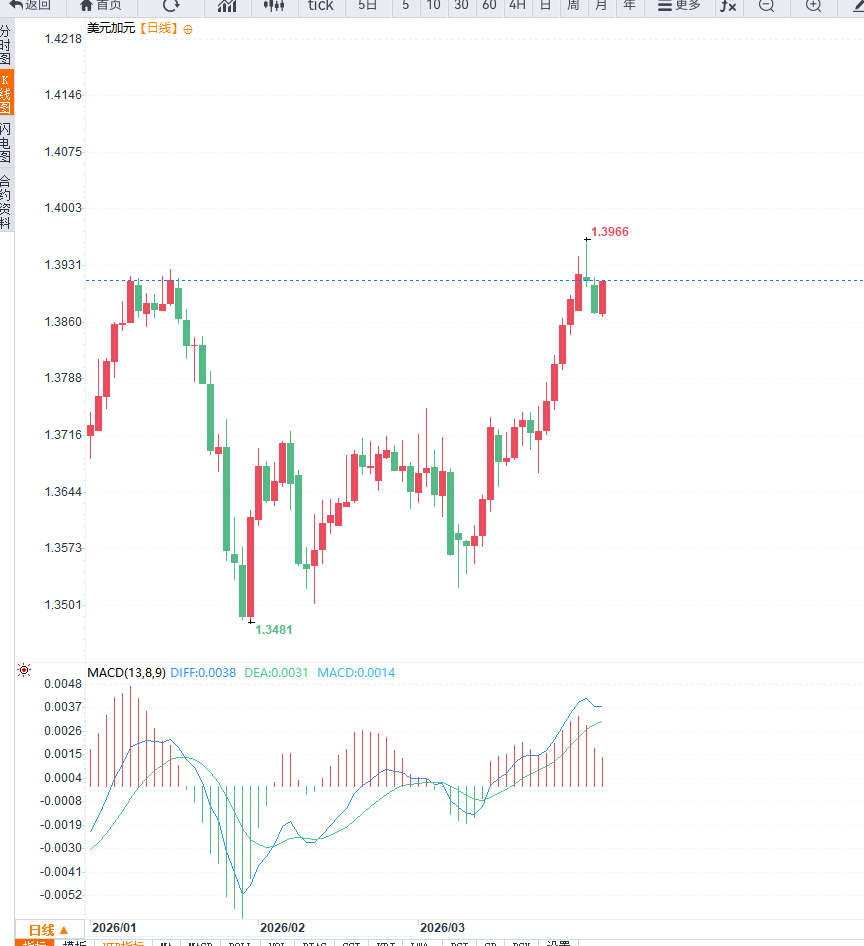
From a technical perspective, the USD/CAD pair remains in a consolidation phase on the daily chart, with the recent rebound being a technical correction. The price rebounded after finding support around 1.3850 , but the 1.3950 and 1.4000 areas represent significant resistance; a break above these levels would open up further upside potential. From a momentum perspective, the daily MACD has stabilized at low levels but has not yet formed a clear bullish divergence, indicating that the trend has not yet fully strengthened.
On the 4-hour chart, the price rebound was accompanied by a short-term momentum recovery, but the overall structure remains range-bound. The moving average system is gradually flattening, indicating a weak trend. Short-term support levels to watch are 1.3850 and 1.3800 ; a break below these levels could lead to a retest of the 1.3750 area. Resistance is concentrated at 1.3950 and 1.4000 ; repeated failed attempts to break higher could result in a pullback.
Editor's Summary : The current USD/CAD exchange rate is driven by a combination of factors. On one hand, Trump's remarks have strengthened risk aversion and boosted the US dollar; on the other hand, rising oil prices have supported the Canadian dollar, limiting its gains. Technically, the exchange rate remains within a trading range, lacking a clear short-term trend. Going forward, key factors to watch include evolving geopolitical situations, changes in US Treasury yields, and oil price movements, as these will determine whether the exchange rate can break through key levels and establish a new direction.
In his speech, Trump emphasized that Iran's military capabilities had been significantly weakened, including limited missile and drone capabilities. He also pointed out that Iran's navy and air force had suffered heavy losses and stated that the United States planned to end the conflict within the next two to three weeks . While this statement showed a phased achievement, it did not alleviate market concerns about the uncertainty of the situation. Instead, it amplified risk appetite volatility and drove funds into dollar assets.
Meanwhile, the US interest rate environment continued to support the dollar. The Federal Reserve maintained its interest rate at 3.50%–3.75% at its March 2026 meeting. Although the dot plot indicated a possible 25 basis point rate cut this year, some officials have shifted to a "no rate cut" expectation. Against this backdrop, US Treasury yields rebounded, with both 2-year and 10-year Treasury yields rising in tandem, reflecting a strengthening market expectation of "high interest rates lasting longer." This change enhanced the attractiveness of dollar assets, becoming a significant factor supporting the exchange rate.
However, the fundamentals of the Canadian dollar cannot be ignored. As the largest supplier of crude oil to the United States, the Canadian economy is highly correlated with oil price movements. Recently, crude oil prices have rebounded significantly, with WTI crude rising nearly 5% to around $98.90 per barrel . Higher oil prices typically strengthen the Canadian dollar, thus putting downward pressure on the USD/CAD exchange rate. Therefore, under the combined effect of a stronger US dollar and supportive oil prices for the Canadian dollar, the upside potential of the exchange rate is somewhat limited.
From an overall structural perspective, the current USD/CAD exchange rate exhibits a clear "hedging logic": the US dollar benefits from risk aversion and interest rate expectations, while the Canadian dollar benefits from rising energy prices. This interplay of bullish and bearish factors makes the exchange rate more likely to remain range-bound in the short term.
From a technical perspective, the USD/CAD pair remains in a consolidation phase on the daily chart, with the recent rebound being a technical correction. The price rebounded after finding support around 1.3850 , but the 1.3950 and 1.4000 areas represent significant resistance; a break above these levels would open up further upside potential. From a momentum perspective, the daily MACD has stabilized at low levels but has not yet formed a clear bullish divergence, indicating that the trend has not yet fully strengthened.
On the 4-hour chart, the price rebound was accompanied by a short-term momentum recovery, but the overall structure remains range-bound. The moving average system is gradually flattening, indicating a weak trend. Short-term support levels to watch are 1.3850 and 1.3800 ; a break below these levels could lead to a retest of the 1.3750 area. Resistance is concentrated at 1.3950 and 1.4000 ; repeated failed attempts to break higher could result in a pullback.
Editor's Summary : The current USD/CAD exchange rate is driven by a combination of factors. On one hand, Trump's remarks have strengthened risk aversion and boosted the US dollar; on the other hand, rising oil prices have supported the Canadian dollar, limiting its gains. Technically, the exchange rate remains within a trading range, lacking a clear short-term trend. Going forward, key factors to watch include evolving geopolitical situations, changes in US Treasury yields, and oil price movements, as these will determine whether the exchange rate can break through key levels and establish a new direction.
- Risk Warning and Disclaimer
- The market involves risk, and trading may not be suitable for all investors. This article is for reference only and does not constitute personal investment advice, nor does it take into account certain users’ specific investment objectives, financial situation, or other needs. Any investment decisions made based on this information are at your own risk.