A rebound in the US dollar, coupled with rising expectations of yen intervention, has pushed the USD/JPY exchange rate close to the 160 mark once again.
2026-04-02 14:27:29
The US dollar continued its upward momentum against the Japanese yen during Asian trading hours, rising to around 159.20 and demonstrating significant short-term strength. The core driver of this rally was US President Donald Trump's latest remarks, whose tough stance on the situation with Iran reinforced market risk aversion, thereby boosting demand for the US dollar.

In his speech, Trump stated that the United States is systematically weakening Iran's ability to pose a threat externally, noting that its missile and drone capabilities have been significantly limited. Meanwhile, the White House emphasized that military operations have achieved or even exceeded their objectives, including the destruction of key ballistic missiles and production facilities. While these statements demonstrate some progress, they have not alleviated market concerns about continued tensions, instead keeping risk sentiment at a high level.
Against this backdrop, the US dollar, as a major global safe-haven asset, received support, driving the USD/JPY exchange rate to continue its upward trend. Meanwhile, the ongoing uncertainty in the Middle East continues to drive market funds towards safe-haven assets, further strengthening the dollar's advantage.
However, potential supporting factors for the yen should not be overlooked. Japanese Ministry of Finance officials recently stated that if excessive speculation occurs in the market, Japan may take "decisive measures" to stabilize the exchange rate. This statement has been interpreted by the market as a signal of potential intervention, especially as the exchange rate approaches the key psychological level of 160 , significantly increasing the risk of intervention.
From a macroeconomic perspective, the current appreciation of the USD/JPY exchange rate is primarily driven by the US dollar, namely the combined effect of safe-haven demand and interest rate expectations, while the yen has been under long-term pressure due to ultra-loose monetary policy. However, as the exchange rate approaches a key range, expectations of policy intervention by the Japanese authorities are gradually increasing, exerting upward pressure on the exchange rate.
From a technical perspective, the USD/JPY pair maintains a clear upward trend on the daily chart, with the price consistently trading above the moving average system, indicating a solid bullish structure. Initial resistance is currently at 159.50 , with further resistance levels at 160.00 and 161.20 , the latter being a key psychological and policy-sensitive area. Support lies at 158.20 ; a break below this level could lead to tests of the 157.50 and 156.80 areas. In terms of momentum, the daily MACD remains bullish, but high-level momentum is starting to weaken, warranting caution regarding a potential period of consolidation.
On the 4-hour chart, the price is showing an accelerating upward trend, but it has entered a relatively high area in the short term. Technical indicators such as the RSI are approaching overbought territory, indicating a potential short-term pullback; while the MACD maintains a bullish structure, the histogram's growth rate is slowing, suggesting weakening upward momentum. If the price fails to break through the 160 level effectively, it may enter a period of high-level consolidation or a technical correction.
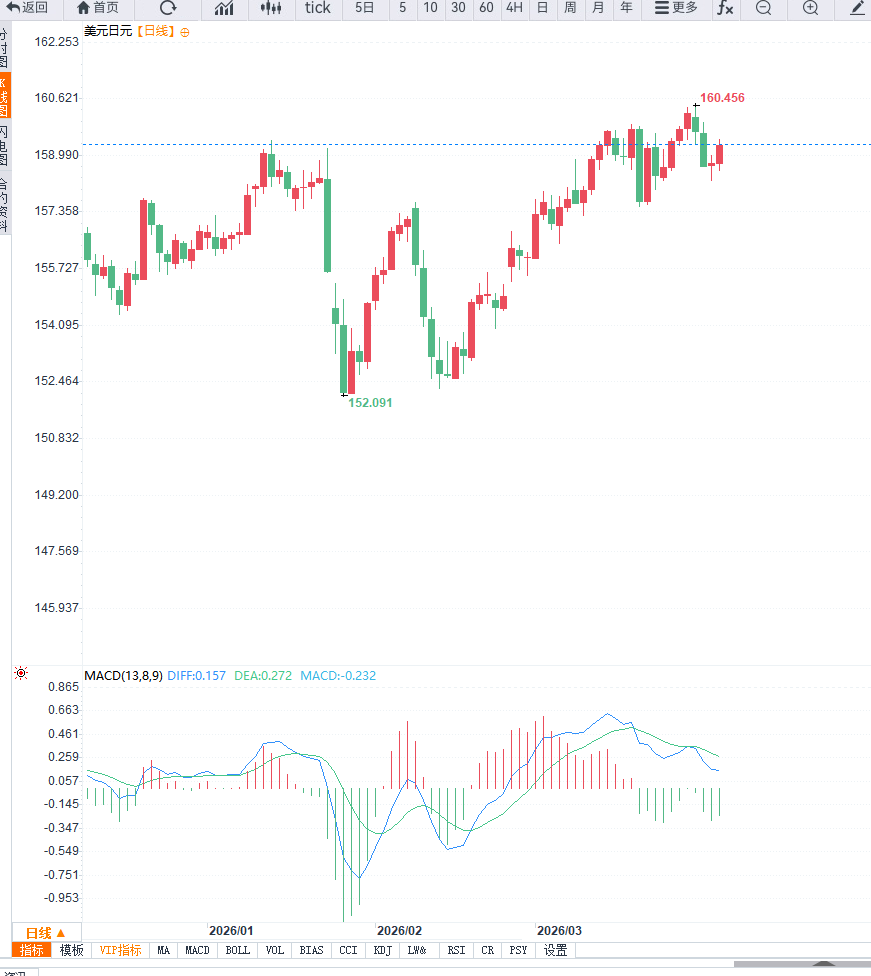
Editor's Summary : The current USD/JPY exchange rate movement reflects the interplay between a strong dollar and yen policy constraints. On one hand, Trump's remarks have heightened geopolitical tensions, supporting a continued dollar strength; on the other hand, Japan's intervention signals have supported the yen and limited its upside potential. Technically, the trend remains bullish, but the pair is approaching a key resistance zone in the short term. Future movement hinges on whether the 160 level is breached and whether Japan takes actual intervention measures. Investors should be wary of the risk of high-level volatility.
In his speech, Trump stated that the United States is systematically weakening Iran's ability to pose a threat externally, noting that its missile and drone capabilities have been significantly limited. Meanwhile, the White House emphasized that military operations have achieved or even exceeded their objectives, including the destruction of key ballistic missiles and production facilities. While these statements demonstrate some progress, they have not alleviated market concerns about continued tensions, instead keeping risk sentiment at a high level.
Against this backdrop, the US dollar, as a major global safe-haven asset, received support, driving the USD/JPY exchange rate to continue its upward trend. Meanwhile, the ongoing uncertainty in the Middle East continues to drive market funds towards safe-haven assets, further strengthening the dollar's advantage.
However, potential supporting factors for the yen should not be overlooked. Japanese Ministry of Finance officials recently stated that if excessive speculation occurs in the market, Japan may take "decisive measures" to stabilize the exchange rate. This statement has been interpreted by the market as a signal of potential intervention, especially as the exchange rate approaches the key psychological level of 160 , significantly increasing the risk of intervention.
From a macroeconomic perspective, the current appreciation of the USD/JPY exchange rate is primarily driven by the US dollar, namely the combined effect of safe-haven demand and interest rate expectations, while the yen has been under long-term pressure due to ultra-loose monetary policy. However, as the exchange rate approaches a key range, expectations of policy intervention by the Japanese authorities are gradually increasing, exerting upward pressure on the exchange rate.
From a technical perspective, the USD/JPY pair maintains a clear upward trend on the daily chart, with the price consistently trading above the moving average system, indicating a solid bullish structure. Initial resistance is currently at 159.50 , with further resistance levels at 160.00 and 161.20 , the latter being a key psychological and policy-sensitive area. Support lies at 158.20 ; a break below this level could lead to tests of the 157.50 and 156.80 areas. In terms of momentum, the daily MACD remains bullish, but high-level momentum is starting to weaken, warranting caution regarding a potential period of consolidation.
On the 4-hour chart, the price is showing an accelerating upward trend, but it has entered a relatively high area in the short term. Technical indicators such as the RSI are approaching overbought territory, indicating a potential short-term pullback; while the MACD maintains a bullish structure, the histogram's growth rate is slowing, suggesting weakening upward momentum. If the price fails to break through the 160 level effectively, it may enter a period of high-level consolidation or a technical correction.
Editor's Summary : The current USD/JPY exchange rate movement reflects the interplay between a strong dollar and yen policy constraints. On one hand, Trump's remarks have heightened geopolitical tensions, supporting a continued dollar strength; on the other hand, Japan's intervention signals have supported the yen and limited its upside potential. Technically, the trend remains bullish, but the pair is approaching a key resistance zone in the short term. Future movement hinges on whether the 160 level is breached and whether Japan takes actual intervention measures. Investors should be wary of the risk of high-level volatility.
- Risk Warning and Disclaimer
- The market involves risk, and trading may not be suitable for all investors. This article is for reference only and does not constitute personal investment advice, nor does it take into account certain users’ specific investment objectives, financial situation, or other needs. Any investment decisions made based on this information are at your own risk.