The US-Iran conflict triggered a huge fluctuation in gold prices. Is the recent correction a trap for short sellers or a good opportunity to buy in?
2026-04-02 21:09:38
On Thursday (April 2), spot gold experienced significant volatility during the European and American trading sessions. Impacted by concerns about runaway inflation driven by soaring oil prices, it once fell by 4% during the session, before rebounding slightly to recover some of its losses. It is currently trading around 4618, with the decline narrowing to 3%.
The core logic behind this round of rapid decline in gold prices is clear: the US-Iran conflict pushed up oil prices, leading to rising inflation expectations. The market anticipated that the Federal Reserve would be forced to postpone interest rate cuts to curb inflation. Coupled with the concentrated release of emergency selling pressure from some central banks, short-term disturbances dominated the gold price trend.
As the conflict between the US and Iran continues to escalate, the pressure on Türkiye's foreign exchange reserves, which are heavily reliant on energy imports, is increasing dramatically.
Its official foreign exchange reserves are only over US$50 billion, while its annual energy import expenditures are close to US$60 billion. Coupled with capital outflows and the depletion caused by exchange rate stabilization, its foreign exchange reserves are no longer sufficient to cover rigid external payment needs, and the red line for reserve security is in grave danger.
The country relies on imports for 90% of its oil and 98% of its natural gas. Soaring oil prices, coupled with Iran's halt to natural gas supplies, have led to a sharp increase in energy import costs.
At the same time, geopolitical risks triggered panic capital outflows and a sharp drop in the lira's exchange rate. The central bank was forced to deplete a large amount of foreign exchange reserves to stabilize the economy. Foreign trade and tourism were also impacted by the situation, and foreign exchange reserves quickly approached the danger zone.
To alleviate the dollar liquidity gap, the Central Bank of Turkey adopted a combination of operations last week: it conducted 42 tons of gold swap transactions to raise short-term funds, while selling only 21 tons of gold directly to exchange for foreign currency. By using swaps as the main method and small-scale sales as a supplement, the central bank aimed to solve the immediate crisis while preserving its core gold reserves as much as possible, demonstrating its reluctance to sell gold.
The previous gold sales by Middle Eastern countries were emergency measures to alleviate foreign exchange shortages, and were not intended to negate the long-term value of gold.
In stark contrast to Türkiye's passive approach, the Bank of Canada has demonstrated a proactive stance on gold allocation.
Data shows that Canada's gold imports surged in February, driving a 45.6% jump in imports of "metals and nonmetals mineral products," pushing total imports to a record high and widening the trade deficit to C$5.74 billion, a six-month peak.
Domestic entities are making large-scale purchases of gold from the United States, highlighting that central banks still have a long-term positive outlook on gold's hedging and allocation value.
The divergence in global central bank operations regarding gold is essentially a difference between short-term liquidity needs and long-term asset allocation logic; core allocation confidence has not been reversed by short-term fluctuations.
Despite short-term downward pressure on gold prices, the instability of the US dollar's credit rating continues to provide long-term support for gold.
The number of initial jobless claims in the United States fell to 202,000, seemingly indicating a stable labor market, but there are hidden concerns: corporate layoffs increased by 25% month-on-month in March, with a surge in layoffs in the technology and transportation industries. AI substitution and corporate hiring contraction have become the main drags.
Coupled with soaring oil prices pushing up inflation, the Federal Reserve is caught in a monetary policy dilemma: "to combat inflation, it needs to maintain high interest rates; to stabilize the economy, it needs to loosen monetary policy."
Furthermore, the continued disruptions caused by US tariff policies, the reduction in labor supply due to immigration policies, and the historically low share of Canadian exports to the US have all weakened the foundation of the US dollar's credibility, making gold's hedging value as a supranational hard currency still prominent.
Overall, this round of gold price decline is a temporary consolidation caused by short-term inflation expectations and emergency selling pressure from central banks, and is not a signal of a trend reversal.
From the core logic perspective, the unresolved geopolitical conflicts in the Middle East, the high oil prices boosting inflation resilience, the deep cracks in the credibility of the US dollar, and the continued demand for gold by global central banks (with both reluctance to sell and increased holdings) are all long-term supporting factors that have not changed.
With short-term selling pressure digested, gold is expected to return to an upward trajectory after consolidation, and there is still considerable room for further price movement.
From a technical perspective, spot gold failed to hold the upper channel line and the 0.618 level, and has now returned to an upward channel. In the future, 4700 will become an important resistance level to test the bulls and bears of gold. The support level is around 4600, which is gradually moving towards the middle channel line. The further support level is around 4426, which is also the lower channel line.
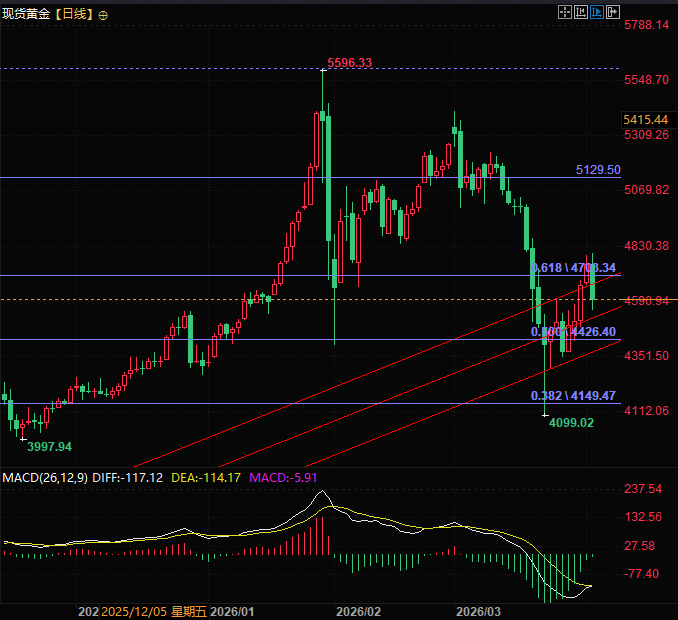
(Spot gold daily chart, source: EasyForex subsidiary)
At 21:06 Beijing time, spot gold is currently trading at $4,608 per ounce.
The core logic behind this round of rapid decline in gold prices is clear: the US-Iran conflict pushed up oil prices, leading to rising inflation expectations. The market anticipated that the Federal Reserve would be forced to postpone interest rate cuts to curb inflation. Coupled with the concentrated release of emergency selling pressure from some central banks, short-term disturbances dominated the gold price trend.
Türkiye faces a foreign exchange crisis, making gold an emergency currency exchange tool.
As the conflict between the US and Iran continues to escalate, the pressure on Türkiye's foreign exchange reserves, which are heavily reliant on energy imports, is increasing dramatically.
Its official foreign exchange reserves are only over US$50 billion, while its annual energy import expenditures are close to US$60 billion. Coupled with capital outflows and the depletion caused by exchange rate stabilization, its foreign exchange reserves are no longer sufficient to cover rigid external payment needs, and the red line for reserve security is in grave danger.
The country relies on imports for 90% of its oil and 98% of its natural gas. Soaring oil prices, coupled with Iran's halt to natural gas supplies, have led to a sharp increase in energy import costs.
At the same time, geopolitical risks triggered panic capital outflows and a sharp drop in the lira's exchange rate. The central bank was forced to deplete a large amount of foreign exchange reserves to stabilize the economy. Foreign trade and tourism were also impacted by the situation, and foreign exchange reserves quickly approached the danger zone.
To alleviate the dollar liquidity gap, the Central Bank of Turkey adopted a combination of operations last week: it conducted 42 tons of gold swap transactions to raise short-term funds, while selling only 21 tons of gold directly to exchange for foreign currency. By using swaps as the main method and small-scale sales as a supplement, the central bank aimed to solve the immediate crisis while preserving its core gold reserves as much as possible, demonstrating its reluctance to sell gold.
The previous gold sales by Middle Eastern countries were emergency measures to alleviate foreign exchange shortages, and were not intended to negate the long-term value of gold.
Diverging central bank stances and increased Canadian holdings highlight the long-term value of gold.
In stark contrast to Türkiye's passive approach, the Bank of Canada has demonstrated a proactive stance on gold allocation.
Data shows that Canada's gold imports surged in February, driving a 45.6% jump in imports of "metals and nonmetals mineral products," pushing total imports to a record high and widening the trade deficit to C$5.74 billion, a six-month peak.
Domestic entities are making large-scale purchases of gold from the United States, highlighting that central banks still have a long-term positive outlook on gold's hedging and allocation value.
The divergence in global central bank operations regarding gold is essentially a difference between short-term liquidity needs and long-term asset allocation logic; core allocation confidence has not been reversed by short-term fluctuations.
Uncertainties surrounding the credibility of the US dollar underscore the hedging properties of gold.
Despite short-term downward pressure on gold prices, the instability of the US dollar's credit rating continues to provide long-term support for gold.
The number of initial jobless claims in the United States fell to 202,000, seemingly indicating a stable labor market, but there are hidden concerns: corporate layoffs increased by 25% month-on-month in March, with a surge in layoffs in the technology and transportation industries. AI substitution and corporate hiring contraction have become the main drags.
Coupled with soaring oil prices pushing up inflation, the Federal Reserve is caught in a monetary policy dilemma: "to combat inflation, it needs to maintain high interest rates; to stabilize the economy, it needs to loosen monetary policy."
Furthermore, the continued disruptions caused by US tariff policies, the reduction in labor supply due to immigration policies, and the historically low share of Canadian exports to the US have all weakened the foundation of the US dollar's credibility, making gold's hedging value as a supranational hard currency still prominent.
A period of consolidation does not change the long-term logic; gold still has room to rise.
Overall, this round of gold price decline is a temporary consolidation caused by short-term inflation expectations and emergency selling pressure from central banks, and is not a signal of a trend reversal.
From the core logic perspective, the unresolved geopolitical conflicts in the Middle East, the high oil prices boosting inflation resilience, the deep cracks in the credibility of the US dollar, and the continued demand for gold by global central banks (with both reluctance to sell and increased holdings) are all long-term supporting factors that have not changed.
With short-term selling pressure digested, gold is expected to return to an upward trajectory after consolidation, and there is still considerable room for further price movement.
From a technical perspective, spot gold failed to hold the upper channel line and the 0.618 level, and has now returned to an upward channel. In the future, 4700 will become an important resistance level to test the bulls and bears of gold. The support level is around 4600, which is gradually moving towards the middle channel line. The further support level is around 4426, which is also the lower channel line.
(Spot gold daily chart, source: EasyForex subsidiary)
At 21:06 Beijing time, spot gold is currently trading at $4,608 per ounce.
- Risk Warning and Disclaimer
- The market involves risk, and trading may not be suitable for all investors. This article is for reference only and does not constitute personal investment advice, nor does it take into account certain users’ specific investment objectives, financial situation, or other needs. Any investment decisions made based on this information are at your own risk.