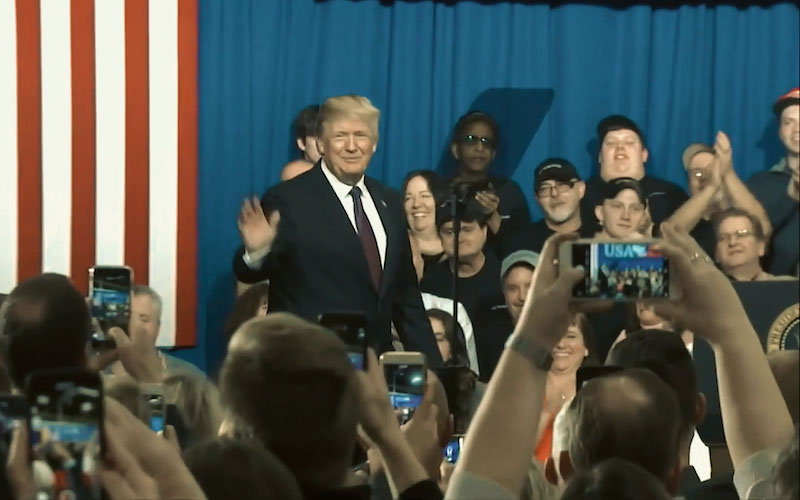
Trump's speech on April 2: "Iraq 2.0" risk warnings sounded, conflict could drag on for years.
2026-04-03 01:54:29
On April 2, 2026, Trump delivered a national televised address, completely reversing his previous optimistic statements that "diplomatic negotiations will advance and the conflict will be resolved within weeks," and sending a clear signal of a full-scale escalation of US-Iran military action. This military strike against Iran is rapidly shifting from airstrikes to high-risk ground intervention, and the shadow of a protracted war of attrition, reminiscent of "Iraq 2.0," is quietly looming over the Middle East, bringing about a disruptive upheaval to global energy supply and inflation patterns.
The speech shifted: from a diplomatic buffer to a "declaration of action" on military escalation.
In recent weeks, the Trump administration has consistently signaled a conciliatory stance, repeatedly mentioning progress in indirect negotiations with Iran and smooth information exchange, and has put forward 15 peace proposals, which initially suppressed market expectations for rising oil prices. However, in his speech on April 2, all diplomatic statements were significantly weakened. Trump stated bluntly that "the intensity of military action is continuing to escalate," explicitly ordering "another two to three weeks of intense strikes," while also warning the public in advance that a high oil price shock was inevitable, but this was a necessary price to pay for "resolving the core national security issue of the Iranian nuclear threat."
Several international political and military analysts pointed out that this speech was by no means a mere propaganda effort, but rather a clear "declaration of action"—the US military strike against Iran will be comprehensively escalated, and the possibility of ground intervention has transformed from a theoretical risk into a realistic contingency plan. CNBC commented that Trump's release of a tough signal at this time is essentially a preemptive measure to "inoculate" the domestic public at the crucial juncture of oil prices breaking through $100-113 per barrel, laying the groundwork for subsequent escalated military action and its associated economic costs.
Core objective: Air strikes are insufficient to eliminate nuclear threats; seizing uranium on the ground becomes the only option.
The core of the Trump administration's military action against Iran has always been to "permanently eliminate the Iranian nuclear threat." Although continuous air strikes have severely damaged many of Iran's publicly visible nuclear facilities, Iran still retains about 400-450 kilograms of highly enriched uranium with an enrichment level of 60%—these critical nuclear materials are buried deep underground in hardened facilities, in concealed locations and heavily protected, making it impossible to completely remove them by air strikes alone.
Multiple nuclear security experts and former U.S. defense officials have jointly pointed out that only by carrying out a "physical seizure"—completely removing and transporting highly enriched uranium from underground facilities—can the nuclear risk be fundamentally mitigated. Currently, the Pentagon has initiated substantive planning: a joint operation involving U.S. special forces and elite Israeli forces is planned, requiring the deployment of hundreds to thousands of ground personnel, along with heavy excavation equipment, temporary runways, and secure transport equipment for nuclear materials. Simultaneously, a temporary security zone will be established in the operation area to guard against retaliation from various Iranian armed groups.
Authoritative organizations such as CSIS, the BBC, and The New York Times believe that such uranium seizure operations are unprecedentedly complex, far exceeding the scope of conventional special operations, and once launched, will significantly raise the threshold and risks for US ground intervention.
Experts warn: Iran's resilience far exceeds Iraq's, drastically increasing the risk of an "Iraq 2.0".
Mainstream experts in the fields of international military affairs and international relations have reached a consensus: once the United States launches a ground-based operation to seize uranium, it is highly likely to repeat the mistakes of the 2003 Iraq War, falling into a protracted war of attrition that is "easy to advance but difficult to retreat," and may even evolve into an "Iraq 2.0" that is more troublesome than the Iraq War.
Geographically and in terms of basic conditions, Iran possesses far greater strategic depth and resistance capabilities than Iraq: its land area is 3.5 times that of Iraq, its population is three times that of Iraq, and its territory is dominated by the Zagros Mountains, high-altitude deserts, and complex, rugged terrain, making it difficult to deploy large-scale mechanized forces. This makes it impossible to replicate the "Desert Storm" model used by the US military to defeat the Iraqi regular army. Retired US Lieutenant General Mark Hertling bluntly stated that Iran's mountainous and desert terrain would drag any ground invasion into a protracted guerrilla war, and the US military has no possibility of replicating the Iraqi model.
In terms of regime resilience, Iran's "mosaic defense" strategy—decentralized deployment of military forces and reliance on a broad network of proxies in the Middle East to build a counterattack system—means that the more intense the external attacks, the more united and resolute the domestic regime becomes. Currently, there is no indication that the Iranian people will accept external "liberation." Think tanks such as the Brookings Institution and the Atlantic Council warn that if the United States forcibly pushes for regime change, it will inevitably trigger nationwide unrest and fragmentation in Iran, with the level of chaos far exceeding that of Iraq after 2003.
Even more alarming is the risk of "mission creep": Although US officials have repeatedly emphasized that "the uranium seizure is a limited operation and not intended for permanent occupation," institutions such as the Lowry Institute and the Cato Institute point out that the US currently lacks both a clear post-war political objective and a clear withdrawal mechanism. If ground troops become involved in Iranian guerrilla warfare and proxy retaliation, the conflict could drag on from "weeks" to "months or even years," and a full-scale invasion could require hundreds of thousands of US troops, with war costs far exceeding the combined costs of the Iraq and Afghanistan wars.
Long-term projection: Conflicts drag on for years, high oil prices and global stagflation become the new normal.
According to predictions from think tanks such as the Brookings Institution, CSIS, and Oxford Economics, even if the US military completes the "kinetic phase" of seizing uranium within weeks, the subsequent regional chain reactions, proxy retaliations, and situational reconstruction will continue for months or even years. The risk of shipping disruptions in the Strait of Hormuz will be long-term—Iran and its allies will inevitably retaliate by blocking the strait and attacking oil tankers, keeping approximately 20% of global oil supply routes blocked, and the supply gap will be difficult to close quickly.
The economic impact has already been evident: following Trump's speech, Brent crude oil jumped to the $100-113/barrel range. The market consensus is that if the conflict drags on and the Strait of Hormuz remains disrupted, Brent crude oil will likely remain at a high level of $130-150/barrel for an extended period, with geopolitical premiums becoming the core support for oil prices.
High oil prices will drive up global inflation through the entire supply chain: rising refined oil prices will directly increase residents' travel costs; soaring shipping and land transportation costs will further increase logistics costs for food, daily necessities, and industrial raw materials; as a core raw material for fertilizers, plastics, and other chemical products, oil will drive up fertilizer prices, which will in turn trigger a new round of global food price increases, ultimately affecting the global consumer goods market.
Even though the United States is already a net oil exporter, it will find it difficult to remain unaffected—domestic inflationary pressures will rise significantly, and economic growth faces the risk of slowing down. Oxford Economics warns that in the next 2-3 years, the global economy is highly likely to fall into a "persistent inflationary environment dominated by geopolitical premiums," with high production costs for enterprises, compressed consumer spending power, and a comprehensive increase in the risk of stagflation. Global investors and businesses need to deploy defensive assets in advance to cope with this long-term economic turmoil triggered by the Middle East conflict.
In short, Trump's speech on April 2 was no longer a simple military threat, but a formal prelude to the escalation of the US-Iran conflict—a storm that could trigger "Iraq 2.0" and disrupt the global energy and economic landscape has quietly begun.
The speech shifted: from a diplomatic buffer to a "declaration of action" on military escalation.
In recent weeks, the Trump administration has consistently signaled a conciliatory stance, repeatedly mentioning progress in indirect negotiations with Iran and smooth information exchange, and has put forward 15 peace proposals, which initially suppressed market expectations for rising oil prices. However, in his speech on April 2, all diplomatic statements were significantly weakened. Trump stated bluntly that "the intensity of military action is continuing to escalate," explicitly ordering "another two to three weeks of intense strikes," while also warning the public in advance that a high oil price shock was inevitable, but this was a necessary price to pay for "resolving the core national security issue of the Iranian nuclear threat."
Several international political and military analysts pointed out that this speech was by no means a mere propaganda effort, but rather a clear "declaration of action"—the US military strike against Iran will be comprehensively escalated, and the possibility of ground intervention has transformed from a theoretical risk into a realistic contingency plan. CNBC commented that Trump's release of a tough signal at this time is essentially a preemptive measure to "inoculate" the domestic public at the crucial juncture of oil prices breaking through $100-113 per barrel, laying the groundwork for subsequent escalated military action and its associated economic costs.
Core objective: Air strikes are insufficient to eliminate nuclear threats; seizing uranium on the ground becomes the only option.
The core of the Trump administration's military action against Iran has always been to "permanently eliminate the Iranian nuclear threat." Although continuous air strikes have severely damaged many of Iran's publicly visible nuclear facilities, Iran still retains about 400-450 kilograms of highly enriched uranium with an enrichment level of 60%—these critical nuclear materials are buried deep underground in hardened facilities, in concealed locations and heavily protected, making it impossible to completely remove them by air strikes alone.
Multiple nuclear security experts and former U.S. defense officials have jointly pointed out that only by carrying out a "physical seizure"—completely removing and transporting highly enriched uranium from underground facilities—can the nuclear risk be fundamentally mitigated. Currently, the Pentagon has initiated substantive planning: a joint operation involving U.S. special forces and elite Israeli forces is planned, requiring the deployment of hundreds to thousands of ground personnel, along with heavy excavation equipment, temporary runways, and secure transport equipment for nuclear materials. Simultaneously, a temporary security zone will be established in the operation area to guard against retaliation from various Iranian armed groups.
Authoritative organizations such as CSIS, the BBC, and The New York Times believe that such uranium seizure operations are unprecedentedly complex, far exceeding the scope of conventional special operations, and once launched, will significantly raise the threshold and risks for US ground intervention.
Experts warn: Iran's resilience far exceeds Iraq's, drastically increasing the risk of an "Iraq 2.0".
Mainstream experts in the fields of international military affairs and international relations have reached a consensus: once the United States launches a ground-based operation to seize uranium, it is highly likely to repeat the mistakes of the 2003 Iraq War, falling into a protracted war of attrition that is "easy to advance but difficult to retreat," and may even evolve into an "Iraq 2.0" that is more troublesome than the Iraq War.
Geographically and in terms of basic conditions, Iran possesses far greater strategic depth and resistance capabilities than Iraq: its land area is 3.5 times that of Iraq, its population is three times that of Iraq, and its territory is dominated by the Zagros Mountains, high-altitude deserts, and complex, rugged terrain, making it difficult to deploy large-scale mechanized forces. This makes it impossible to replicate the "Desert Storm" model used by the US military to defeat the Iraqi regular army. Retired US Lieutenant General Mark Hertling bluntly stated that Iran's mountainous and desert terrain would drag any ground invasion into a protracted guerrilla war, and the US military has no possibility of replicating the Iraqi model.
In terms of regime resilience, Iran's "mosaic defense" strategy—decentralized deployment of military forces and reliance on a broad network of proxies in the Middle East to build a counterattack system—means that the more intense the external attacks, the more united and resolute the domestic regime becomes. Currently, there is no indication that the Iranian people will accept external "liberation." Think tanks such as the Brookings Institution and the Atlantic Council warn that if the United States forcibly pushes for regime change, it will inevitably trigger nationwide unrest and fragmentation in Iran, with the level of chaos far exceeding that of Iraq after 2003.
Even more alarming is the risk of "mission creep": Although US officials have repeatedly emphasized that "the uranium seizure is a limited operation and not intended for permanent occupation," institutions such as the Lowry Institute and the Cato Institute point out that the US currently lacks both a clear post-war political objective and a clear withdrawal mechanism. If ground troops become involved in Iranian guerrilla warfare and proxy retaliation, the conflict could drag on from "weeks" to "months or even years," and a full-scale invasion could require hundreds of thousands of US troops, with war costs far exceeding the combined costs of the Iraq and Afghanistan wars.
Long-term projection: Conflicts drag on for years, high oil prices and global stagflation become the new normal.
According to predictions from think tanks such as the Brookings Institution, CSIS, and Oxford Economics, even if the US military completes the "kinetic phase" of seizing uranium within weeks, the subsequent regional chain reactions, proxy retaliations, and situational reconstruction will continue for months or even years. The risk of shipping disruptions in the Strait of Hormuz will be long-term—Iran and its allies will inevitably retaliate by blocking the strait and attacking oil tankers, keeping approximately 20% of global oil supply routes blocked, and the supply gap will be difficult to close quickly.
The economic impact has already been evident: following Trump's speech, Brent crude oil jumped to the $100-113/barrel range. The market consensus is that if the conflict drags on and the Strait of Hormuz remains disrupted, Brent crude oil will likely remain at a high level of $130-150/barrel for an extended period, with geopolitical premiums becoming the core support for oil prices.
High oil prices will drive up global inflation through the entire supply chain: rising refined oil prices will directly increase residents' travel costs; soaring shipping and land transportation costs will further increase logistics costs for food, daily necessities, and industrial raw materials; as a core raw material for fertilizers, plastics, and other chemical products, oil will drive up fertilizer prices, which will in turn trigger a new round of global food price increases, ultimately affecting the global consumer goods market.
Even though the United States is already a net oil exporter, it will find it difficult to remain unaffected—domestic inflationary pressures will rise significantly, and economic growth faces the risk of slowing down. Oxford Economics warns that in the next 2-3 years, the global economy is highly likely to fall into a "persistent inflationary environment dominated by geopolitical premiums," with high production costs for enterprises, compressed consumer spending power, and a comprehensive increase in the risk of stagflation. Global investors and businesses need to deploy defensive assets in advance to cope with this long-term economic turmoil triggered by the Middle East conflict.
In short, Trump's speech on April 2 was no longer a simple military threat, but a formal prelude to the escalation of the US-Iran conflict—a storm that could trigger "Iraq 2.0" and disrupt the global energy and economic landscape has quietly begun.
- Risk Warning and Disclaimer
- The market involves risk, and trading may not be suitable for all investors. This article is for reference only and does not constitute personal investment advice, nor does it take into account certain users’ specific investment objectives, financial situation, or other needs. Any investment decisions made based on this information are at your own risk.