A life-or-death tug-of-war at the 100 mark! Hopes for a ceasefire in Iran versus the risk of escalation.
2026-04-06 20:58:43
On Monday (April 6) during the European session, the US dollar index maintained a narrow range of fluctuation after opening, reaching 99.91 at one point, down slightly by about 0.29%. The US dollar index did not show any significant consecutive rises or falls (it has fluctuated narrowly within the range of 99.80-100.30 for the past three days), with the daily fluctuation range controlled at 0.4%-0.6%.
The US dollar saw a slight decline, mainly supported by rising oil prices and the risk of escalating conflict with Iran. However, the hope for a ceasefire negotiation under Trump's deadline eased risk aversion in the short term, and the market quickly switched between "risk repricing" and "hedging demand".

Fundamental analysis
Oil-driven support for reshaping the dollar's path
OCBC strategists explicitly pointed out that the sharp rise in oil prices has completely overturned the expectation of a gradual weakening of the US dollar at the beginning of the year, re-establishing support for the dollar. Brent crude oil once broke through $110 per barrel, and the energy risk premium boosted the safe-haven appeal of the dollar. The unexpectedly strong US jobs report in March and the stabilization of the labor market further reduced the Fed's room for easing, which is highly consistent with the hawkish interest rate repricing since the US-Iran conflict. If credible signs of easing emerge, the dollar may resume a moderate depreciation, but even if oil prices fall significantly in the second half of 2026, the decline will be limited, as the resilience of the US economy and the safe-haven role of the dollar will provide a strong buffer.
The risk of escalation in Iran strengthens the dollar's power.
Continued geopolitical tensions surrounding Iran remain the dominant factor in market sentiment. A prolonged disruption to energy flows through the Strait of Hormuz would be particularly detrimental to Asian economies, and dollar buying continues amid declining risk appetite. High US Treasury yields (the two-year yield remains above 3.8%), coupled with robust labor data, further solidify the attractiveness of dollar carry trades, suggesting that oil prices are likely to remain high and the risk skewed to the upside.
Trump's deadline exacerbates uncertainty but supports hedging demand.
Trump's social media ultimatum on Sunday (regarding Tuesday's attack on Iranian facilities) unsettled investors. Although some media outlets reported that negotiations for a 45-day ceasefire were underway, the market generally believed that "an agreement is unlikely to be reached quickly, and the risk of escalation still needs to be guarded against." This solidified the dollar's position as the preferred safe-haven asset, while concerns about high inflation and stagflation further disrupted the global interest rate outlook.
Federal Reserve policy expectations and the resilience of the US economy
Strong non-farm payroll data continues to be a positive factor, and the market has no longer priced in a significant interest rate cut in 2026, providing solid support for the dollar's medium-term bottom.
mainstream view
OCBC Bank analysts pointed out that rising oil prices have revised the foreign exchange outlook, and they are optimistic about a stronger US dollar in the short term. Although the DXY may decline slightly over the next year, it will still benefit from the resilience of the US economy and the high interest rate stance.
Mitsubishi UFJ Financial Group emphasized that geopolitical tensions with Iran have strengthened the US dollar, and high yields and declining risk appetite have jointly supported carry trade buying.
Reuters believes the dollar is stable as traders weigh the escalation of the Iran war against Iran against hopes for a ceasefire, while Trump's deadline fuels market concerns about a continued expansion of negative macroeconomic impacts.
Technical Analysis
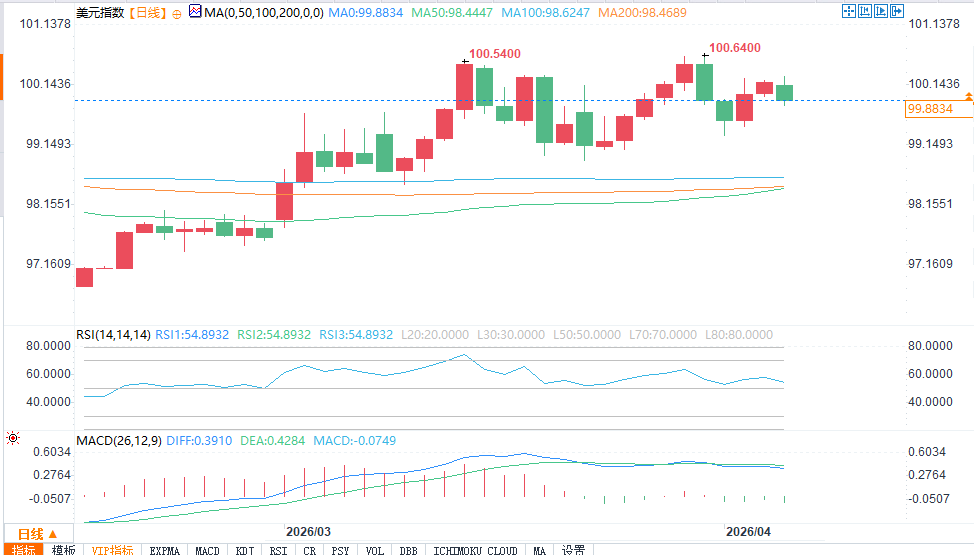
(US Dollar Index Daily Chart Source: FX678)
Moving Averages (MA): The daily MAs are in a bullish alignment (MA50 crosses above MA200 in a golden cross and remains intact). In the short term, MA5 and MA10 are intertwined in the 100.00-100.20 range, and the overall trend is still in a range-bound oscillation.
Oscillators (RSI & MACD): RSI is in the neutral range of 54, with no overbought or oversold signals; MACD histogram is close to the zero axis, suggesting that the short-term direction is unclear and a valid breakout of the 100.30 resistance or 99.70 support is needed to confirm an acceleration of the trend.
Overall technical summary: Driven by geopolitics and oil prices, any breakout in either direction could trigger a 1%-2% acceleration. It is recommended to combine fundamental event-driven catalysts with trading strategies.
Financial History
Key events to watch today (Beijing time/Eastern time):
22:00 (10:00 Eastern Time): US March ISM Services PMI (Forecast 55.4%, Previous 56.1%) and New Orders and Price Indices
This week's key releases include the FOMC meeting minutes, GDP, and CPI, which are expected to significantly amplify volatility.
Frequently Asked Questions
Q1: Why is rising oil prices the core driver of the reshaping of the dollar's path?
A: OCBC Bank explicitly stated that at the beginning of the year, the market expected the US dollar to gradually weaken due to policy uncertainty and an improving global economy. However, the sharp rise in oil prices completely changed this logic. Energy risk premiums boosted safe-haven demand, while strong March employment data reduced expectations of further easing by the Federal Reserve; both factors combined to strengthen the dollar's support. Even if oil prices fall later, the dollar's decline will be limited, as the resilience of the US economy and its safe-haven role will act as a natural buffer.
Q2: Is the escalation of the conflict with Iran and the hope for a ceasefire a positive or negative factor for the US dollar?
A: In the short term, the conflict presents a double-edged sword effect: escalating conflict (including Trump's deadline) will push up oil prices and strengthen the safe-haven appeal of the US dollar (positive); however, if the ceasefire negotiations make substantial progress, a recovery in risk appetite will put pressure on the US dollar. The market is currently in a state of equilibrium, "not quite believing that an agreement can be reached quickly, but still needing to hedge against the worst-case scenario in advance," which is the main reason for today's volatility.
Q3: Why did Trump's ultimatum on Sunday keep the dollar stable instead of surging?
A: Reuters points out that while the deadline itself is unsettling, investors believe that "war may not break out immediately tomorrow," and are more concerned about the negative impact of a prolonged period of chaos on the macroeconomy. The dollar's status as the preferred safe-haven asset is thus reinforced, but hopes for a ceasefire triggered some profit-taking, causing the DXY to decline slightly rather than surge.
Q4: Why did the US employment data in March continue to support the medium-term trend of the US dollar?
A: Strong non-farm payroll data indicates a stabilizing labor market, directly reducing the need for further easing by the Federal Reserve, and is highly consistent with the hawkish interest rate repricing since the US-Iran conflict. Mitsubishi UFJ emphasizes that the high-yield environment (two-year US Treasury yields above 3.8%) further enhances the attractiveness of dollar carry trades, becoming an important fundamental cornerstone for the dollar's medium- to long-term bottom.
Q5: How should ordinary investors deal with US dollar-related instruments today?
A: We suggest using the 100 level as a benchmark, paying attention to the ISM Services PMI data and the latest geopolitical developments. If the data is better than expected and oil prices remain high, consider taking long positions in the US dollar; conversely, if the ceasefire news is stronger than expected, be wary of the risk of a pullback. The key is to strictly control position size, set stop-loss orders, and pay attention to important events such as the FOMC minutes this week to avoid emotional trading.
The US dollar saw a slight decline, mainly supported by rising oil prices and the risk of escalating conflict with Iran. However, the hope for a ceasefire negotiation under Trump's deadline eased risk aversion in the short term, and the market quickly switched between "risk repricing" and "hedging demand".
Fundamental analysis
Oil-driven support for reshaping the dollar's path
OCBC strategists explicitly pointed out that the sharp rise in oil prices has completely overturned the expectation of a gradual weakening of the US dollar at the beginning of the year, re-establishing support for the dollar. Brent crude oil once broke through $110 per barrel, and the energy risk premium boosted the safe-haven appeal of the dollar. The unexpectedly strong US jobs report in March and the stabilization of the labor market further reduced the Fed's room for easing, which is highly consistent with the hawkish interest rate repricing since the US-Iran conflict. If credible signs of easing emerge, the dollar may resume a moderate depreciation, but even if oil prices fall significantly in the second half of 2026, the decline will be limited, as the resilience of the US economy and the safe-haven role of the dollar will provide a strong buffer.
The risk of escalation in Iran strengthens the dollar's power.
Continued geopolitical tensions surrounding Iran remain the dominant factor in market sentiment. A prolonged disruption to energy flows through the Strait of Hormuz would be particularly detrimental to Asian economies, and dollar buying continues amid declining risk appetite. High US Treasury yields (the two-year yield remains above 3.8%), coupled with robust labor data, further solidify the attractiveness of dollar carry trades, suggesting that oil prices are likely to remain high and the risk skewed to the upside.
Trump's deadline exacerbates uncertainty but supports hedging demand.
Trump's social media ultimatum on Sunday (regarding Tuesday's attack on Iranian facilities) unsettled investors. Although some media outlets reported that negotiations for a 45-day ceasefire were underway, the market generally believed that "an agreement is unlikely to be reached quickly, and the risk of escalation still needs to be guarded against." This solidified the dollar's position as the preferred safe-haven asset, while concerns about high inflation and stagflation further disrupted the global interest rate outlook.
Federal Reserve policy expectations and the resilience of the US economy
Strong non-farm payroll data continues to be a positive factor, and the market has no longer priced in a significant interest rate cut in 2026, providing solid support for the dollar's medium-term bottom.
mainstream view
OCBC Bank analysts pointed out that rising oil prices have revised the foreign exchange outlook, and they are optimistic about a stronger US dollar in the short term. Although the DXY may decline slightly over the next year, it will still benefit from the resilience of the US economy and the high interest rate stance.
Mitsubishi UFJ Financial Group emphasized that geopolitical tensions with Iran have strengthened the US dollar, and high yields and declining risk appetite have jointly supported carry trade buying.
Reuters believes the dollar is stable as traders weigh the escalation of the Iran war against Iran against hopes for a ceasefire, while Trump's deadline fuels market concerns about a continued expansion of negative macroeconomic impacts.
Technical Analysis
(US Dollar Index Daily Chart Source: FX678)
Moving Averages (MA): The daily MAs are in a bullish alignment (MA50 crosses above MA200 in a golden cross and remains intact). In the short term, MA5 and MA10 are intertwined in the 100.00-100.20 range, and the overall trend is still in a range-bound oscillation.
Oscillators (RSI & MACD): RSI is in the neutral range of 54, with no overbought or oversold signals; MACD histogram is close to the zero axis, suggesting that the short-term direction is unclear and a valid breakout of the 100.30 resistance or 99.70 support is needed to confirm an acceleration of the trend.
Overall technical summary: Driven by geopolitics and oil prices, any breakout in either direction could trigger a 1%-2% acceleration. It is recommended to combine fundamental event-driven catalysts with trading strategies.
Financial History
Key events to watch today (Beijing time/Eastern time):
22:00 (10:00 Eastern Time): US March ISM Services PMI (Forecast 55.4%, Previous 56.1%) and New Orders and Price Indices
This week's key releases include the FOMC meeting minutes, GDP, and CPI, which are expected to significantly amplify volatility.
Frequently Asked Questions
Q1: Why is rising oil prices the core driver of the reshaping of the dollar's path?
A: OCBC Bank explicitly stated that at the beginning of the year, the market expected the US dollar to gradually weaken due to policy uncertainty and an improving global economy. However, the sharp rise in oil prices completely changed this logic. Energy risk premiums boosted safe-haven demand, while strong March employment data reduced expectations of further easing by the Federal Reserve; both factors combined to strengthen the dollar's support. Even if oil prices fall later, the dollar's decline will be limited, as the resilience of the US economy and its safe-haven role will act as a natural buffer.
Q2: Is the escalation of the conflict with Iran and the hope for a ceasefire a positive or negative factor for the US dollar?
A: In the short term, the conflict presents a double-edged sword effect: escalating conflict (including Trump's deadline) will push up oil prices and strengthen the safe-haven appeal of the US dollar (positive); however, if the ceasefire negotiations make substantial progress, a recovery in risk appetite will put pressure on the US dollar. The market is currently in a state of equilibrium, "not quite believing that an agreement can be reached quickly, but still needing to hedge against the worst-case scenario in advance," which is the main reason for today's volatility.
Q3: Why did Trump's ultimatum on Sunday keep the dollar stable instead of surging?
A: Reuters points out that while the deadline itself is unsettling, investors believe that "war may not break out immediately tomorrow," and are more concerned about the negative impact of a prolonged period of chaos on the macroeconomy. The dollar's status as the preferred safe-haven asset is thus reinforced, but hopes for a ceasefire triggered some profit-taking, causing the DXY to decline slightly rather than surge.
Q4: Why did the US employment data in March continue to support the medium-term trend of the US dollar?
A: Strong non-farm payroll data indicates a stabilizing labor market, directly reducing the need for further easing by the Federal Reserve, and is highly consistent with the hawkish interest rate repricing since the US-Iran conflict. Mitsubishi UFJ emphasizes that the high-yield environment (two-year US Treasury yields above 3.8%) further enhances the attractiveness of dollar carry trades, becoming an important fundamental cornerstone for the dollar's medium- to long-term bottom.
Q5: How should ordinary investors deal with US dollar-related instruments today?
A: We suggest using the 100 level as a benchmark, paying attention to the ISM Services PMI data and the latest geopolitical developments. If the data is better than expected and oil prices remain high, consider taking long positions in the US dollar; conversely, if the ceasefire news is stronger than expected, be wary of the risk of a pullback. The key is to strictly control position size, set stop-loss orders, and pay attention to important events such as the FOMC minutes this week to avoid emotional trading.
- Risk Warning and Disclaimer
- The market involves risk, and trading may not be suitable for all investors. This article is for reference only and does not constitute personal investment advice, nor does it take into account certain users’ specific investment objectives, financial situation, or other needs. Any investment decisions made based on this information are at your own risk.