The USD/CAD pair's movement is attracting attention after a technical breakout.
2026-04-06 22:22:21
On Monday, April 6th, Canadian markets were closed for Easter, while US markets remained open for trading. The USD/CAD exchange rate failed to maintain last week's highs, with selling gradually taking over, pushing the pair to a new intraday low. As US Treasury yields retreated after a slight rise, the 10-year yield fell by about 1.5 basis points, influencing the overall cautious tone of the foreign exchange market. On the fundamental front, Canadian private sector activity contracted for the fifth consecutive month in March, with the composite Purchasing Managers' Index (PMI) recording 47.6, a slight increase from February's 47.1, but still well below the 50-point threshold separating expansion from contraction. These signals, coupled with a technical breakdown, collectively put short-term pressure on the USD/CAD pair.

Canada's composite Purchasing Managers' Index (PMI) came in at 47.6 in March, a slight improvement from 47.1 in February, but still remaining in contraction territory for the fifth consecutive month. The manufacturing index fell to 50.0 from 51.0 in February, just touching the 50-point threshold separating expansion from contraction, indicating that output may stagnate for the first time in 2026. The services index, however, rose to 47.2 from 46.5, remaining the main drag on the overall index. Employment contracted for the seventh consecutive month, albeit at a moderate pace, but companies chose to reduce jobs or not fill vacancies, indicating continued pressure on the labor market.
Compared to February's data, significant changes have occurred on the price front. Input cost inflation accelerated to its highest level since June of last year, while output price inflation also rose to its strongest level since July of last year, reflecting both supply chain pressures and weak demand. Although business confidence rebounded slightly from February, reaching its highest level since September of last year, it remains at a historically low level, indicating that optimism about the outlook is only a marginal recovery.
The following is a comparison of the main sub-data for March and February:
The USD/CAD exchange rate broke below the key 4-hour chart trading range of 1.3925-1.3935, which has acted as support multiple times since September, during the European session. The failure to hold this range clearly shifted the short-term bias towards sellers. The 100-hour moving average near 1.3915 was also breached; this moving average, which had briefly tested and rebounded last week, acted as support, and today's pullback and break below it constitutes a short-term negative technical signal.
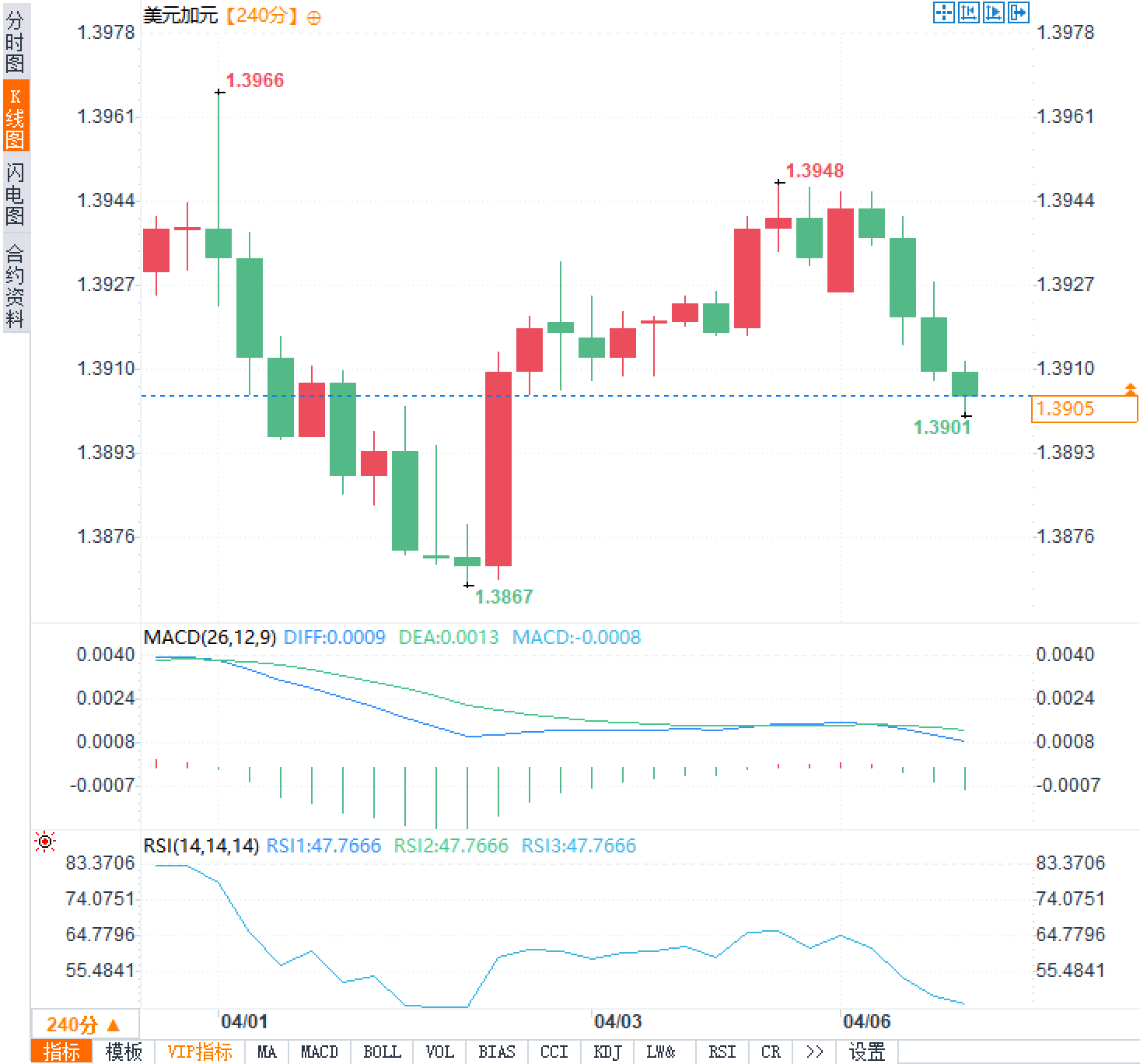
For sellers to further expand their gains, they need to pay attention to the 200-hour moving average around 1.3890. This moving average has played a key role recently: on March 23, the price briefly broke below it but failed to sustain the decline, quickly rebounding; in early March, it even acted as a bottom support level, initiating a rebound. Currently, the exchange rate is at its intraday low, and with the decline in US yields, short-term market caution has further solidified the technical weakness.
Input cost inflation accelerated to its highest level since June of last year, while output price inflation rose to its strongest level since July of last year, indicating that businesses can still partially pass on rising costs, but persistently weak demand limits room for price increases. New business declined for the sixteenth consecutive month, coupled with employment contracting for the seventh consecutive month, reflecting a conservative attitude among businesses towards expansion. Although confidence has improved marginally, it is difficult to immediately translate into actual output growth.
From the Bank of Canada's perspective, continued private sector contraction and employment pressures may reinforce its concern about slowing economic growth. A double acceleration on the price side poses a constraint: rising input costs could push up overall inflation expectations, while output prices following suit indicate that firms still have pricing power, but a full-blown inflation spiral has not yet formed.
In the short term, the USD/CAD pair still faces technical correction pressure, with the 200-hour moving average becoming a key level to watch. Holding above this level could ease selling pressure; conversely, a break below could open up further downside potential. In the medium term, whether the Canadian private sector can escape continuous contraction will depend on a recovery in new orders and employment stability, while price inflation will be a crucial factor in the Bank of Canada's policy decisions. Traders are closely monitoring US data releases and yield curve changes, as these factors will continue to dominate short-term USD/CAD volatility.
Canadian private sector contraction continues – key data perspective
Canada's composite Purchasing Managers' Index (PMI) came in at 47.6 in March, a slight improvement from 47.1 in February, but still remaining in contraction territory for the fifth consecutive month. The manufacturing index fell to 50.0 from 51.0 in February, just touching the 50-point threshold separating expansion from contraction, indicating that output may stagnate for the first time in 2026. The services index, however, rose to 47.2 from 46.5, remaining the main drag on the overall index. Employment contracted for the seventh consecutive month, albeit at a moderate pace, but companies chose to reduce jobs or not fill vacancies, indicating continued pressure on the labor market.
Compared to February's data, significant changes have occurred on the price front. Input cost inflation accelerated to its highest level since June of last year, while output price inflation also rose to its strongest level since July of last year, reflecting both supply chain pressures and weak demand. Although business confidence rebounded slightly from February, reaching its highest level since September of last year, it remains at a historically low level, indicating that optimism about the outlook is only a marginal recovery.
The following is a comparison of the main sub-data for March and February:
| index | March figures | February figures | change |
|---|---|---|---|
| Composite Purchasing Managers' Index | 47.6 | 47.1 | +0.5 |
| Manufacturing Index | 50.0 | 51.0 | -1.0 |
| Service Sector Index | 47.2 | 46.5 | +0.7 |
| Total new business volume | shrink | shrink | 16 consecutive months |
The USD/CAD pair has broken down technically, shifting short-term control to sellers.
The USD/CAD exchange rate broke below the key 4-hour chart trading range of 1.3925-1.3935, which has acted as support multiple times since September, during the European session. The failure to hold this range clearly shifted the short-term bias towards sellers. The 100-hour moving average near 1.3915 was also breached; this moving average, which had briefly tested and rebounded last week, acted as support, and today's pullback and break below it constitutes a short-term negative technical signal.
For sellers to further expand their gains, they need to pay attention to the 200-hour moving average around 1.3890. This moving average has played a key role recently: on March 23, the price briefly broke below it but failed to sustain the decline, quickly rebounding; in early March, it even acted as a bottom support level, initiating a rebound. Currently, the exchange rate is at its intraday low, and with the decline in US yields, short-term market caution has further solidified the technical weakness.
In-depth analysis of the interplay between price pressures and the policy environment.
Input cost inflation accelerated to its highest level since June of last year, while output price inflation rose to its strongest level since July of last year, indicating that businesses can still partially pass on rising costs, but persistently weak demand limits room for price increases. New business declined for the sixteenth consecutive month, coupled with employment contracting for the seventh consecutive month, reflecting a conservative attitude among businesses towards expansion. Although confidence has improved marginally, it is difficult to immediately translate into actual output growth.
From the Bank of Canada's perspective, continued private sector contraction and employment pressures may reinforce its concern about slowing economic growth. A double acceleration on the price side poses a constraint: rising input costs could push up overall inflation expectations, while output prices following suit indicate that firms still have pricing power, but a full-blown inflation spiral has not yet formed.
Market Outlook and Risk Assessment
In the short term, the USD/CAD pair still faces technical correction pressure, with the 200-hour moving average becoming a key level to watch. Holding above this level could ease selling pressure; conversely, a break below could open up further downside potential. In the medium term, whether the Canadian private sector can escape continuous contraction will depend on a recovery in new orders and employment stability, while price inflation will be a crucial factor in the Bank of Canada's policy decisions. Traders are closely monitoring US data releases and yield curve changes, as these factors will continue to dominate short-term USD/CAD volatility.
- Risk Warning and Disclaimer
- The market involves risk, and trading may not be suitable for all investors. This article is for reference only and does not constitute personal investment advice, nor does it take into account certain users’ specific investment objectives, financial situation, or other needs. Any investment decisions made based on this information are at your own risk.