Despite positive non-farm payroll data and escalating geopolitical tensions, the US dollar fell? What is the market trading on?
2026-04-06 21:48:03
As the conflict between the US and Iran continues to escalate, ceasefire negotiations have become a key variable in the market.
According to Axios, citing sources in the United States, Israel, and the region, the United States and Iran are negotiating a 45-day temporary ceasefire agreement with regional mediators, which could help end the conflict.
Both Washington and Tehran have received a two-step plan to end the state of hostilities, which could take effect as early as Monday and reopen the Strait of Hormuz. Iranian Foreign Ministry spokesman Esmail Bagheei stated that Tehran has formulated a diplomatic response to the United States, which will be announced at the appropriate time.
Previously, US President Trump issued an ultimatum, stating that if the Strait of Hormuz failed to reopen by 8 p.m. Eastern Time on Tuesday and no agreement was reached, he would strike Iranian power plants and other civilian infrastructure.
Despite the uncertainty surrounding the final agreement, ongoing diplomatic efforts have significantly eased market panic over escalating conflict, and global risk appetite is gradually recovering.
Gold prices stabilized and rebounded on Monday, supported by improved risk sentiment following the US-Iran ceasefire negotiations and a weaker dollar. Spot gold (XAU/USD) gradually recovered from its intraday low of around $4,600 per ounce, reaching approximately $4,674 per ounce at the time of writing, with initial signs of a rebound.
However, the upside potential for gold is still limited by expectations of Federal Reserve policy.
Last week's stronger-than-expected US non-farm payroll data continued to cool market expectations for a Fed rate cut. Coupled with the easing of geopolitical tensions, the market is increasingly betting that the Fed will maintain high interest rates for a longer period of time, and may even start raising rates.
The US Treasury yield curve remained bearishly flat. During the Tokyo session, US Treasury yields initially rebounded slightly due to hopes of a ceasefire, but then fluctuated downwards. Rising yields limited the attractiveness of non-interest-bearing gold, making it difficult to break out of the range-bound trading pattern in the short term.
Today's dollar movement can be described as "abnormal," exhibiting a clear characteristic of "positive news failing to drive up prices."
From the perspective of supporting factors, the better-than-expected non-farm payroll data last week, the rise in US Treasury yields, and the safe-haven demand under geopolitical risks should have jointly supported the strengthening of the US dollar.
Meanwhile, swap spreads widened slightly at the open on Monday (excluding 2-year swaps), indicating that short-term interest rates and swap rates are more fully pricing in expectations of interest rate cuts, which theoretically further strengthens the support for the US dollar.
However, in reality, the US dollar weakened in the opposite direction. The core logic lies in the market's pricing of Trump's "TACO" (Trump Always Chickens Out) strategy.
Investors generally believe that the United States is unlikely to escalate the conflict with Iran, and the geopolitical risk premium will gradually decline, significantly weakening the demand for the US dollar as a safe haven.
Even with non-farm payroll data and US Treasury yields providing fundamental support, market bets on a "de-escalation of the US-Iran conflict" still dominated the dollar's performance, causing it to continue weakening despite positive factors.
In stark contrast to the weakening dollar, oil prices rebounded throughout the day, and the market generally expects them to remain at high levels for an extended period.
Even if investors bet that the US will ultimately choose "TACO" and the US-Iran conflict will de-escalate, oil prices will be difficult to return to pre-war levels: on the one hand, the Strait of Hormuz, as a core channel for global energy transportation, has become a long-term pricing factor due to its navigation risks, and the potential uncertainty of the Middle East situation will continue to support oil prices;
On the other hand, supply-side constraints such as OPEC+ production cuts and the Russian ban on refined oil exports have not yet been lifted, and coupled with the potential impact of war on regional energy infrastructure, the tight global energy supply situation is unlikely to ease in the short term.
This expectation means that even if the United States avoids escalating the conflict, global inflationary pressures will not ease substantially; on the contrary, they may become "inflation sticky" due to high oil prices.
This combination of "US retreat but high inflation" has a dual impact on gold: a weaker dollar should be beneficial to gold prices, but high interest rates and persistent inflation concerns will push up real yields, thereby continuously suppressing the performance of non-interest-bearing gold.
In the short term, market trends will be mainly constrained by two major variables: first, US economic data and Federal Reserve policy signals. The Consumer Price Index (CPI) and Personal Consumption Expenditures (PCE) price index to be released this week will further clarify the inflation outlook and provide clues for the Fed's monetary policy path. The ISM Services Purchasing Managers' Index (PMI) to be released later on Monday in the Americas will also trigger short-term fluctuations.
Secondly, substantial progress in the US-Iran ceasefire negotiations is crucial. If an agreement is reached, the US dollar may weaken further, and gold is expected to continue its rebound. If the negotiations break down and the conflict escalates, the US dollar's safe-haven status will return, and gold will have to contend with both safe-haven demand and high interest rate pressure.
Regardless of the outcome of the negotiations, the high oil price trend is unlikely to change in the short term. The expectation that global central banks will maintain high interest rates for longer will remain the core obstacle to the rise of gold. Going forward, we need to pay close attention to marginal changes in inflation data and geopolitical dynamics.
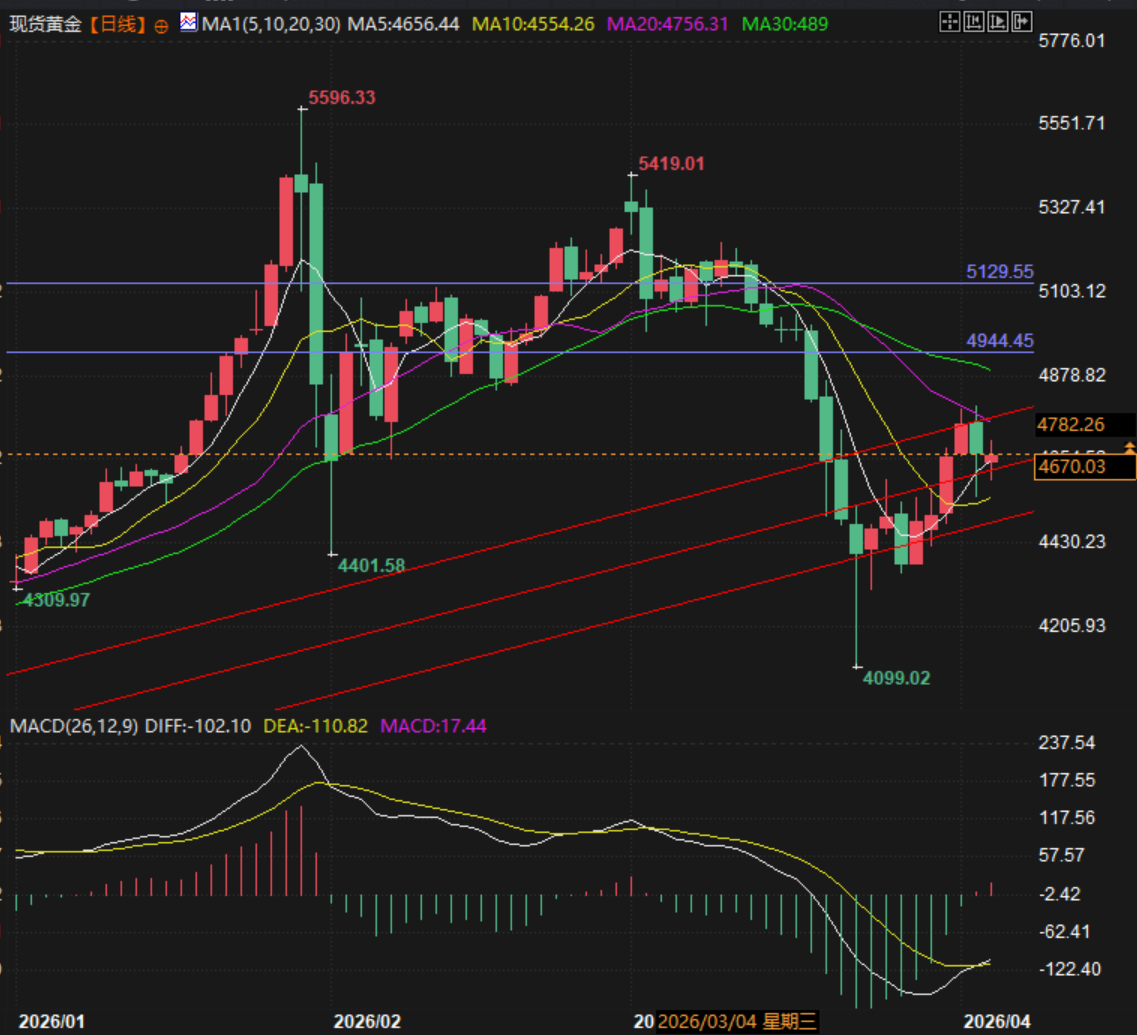
(Spot gold daily chart, source: FX678)
At 21:46 Beijing time, spot gold was trading at $4,671 per ounce.
According to Axios, citing sources in the United States, Israel, and the region, the United States and Iran are negotiating a 45-day temporary ceasefire agreement with regional mediators, which could help end the conflict.
Both Washington and Tehran have received a two-step plan to end the state of hostilities, which could take effect as early as Monday and reopen the Strait of Hormuz. Iranian Foreign Ministry spokesman Esmail Bagheei stated that Tehran has formulated a diplomatic response to the United States, which will be announced at the appropriate time.
Previously, US President Trump issued an ultimatum, stating that if the Strait of Hormuz failed to reopen by 8 p.m. Eastern Time on Tuesday and no agreement was reached, he would strike Iranian power plants and other civilian infrastructure.
Despite the uncertainty surrounding the final agreement, ongoing diplomatic efforts have significantly eased market panic over escalating conflict, and global risk appetite is gradually recovering.
A weaker dollar helped gold stabilize and rebound, but its upside was limited.
Gold prices stabilized and rebounded on Monday, supported by improved risk sentiment following the US-Iran ceasefire negotiations and a weaker dollar. Spot gold (XAU/USD) gradually recovered from its intraday low of around $4,600 per ounce, reaching approximately $4,674 per ounce at the time of writing, with initial signs of a rebound.
However, the upside potential for gold is still limited by expectations of Federal Reserve policy.
Last week's stronger-than-expected US non-farm payroll data continued to cool market expectations for a Fed rate cut. Coupled with the easing of geopolitical tensions, the market is increasingly betting that the Fed will maintain high interest rates for a longer period of time, and may even start raising rates.
The US Treasury yield curve remained bearishly flat. During the Tokyo session, US Treasury yields initially rebounded slightly due to hopes of a ceasefire, but then fluctuated downwards. Rising yields limited the attractiveness of non-interest-bearing gold, making it difficult to break out of the range-bound trading pattern in the short term.
Despite a multitude of positive factors, the US dollar weakened, exhibiting an unusual performance.
Today's dollar movement can be described as "abnormal," exhibiting a clear characteristic of "positive news failing to drive up prices."
From the perspective of supporting factors, the better-than-expected non-farm payroll data last week, the rise in US Treasury yields, and the safe-haven demand under geopolitical risks should have jointly supported the strengthening of the US dollar.
Meanwhile, swap spreads widened slightly at the open on Monday (excluding 2-year swaps), indicating that short-term interest rates and swap rates are more fully pricing in expectations of interest rate cuts, which theoretically further strengthens the support for the US dollar.
However, in reality, the US dollar weakened in the opposite direction. The core logic lies in the market's pricing of Trump's "TACO" (Trump Always Chickens Out) strategy.
Investors generally believe that the United States is unlikely to escalate the conflict with Iran, and the geopolitical risk premium will gradually decline, significantly weakening the demand for the US dollar as a safe haven.
Even with non-farm payroll data and US Treasury yields providing fundamental support, market bets on a "de-escalation of the US-Iran conflict" still dominated the dollar's performance, causing it to continue weakening despite positive factors.
Markets are betting on US "TACO", but oil prices will remain high.
In stark contrast to the weakening dollar, oil prices rebounded throughout the day, and the market generally expects them to remain at high levels for an extended period.
Even if investors bet that the US will ultimately choose "TACO" and the US-Iran conflict will de-escalate, oil prices will be difficult to return to pre-war levels: on the one hand, the Strait of Hormuz, as a core channel for global energy transportation, has become a long-term pricing factor due to its navigation risks, and the potential uncertainty of the Middle East situation will continue to support oil prices;
On the other hand, supply-side constraints such as OPEC+ production cuts and the Russian ban on refined oil exports have not yet been lifted, and coupled with the potential impact of war on regional energy infrastructure, the tight global energy supply situation is unlikely to ease in the short term.
This expectation means that even if the United States avoids escalating the conflict, global inflationary pressures will not ease substantially; on the contrary, they may become "inflation sticky" due to high oil prices.
This combination of "US retreat but high inflation" has a dual impact on gold: a weaker dollar should be beneficial to gold prices, but high interest rates and persistent inflation concerns will push up real yields, thereby continuously suppressing the performance of non-interest-bearing gold.
Short-term focus: Inflation data + negotiation progress, intensifying market competition.
In the short term, market trends will be mainly constrained by two major variables: first, US economic data and Federal Reserve policy signals. The Consumer Price Index (CPI) and Personal Consumption Expenditures (PCE) price index to be released this week will further clarify the inflation outlook and provide clues for the Fed's monetary policy path. The ISM Services Purchasing Managers' Index (PMI) to be released later on Monday in the Americas will also trigger short-term fluctuations.
Secondly, substantial progress in the US-Iran ceasefire negotiations is crucial. If an agreement is reached, the US dollar may weaken further, and gold is expected to continue its rebound. If the negotiations break down and the conflict escalates, the US dollar's safe-haven status will return, and gold will have to contend with both safe-haven demand and high interest rate pressure.
Regardless of the outcome of the negotiations, the high oil price trend is unlikely to change in the short term. The expectation that global central banks will maintain high interest rates for longer will remain the core obstacle to the rise of gold. Going forward, we need to pay close attention to marginal changes in inflation data and geopolitical dynamics.
(Spot gold daily chart, source: FX678)
At 21:46 Beijing time, spot gold was trading at $4,671 per ounce.
- Risk Warning and Disclaimer
- The market involves risk, and trading may not be suitable for all investors. This article is for reference only and does not constitute personal investment advice, nor does it take into account certain users’ specific investment objectives, financial situation, or other needs. Any investment decisions made based on this information are at your own risk.