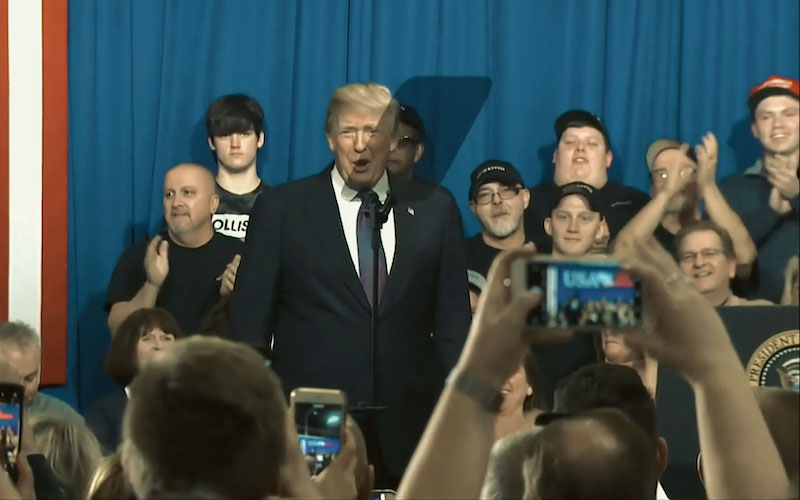
April 7th Financial Breakfast: Iran's "Ten-Point Plan" vs. Trump's Ultimatum; Gold Prices Await Holiday Resumption at $4660; Crude Oil Bulls Pose for Opportunity.
2026-04-07 07:25:21
On Tuesday (April 7, Beijing time) in early Asian trading, spot gold was trading around $4,660 per ounce. Gold prices fell slightly on Monday, despite Trump's renewed threat that Iran would "taste hell" if no agreement was reached by Tuesday. However, Iran sought a lasting ceasefire and resisted pressure for a temporary ceasefire. Meanwhile, Iran released a ten-point peace roadmap, offering to lift the blockade in exchange for a ceasefire. US crude oil was trading around $112.76 per barrel. Oil prices rose in volatile trading on Monday, with the market focused on the return from the holiday, the delayed non-farm payroll data from last Friday, and the latest developments in the Iranian situation. Trump claimed he could destroy Iranian bridges and power plants in four hours.

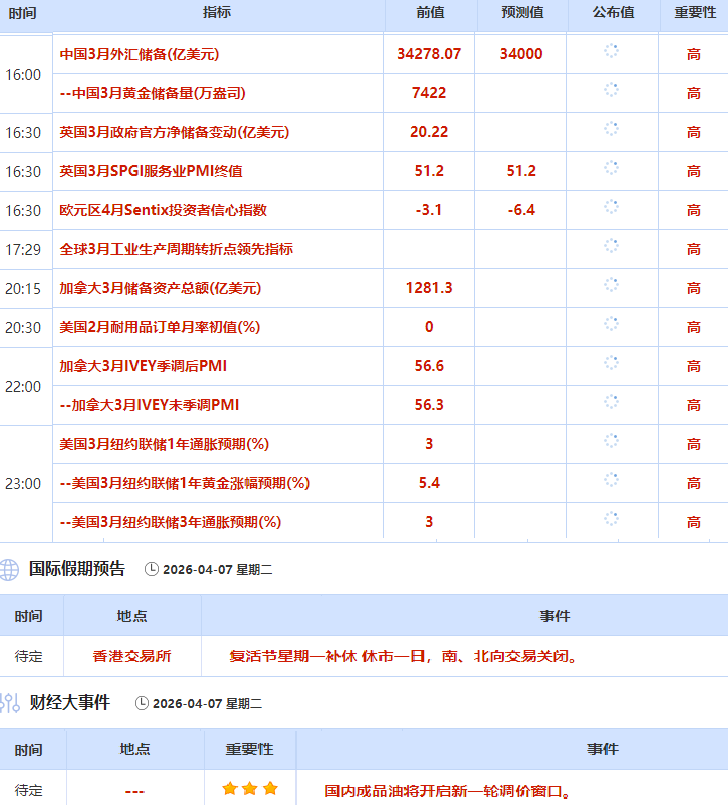
U.S. stocks closed higher on Monday, with the Dow Jones Industrial Average up 0.36%, the S&P 500 up 0.45%, and the Nasdaq Composite up 0.54%. Among the three major indexes, the S&P 500 and Nasdaq Composite closed higher for the fourth consecutive trading day, their longest winning streak since January.
Investors are assessing the progress of the US-Iran ceasefire negotiations while weighing Trump's threats to escalate attacks if Iran does not reopen the Strait of Hormuz.
According to the Iranian news agency, Iran rejected the US proposal for an immediate ceasefire and insisted on a permanent end to the war, but the parties involved are still negotiating potential ceasefire terms, which has brought some comfort to the market.
On the economic data front, US job growth in March far exceeded expectations (178,000 new jobs added and the unemployment rate declined), but the ISM non-manufacturing PMI showed a slowdown in the expansion of the service sector and input prices hit a three-and-a-half-year high.
Markets are focused on the upcoming earnings season, with optimism suggesting that corporate results will support the bull market. Despite recent geopolitical conflicts causing stock market volatility, the S&P 500 has fallen 3.9% since the conflicts began.
Gold prices edged lower on Monday, with spot gold down 0.4% to $4,654.99 an ounce, as investors closely watched the latest developments in the US-Iran situation and awaited further signals regarding the deadline for reopening the Strait of Hormuz.
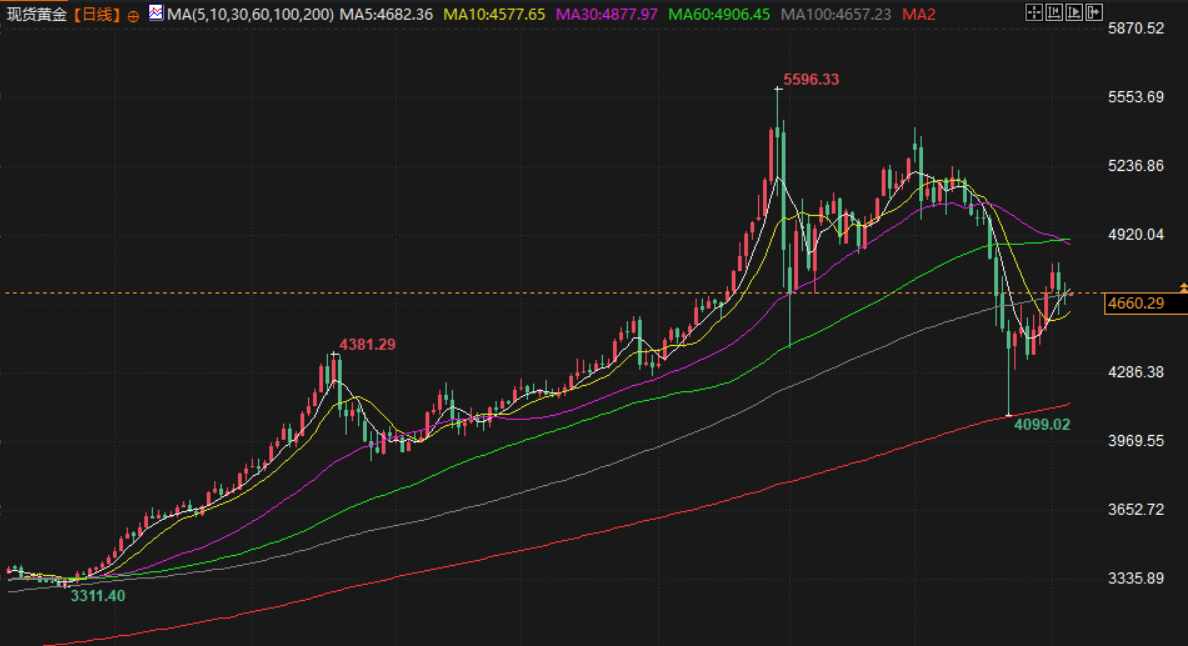
US President Trump threatened to make Iran "taste hell" if no agreement is reached by Tuesday, but Iran is seeking a lasting ceasefire and resisting pressure for a temporary ceasefire. TD Securities analysts pointed out that if the conflict continues, rising oil prices will exacerbate inflationary pressures, potentially limiting the Federal Reserve's room for policy easing and even reigniting discussions about interest rate hikes, which would be bearish for gold.
Investors are also focused on the release of the minutes from the Federal Reserve's March policy meeting on Wednesday, US personal consumption expenditure data on Thursday, and the Consumer Price Index on Friday. Currently, the CME Group's FedWatch tool shows that most traders believe there is no chance of a Fed rate cut this year.
In other precious metals, spot silver fell 0.3% to $72.81 per ounce, platinum fell 0.6% to $1,976.21, and palladium fell 1.1% to $1,487.22.
Oil prices rose in volatile trading on Monday, with Brent crude futures closing up 0.68% at $109.77 a barrel and WTI crude futures closing up 0.78% at $112.40 a barrel, despite indirect negotiations between the US and Iran, as rhetoric between the two sides continued to escalate.
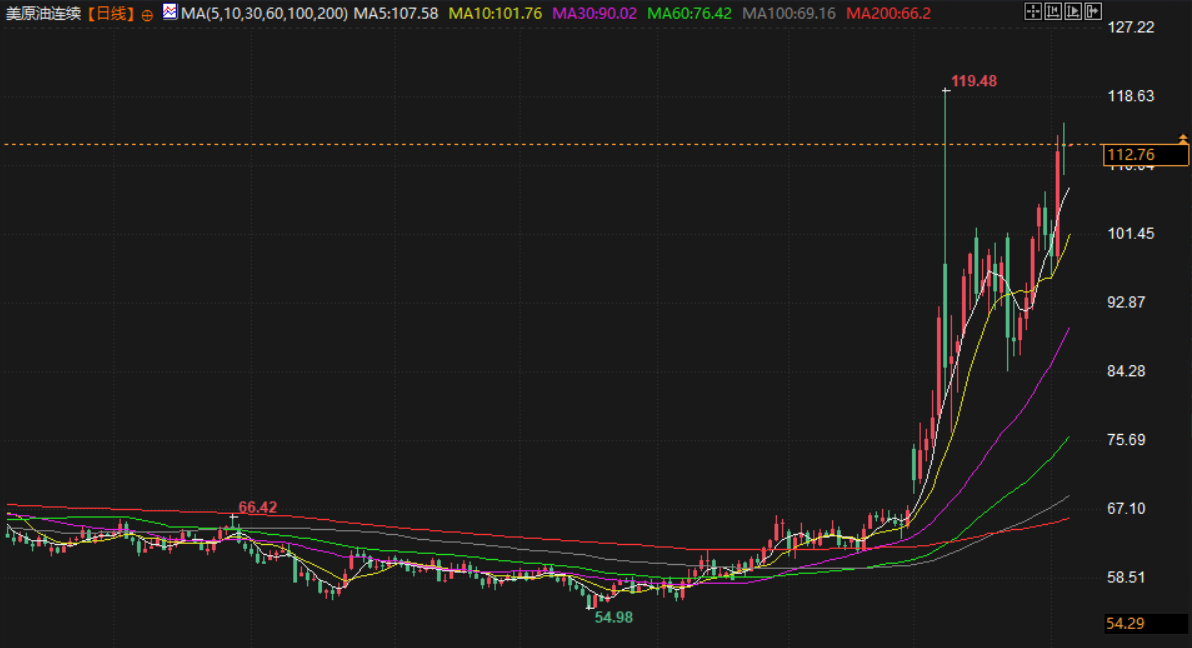
The closure of the Strait of Hormuz has disrupted about one-fifth of the world's oil supply, prompting major consuming countries to seek stockpiling or reduce consumption. The United States and Iran have received a framework proposal from Pakistan, but Iran has refused to immediately reopen the strait, while Trump has threatened to send Tehran "to hell" if no agreement is reached by Tuesday.
Analysts pointed out that the passage of some ships through the Strait over the weekend has become a focus of market attention. Last Thursday, WTI and Brent crude surged 11% and 8% respectively, marking their largest single-day gains since 2020. On the supply side, OPEC+ agreed to a slight increase in production of 206,000 barrels per day in May, and Saudi Aramco raised its official selling price for Arab Light crude to Asia in May to a record $19.50 per barrel above the Oman/Dubai average. Furthermore, the drone attack in Ukraine, which temporarily halted operations at Russia's Ust-Luga export terminal, resumed loading on Saturday.
The dollar index held steady on Monday as traders weighed escalating tensions with hopes for a ceasefire ahead of Trump's latest deadline for reopening the Strait of Hormuz. Trump threatened in a Easter Sunday tweet to strike Iranian power plants and bridges if the strait was not reopened, but media reports indicated negotiators were making a final push, and investors were assessing the possibility of a ceasefire.
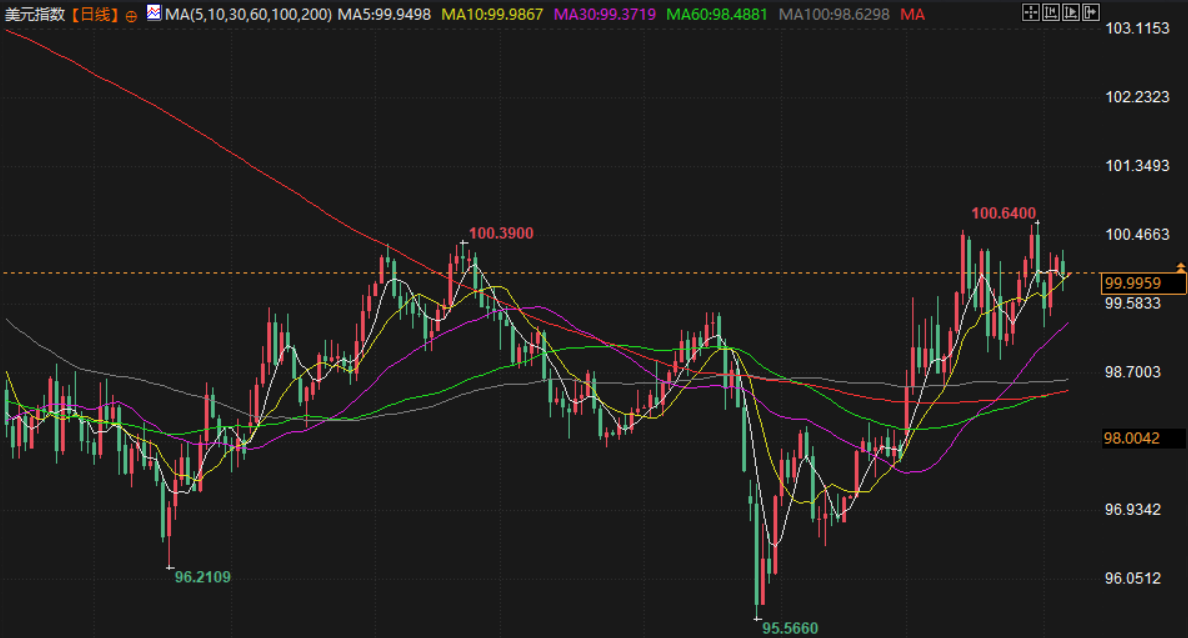
The dollar index closed at 100, the euro at $1.1542, and the pound at $1.324. The yen fell to 159.71 against the dollar, nearing the 160 level and a 21-month low; strong warnings from Japanese officials were followed by geopolitical turmoil supporting demand for the safe-haven dollar, with the market skeptical of substantive intervention. Speculative short positions in the yen reached $5.7 billion, the highest since July 2024. The potential blockade of the Strait of Hormuz exacerbated stagflation concerns, with traders now expecting the Federal Reserve to cut rates only in the second half of 2027, compared to initial market expectations of two rate cuts in 2026. The Australian dollar rose 0.49% to US$0.692, still hovering near a two-month low.
Iran unveils a ten-point peace roadmap, offering to lift the blockade in exchange for a ceasefire.
Iran submitted a ten-point proposal on Monday, aimed at ending its conflict with the US and Israel, according to Iranian state media. The proposal, conveyed by Pakistan, the main mediator, appears unlikely to resolve core differences before the deadline for Trump's Tuesday evening strikes against Iran. Senior Iranian officials stated that the proposal includes guarantees that Iran will not be attacked again, an end to Israel's attacks on Hezbollah in Lebanon, and the complete lifting of sanctions. In exchange, Iran would lift its de facto blockade of the Strait of Hormuz and charge approximately $2 million per passing vessel, to be shared with Oman on the other side of the strait. Iran would use its share to rebuild damaged infrastructure, rather than demanding direct compensation. Iranian state media stated that the proposal text "rejects a ceasefire," emphasizing "the necessity of a permanent end to the war according to Iran's demands." The media also stated that Iran has "demonstrated its superior position in the war." Following the blockade of the Strait of Hormuz and the downing of a US F-15E fighter jet, Iranian leaders reportedly gained increased confidence. While official media outlets have not released the full text of the proposal, they have indicated that it includes a safe passage agreement through the Strait of Hormuz, as well as Iran's demands for the lifting of sanctions, the rebuilding of infrastructure, and an end to regional hostilities. Previously, the United States submitted a 15-point ceasefire proposal through Pakistan on March 24, which was rejected by Iran. Iran subsequently submitted a counter-proposal, some of which was reiterated in Monday's draft.
Trump claims Iran's bridge and power plant destroyed in 4 hours
On the afternoon of April 6 local time (early morning of April 7 Beijing time), US President Trump stated at a White House press conference that the US military "has actually developed a plan that, once activated, within four hours from 8 p.m. to midnight on April 7 Eastern Time, every bridge in Iran will be completely destroyed, every power plant in Iran will be completely paralyzed, engulfed in flames, exploded, and rendered unusable forever. Everything will be reduced to rubble, and the entire process will only take four hours." (CCTV International News)
Trump proposes seizing oil and Straits transit fees: "The spoils belong to the victors."
US President Donald Trump proposed at a press conference on Monday that the United States could charge fees to ships transiting the Strait of Hormuz. When asked about Iran's plans to charge tolls, Trump responded, "Why don't we? We're the winners. We won. Okay? They've been militarily defeated." Trump also spoke of taking over Iranian oil once the conflict is resolved, referring to himself as a businessman. He said, "The spoils belong to the victors."
Trump said the war with Iran depends on Iran's response to the "deadline".
At a White House press conference on June 6, US President Trump stated that whether the war against Iran is about to escalate or is nearing its end depends on Iran's response to his "deadline" of 8 PM Eastern Time on June 7. Trump said, "This is a critical period," adding, "Their deadline is tomorrow. Now, we'll wait and see how things develop." He also stated that Iran is conducting negotiations, "and we believe they are talking in good faith." Trump further threatened Iran, saying, "The whole country could be destroyed overnight, and that night could be tomorrow night."
The United States dropped 100 heavy bombs during the rescue operation.
According to U.S. officials, a U.S. B-1 bomber dropped approximately 100 bombs, each weighing 2,000 pounds, during a mission to rescue the second crew member of an F-15E fighter jet shot down in Iran. One official stated that to ensure mission success, the bombs were dropped on roads, personnel, and Iranian Revolutionary Guard positions. The U.S. military focused on destroying roads near the rescue site to prevent Iranian forces from approaching U.S. troops and aircraft.
Trump says Iran will lose everything if it doesn't back down.
On April 6, US President Trump, speaking to the media at the White House, addressed Iran, stating that Tuesday (April 7) was the final deadline, "unchangeable." Trump reiterated that "Iran cannot have nuclear weapons," citing his withdrawal from the Iran nuclear deal during his first term and the assassination of Qassem Soleimani, then commander of the Quds Force of the Iranian Islamic Revolutionary Guard Corps, as "preventing Israel from being wiped off the map." Trump insisted that he had achieved "regime change" in Iran, claiming that the current Iranian leadership negotiating with the US is "more reasonable." However, he added, "They (Iran) just won't back down, but they will eventually give in—if they don't, they will have nothing." Trump also stated that if he had a choice, he would "take (Iran's) oil" because "oil is readily available, and they (Iran) can't do anything about it." Trump stated, "Unfortunately, the American people want us home—if it were up to me, I would take the oil, I would keep the oil for myself, I would make a lot of money." When asked by a reporter why the fighting continues despite repeated claims by the US that Iranian military capabilities have been destroyed, Trump replied, "They (Iran) still have some missiles, some drones. They were lucky to shoot down one (US) plane." (CCTV International News)
US Vice President Vance is ready to participate in Iran negotiations.
Currently, US Vice President Vance is on standby. If the ongoing, clandestine negotiations progress to the point requiring direct meetings with Iranian officials, he will immediately join these highly sensitive US-Iran talks. According to sources, the negotiations are currently being led by Presidential Envoy Steve Vitkov and President's son-in-law Jared Kushner. If these two make significant progress, Vance will be added to the negotiating team. It is unclear what concessions Iran might make. Trump hinted at this personnel arrangement on Monday, indicating that Vance has clearly defined his role in this conflict. He is gradually becoming a key figure as the White House explores ways to end the conflict.
The Iranian military says it will continue fighting as long as the political leadership deems it "appropriate".
According to a report by the Iranian Students' News Agency on the 6th, an Iranian military spokesperson said that as long as the political leadership deems it "appropriate," "we can continue this war." The spokesperson added that after this war, Iran's deterrent power will reach a level that "makes the enemy afraid to launch any further attacks." (Xinhua)
South Korea's national debt increased by nearly 600 billion yuan last year, reaching half of its GDP.
South Korea's national debt increased by nearly 130 trillion won (approximately 594.61 billion yuan) last year, exceeding 1,300 trillion won and rising to nearly 50% of its GDP. The South Korean government approved the "2025 Fiscal Year National Accounts Report" at a cabinet meeting on the 6th. The report shows that the national debt (central and local government combined) last year was 1,304.5 trillion won, an increase of 129.4 trillion won from the previous year's final accounts (1,175 trillion won), and also 2.6 trillion won higher than the budget forecast (1,301.9 trillion won). The Ministry of Finance and Economy stated that domestic demand in 2025 will weaken due to the martial law situation, coupled with drastic changes in the trade environment caused by the United States. With these internal and external shocks combined, the government strengthened the role of fiscal policy through two supplementary budgets.
The Bank of France liquidated its gold reserves in the US and reinvested in Europe, reaping a profit of €12.8 billion.
According to recent French media reports, between July 2025 and January 2026, the Bank of France gained €12.8 billion in capital gains by selling the last batch of 129 tons of gold stored in the United States and purchasing an equivalent amount in Europe. Currently, all of France's gold reserves have been repatriated to Paris. Since 2005, the Bank of France has been gradually replacing older, non-standard gold bars with those conforming to modern international standards. This time, instead of refining and transporting the gold held in the US, the bank sold it directly, profiting handsomely from 26 transactions while gold prices were high. Bank of France Governor Villeroy insisted that the decision to move French gold out of the US was not politically motivated. He stated that it was mainly because the European market trades in higher-standard gold, and purchasing new gold was more convenient than refining existing inventory.
The explosive growth of AI computing power has propelled a surge of companies entering the liquid cooling sector.
This year, the demand for AI computing power has exploded, opening up new growth opportunities for related industrial chains. Higher computing power requirements place greater demands on the heat dissipation capabilities of numerous chips in data centers, making the liquid cooling industry a "hot track" for companies to enter. A reporter's visit to upstream and downstream companies in the liquid cooling industry chain revealed that many manufacturers are operating at full capacity and continuously expanding their production capacity due to surging demand. The head of a coolant manufacturer told the reporter that immersion coolant technology was long monopolized by foreign companies. Currently, their independently developed high-performance coolant for big data centers has achieved mass production, priced at only a quarter of imported products, and is favored by downstream customers. Currently, my country's liquid cooling industry chain is self-reliant and controllable, possessing cost advantages and faster delivery speeds. Furthermore, my country boasts the world's largest internet application market and abundant AI application scenarios, allowing its liquid cooling technology research and development to accumulate rich experience in ultra-large-scale cluster deployments. (CCTV Finance)
my country has made a major breakthrough in sodium-ion batteries.
A team led by Hu Yongsheng at the Institute of Physics, Chinese Academy of Sciences, published a groundbreaking achievement in *Nature Energy*: They have successfully developed a self-protective polymerizable non-flammable electrolyte (PNE), achieving, for the first time globally, complete prevention of thermal runaway in ampere-hour-level sodium-ion batteries. Breaking away from the traditional notion that "flame-retardant electrolyte equals safety," the team has constructed a three-pronged intelligent safety protection system encompassing thermal stability, interface stability, and physical isolation. When the battery temperature abnormally rises above 150°C, the PNE automatically solidifies from a liquid state into a dense barrier, acting like an "intelligent firewall" inside the battery, completely cutting off the propagation path of thermal runaway. Notably, this breakthrough did not sacrifice the battery's high performance. The battery boasts excellent wide-temperature performance (-40°C to 60°C) and high-voltage stability (>4.3V), and all materials are mature industrial products, giving it a significant competitive advantage in industrialization. This achievement refreshes our understanding of battery safety and lays a solid foundation for the commercialization of sodium-ion batteries in electric vehicles, heavy trucks, and large-scale energy storage. (Xinhua News Agency)
Key Focus Today
stock market
U.S. stocks closed higher on Monday, with the Dow Jones Industrial Average up 0.36%, the S&P 500 up 0.45%, and the Nasdaq Composite up 0.54%. Among the three major indexes, the S&P 500 and Nasdaq Composite closed higher for the fourth consecutive trading day, their longest winning streak since January.
Investors are assessing the progress of the US-Iran ceasefire negotiations while weighing Trump's threats to escalate attacks if Iran does not reopen the Strait of Hormuz.
According to the Iranian news agency, Iran rejected the US proposal for an immediate ceasefire and insisted on a permanent end to the war, but the parties involved are still negotiating potential ceasefire terms, which has brought some comfort to the market.
On the economic data front, US job growth in March far exceeded expectations (178,000 new jobs added and the unemployment rate declined), but the ISM non-manufacturing PMI showed a slowdown in the expansion of the service sector and input prices hit a three-and-a-half-year high.
Markets are focused on the upcoming earnings season, with optimism suggesting that corporate results will support the bull market. Despite recent geopolitical conflicts causing stock market volatility, the S&P 500 has fallen 3.9% since the conflicts began.
Gold Market
Gold prices edged lower on Monday, with spot gold down 0.4% to $4,654.99 an ounce, as investors closely watched the latest developments in the US-Iran situation and awaited further signals regarding the deadline for reopening the Strait of Hormuz.
US President Trump threatened to make Iran "taste hell" if no agreement is reached by Tuesday, but Iran is seeking a lasting ceasefire and resisting pressure for a temporary ceasefire. TD Securities analysts pointed out that if the conflict continues, rising oil prices will exacerbate inflationary pressures, potentially limiting the Federal Reserve's room for policy easing and even reigniting discussions about interest rate hikes, which would be bearish for gold.
Investors are also focused on the release of the minutes from the Federal Reserve's March policy meeting on Wednesday, US personal consumption expenditure data on Thursday, and the Consumer Price Index on Friday. Currently, the CME Group's FedWatch tool shows that most traders believe there is no chance of a Fed rate cut this year.
In other precious metals, spot silver fell 0.3% to $72.81 per ounce, platinum fell 0.6% to $1,976.21, and palladium fell 1.1% to $1,487.22.
oil market
Oil prices rose in volatile trading on Monday, with Brent crude futures closing up 0.68% at $109.77 a barrel and WTI crude futures closing up 0.78% at $112.40 a barrel, despite indirect negotiations between the US and Iran, as rhetoric between the two sides continued to escalate.
The closure of the Strait of Hormuz has disrupted about one-fifth of the world's oil supply, prompting major consuming countries to seek stockpiling or reduce consumption. The United States and Iran have received a framework proposal from Pakistan, but Iran has refused to immediately reopen the strait, while Trump has threatened to send Tehran "to hell" if no agreement is reached by Tuesday.
Analysts pointed out that the passage of some ships through the Strait over the weekend has become a focus of market attention. Last Thursday, WTI and Brent crude surged 11% and 8% respectively, marking their largest single-day gains since 2020. On the supply side, OPEC+ agreed to a slight increase in production of 206,000 barrels per day in May, and Saudi Aramco raised its official selling price for Arab Light crude to Asia in May to a record $19.50 per barrel above the Oman/Dubai average. Furthermore, the drone attack in Ukraine, which temporarily halted operations at Russia's Ust-Luga export terminal, resumed loading on Saturday.
Foreign exchange market
The dollar index held steady on Monday as traders weighed escalating tensions with hopes for a ceasefire ahead of Trump's latest deadline for reopening the Strait of Hormuz. Trump threatened in a Easter Sunday tweet to strike Iranian power plants and bridges if the strait was not reopened, but media reports indicated negotiators were making a final push, and investors were assessing the possibility of a ceasefire.
The dollar index closed at 100, the euro at $1.1542, and the pound at $1.324. The yen fell to 159.71 against the dollar, nearing the 160 level and a 21-month low; strong warnings from Japanese officials were followed by geopolitical turmoil supporting demand for the safe-haven dollar, with the market skeptical of substantive intervention. Speculative short positions in the yen reached $5.7 billion, the highest since July 2024. The potential blockade of the Strait of Hormuz exacerbated stagflation concerns, with traders now expecting the Federal Reserve to cut rates only in the second half of 2027, compared to initial market expectations of two rate cuts in 2026. The Australian dollar rose 0.49% to US$0.692, still hovering near a two-month low.
International News
Iran unveils a ten-point peace roadmap, offering to lift the blockade in exchange for a ceasefire.
Iran submitted a ten-point proposal on Monday, aimed at ending its conflict with the US and Israel, according to Iranian state media. The proposal, conveyed by Pakistan, the main mediator, appears unlikely to resolve core differences before the deadline for Trump's Tuesday evening strikes against Iran. Senior Iranian officials stated that the proposal includes guarantees that Iran will not be attacked again, an end to Israel's attacks on Hezbollah in Lebanon, and the complete lifting of sanctions. In exchange, Iran would lift its de facto blockade of the Strait of Hormuz and charge approximately $2 million per passing vessel, to be shared with Oman on the other side of the strait. Iran would use its share to rebuild damaged infrastructure, rather than demanding direct compensation. Iranian state media stated that the proposal text "rejects a ceasefire," emphasizing "the necessity of a permanent end to the war according to Iran's demands." The media also stated that Iran has "demonstrated its superior position in the war." Following the blockade of the Strait of Hormuz and the downing of a US F-15E fighter jet, Iranian leaders reportedly gained increased confidence. While official media outlets have not released the full text of the proposal, they have indicated that it includes a safe passage agreement through the Strait of Hormuz, as well as Iran's demands for the lifting of sanctions, the rebuilding of infrastructure, and an end to regional hostilities. Previously, the United States submitted a 15-point ceasefire proposal through Pakistan on March 24, which was rejected by Iran. Iran subsequently submitted a counter-proposal, some of which was reiterated in Monday's draft.
Trump claims Iran's bridge and power plant destroyed in 4 hours
On the afternoon of April 6 local time (early morning of April 7 Beijing time), US President Trump stated at a White House press conference that the US military "has actually developed a plan that, once activated, within four hours from 8 p.m. to midnight on April 7 Eastern Time, every bridge in Iran will be completely destroyed, every power plant in Iran will be completely paralyzed, engulfed in flames, exploded, and rendered unusable forever. Everything will be reduced to rubble, and the entire process will only take four hours." (CCTV International News)
Trump proposes seizing oil and Straits transit fees: "The spoils belong to the victors."
US President Donald Trump proposed at a press conference on Monday that the United States could charge fees to ships transiting the Strait of Hormuz. When asked about Iran's plans to charge tolls, Trump responded, "Why don't we? We're the winners. We won. Okay? They've been militarily defeated." Trump also spoke of taking over Iranian oil once the conflict is resolved, referring to himself as a businessman. He said, "The spoils belong to the victors."
Trump said the war with Iran depends on Iran's response to the "deadline".
At a White House press conference on June 6, US President Trump stated that whether the war against Iran is about to escalate or is nearing its end depends on Iran's response to his "deadline" of 8 PM Eastern Time on June 7. Trump said, "This is a critical period," adding, "Their deadline is tomorrow. Now, we'll wait and see how things develop." He also stated that Iran is conducting negotiations, "and we believe they are talking in good faith." Trump further threatened Iran, saying, "The whole country could be destroyed overnight, and that night could be tomorrow night."
The United States dropped 100 heavy bombs during the rescue operation.
According to U.S. officials, a U.S. B-1 bomber dropped approximately 100 bombs, each weighing 2,000 pounds, during a mission to rescue the second crew member of an F-15E fighter jet shot down in Iran. One official stated that to ensure mission success, the bombs were dropped on roads, personnel, and Iranian Revolutionary Guard positions. The U.S. military focused on destroying roads near the rescue site to prevent Iranian forces from approaching U.S. troops and aircraft.
Trump says Iran will lose everything if it doesn't back down.
On April 6, US President Trump, speaking to the media at the White House, addressed Iran, stating that Tuesday (April 7) was the final deadline, "unchangeable." Trump reiterated that "Iran cannot have nuclear weapons," citing his withdrawal from the Iran nuclear deal during his first term and the assassination of Qassem Soleimani, then commander of the Quds Force of the Iranian Islamic Revolutionary Guard Corps, as "preventing Israel from being wiped off the map." Trump insisted that he had achieved "regime change" in Iran, claiming that the current Iranian leadership negotiating with the US is "more reasonable." However, he added, "They (Iran) just won't back down, but they will eventually give in—if they don't, they will have nothing." Trump also stated that if he had a choice, he would "take (Iran's) oil" because "oil is readily available, and they (Iran) can't do anything about it." Trump stated, "Unfortunately, the American people want us home—if it were up to me, I would take the oil, I would keep the oil for myself, I would make a lot of money." When asked by a reporter why the fighting continues despite repeated claims by the US that Iranian military capabilities have been destroyed, Trump replied, "They (Iran) still have some missiles, some drones. They were lucky to shoot down one (US) plane." (CCTV International News)
US Vice President Vance is ready to participate in Iran negotiations.
Currently, US Vice President Vance is on standby. If the ongoing, clandestine negotiations progress to the point requiring direct meetings with Iranian officials, he will immediately join these highly sensitive US-Iran talks. According to sources, the negotiations are currently being led by Presidential Envoy Steve Vitkov and President's son-in-law Jared Kushner. If these two make significant progress, Vance will be added to the negotiating team. It is unclear what concessions Iran might make. Trump hinted at this personnel arrangement on Monday, indicating that Vance has clearly defined his role in this conflict. He is gradually becoming a key figure as the White House explores ways to end the conflict.
The Iranian military says it will continue fighting as long as the political leadership deems it "appropriate".
According to a report by the Iranian Students' News Agency on the 6th, an Iranian military spokesperson said that as long as the political leadership deems it "appropriate," "we can continue this war." The spokesperson added that after this war, Iran's deterrent power will reach a level that "makes the enemy afraid to launch any further attacks." (Xinhua)
South Korea's national debt increased by nearly 600 billion yuan last year, reaching half of its GDP.
South Korea's national debt increased by nearly 130 trillion won (approximately 594.61 billion yuan) last year, exceeding 1,300 trillion won and rising to nearly 50% of its GDP. The South Korean government approved the "2025 Fiscal Year National Accounts Report" at a cabinet meeting on the 6th. The report shows that the national debt (central and local government combined) last year was 1,304.5 trillion won, an increase of 129.4 trillion won from the previous year's final accounts (1,175 trillion won), and also 2.6 trillion won higher than the budget forecast (1,301.9 trillion won). The Ministry of Finance and Economy stated that domestic demand in 2025 will weaken due to the martial law situation, coupled with drastic changes in the trade environment caused by the United States. With these internal and external shocks combined, the government strengthened the role of fiscal policy through two supplementary budgets.
The Bank of France liquidated its gold reserves in the US and reinvested in Europe, reaping a profit of €12.8 billion.
According to recent French media reports, between July 2025 and January 2026, the Bank of France gained €12.8 billion in capital gains by selling the last batch of 129 tons of gold stored in the United States and purchasing an equivalent amount in Europe. Currently, all of France's gold reserves have been repatriated to Paris. Since 2005, the Bank of France has been gradually replacing older, non-standard gold bars with those conforming to modern international standards. This time, instead of refining and transporting the gold held in the US, the bank sold it directly, profiting handsomely from 26 transactions while gold prices were high. Bank of France Governor Villeroy insisted that the decision to move French gold out of the US was not politically motivated. He stated that it was mainly because the European market trades in higher-standard gold, and purchasing new gold was more convenient than refining existing inventory.
Domestic News
The explosive growth of AI computing power has propelled a surge of companies entering the liquid cooling sector.
This year, the demand for AI computing power has exploded, opening up new growth opportunities for related industrial chains. Higher computing power requirements place greater demands on the heat dissipation capabilities of numerous chips in data centers, making the liquid cooling industry a "hot track" for companies to enter. A reporter's visit to upstream and downstream companies in the liquid cooling industry chain revealed that many manufacturers are operating at full capacity and continuously expanding their production capacity due to surging demand. The head of a coolant manufacturer told the reporter that immersion coolant technology was long monopolized by foreign companies. Currently, their independently developed high-performance coolant for big data centers has achieved mass production, priced at only a quarter of imported products, and is favored by downstream customers. Currently, my country's liquid cooling industry chain is self-reliant and controllable, possessing cost advantages and faster delivery speeds. Furthermore, my country boasts the world's largest internet application market and abundant AI application scenarios, allowing its liquid cooling technology research and development to accumulate rich experience in ultra-large-scale cluster deployments. (CCTV Finance)
my country has made a major breakthrough in sodium-ion batteries.
A team led by Hu Yongsheng at the Institute of Physics, Chinese Academy of Sciences, published a groundbreaking achievement in *Nature Energy*: They have successfully developed a self-protective polymerizable non-flammable electrolyte (PNE), achieving, for the first time globally, complete prevention of thermal runaway in ampere-hour-level sodium-ion batteries. Breaking away from the traditional notion that "flame-retardant electrolyte equals safety," the team has constructed a three-pronged intelligent safety protection system encompassing thermal stability, interface stability, and physical isolation. When the battery temperature abnormally rises above 150°C, the PNE automatically solidifies from a liquid state into a dense barrier, acting like an "intelligent firewall" inside the battery, completely cutting off the propagation path of thermal runaway. Notably, this breakthrough did not sacrifice the battery's high performance. The battery boasts excellent wide-temperature performance (-40°C to 60°C) and high-voltage stability (>4.3V), and all materials are mature industrial products, giving it a significant competitive advantage in industrialization. This achievement refreshes our understanding of battery safety and lays a solid foundation for the commercialization of sodium-ion batteries in electric vehicles, heavy trucks, and large-scale energy storage. (Xinhua News Agency)
- Risk Warning and Disclaimer
- The market involves risk, and trading may not be suitable for all investors. This article is for reference only and does not constitute personal investment advice, nor does it take into account certain users’ specific investment objectives, financial situation, or other needs. Any investment decisions made based on this information are at your own risk.