













Weakening geopolitical support coupled with a strong dollar led to continued gold price correction; a range-bound trading strategy is recommended.
2026-04-07 09:58:16
On Tuesday during Asian trading hours, spot gold retreated to around $4,620 , a significant pullback from its previous high, exhibiting an overall consolidation pattern after an initial surge. From a market structure perspective, gold is currently navigating a complex interplay of multiple factors, but short-term bearish signals are gradually strengthening.

From a fundamental perspective, the situation in the Middle East remains centered around the Strait of Hormuz. US President Donald Trump's earlier deadline and tough stance initially boosted risk aversion. However, as the market gradually digested the associated risks, the marginal support from geopolitical factors for gold prices weakened significantly, failing to drive a sustained upward trend. This indicates that the market is currently more focused on macroeconomic variables rather than single event-driven factors.
Meanwhile, the macroeconomic environment is exerting significant downward pressure on gold. The Federal Reserve's policy expectations remain tight, and the market widely anticipates that interest rates will remain high for an extended period. Furthermore, the persistently high level of the US dollar index is reinforcing this downward pressure on gold. Since gold is priced in US dollars, a stronger dollar typically means gold becomes less attractive to non-dollar investors, thus suppressing price increases.
On the inflation front, persistently high oil prices have further reinforced market expectations of sticky inflation, which has also weakened expectations of interest rate cuts to some extent. Overall, the combination of "high interest rates + a strong dollar" is becoming the dominant factor in the current gold price trend, making it difficult for its safe-haven attributes to play a full role.
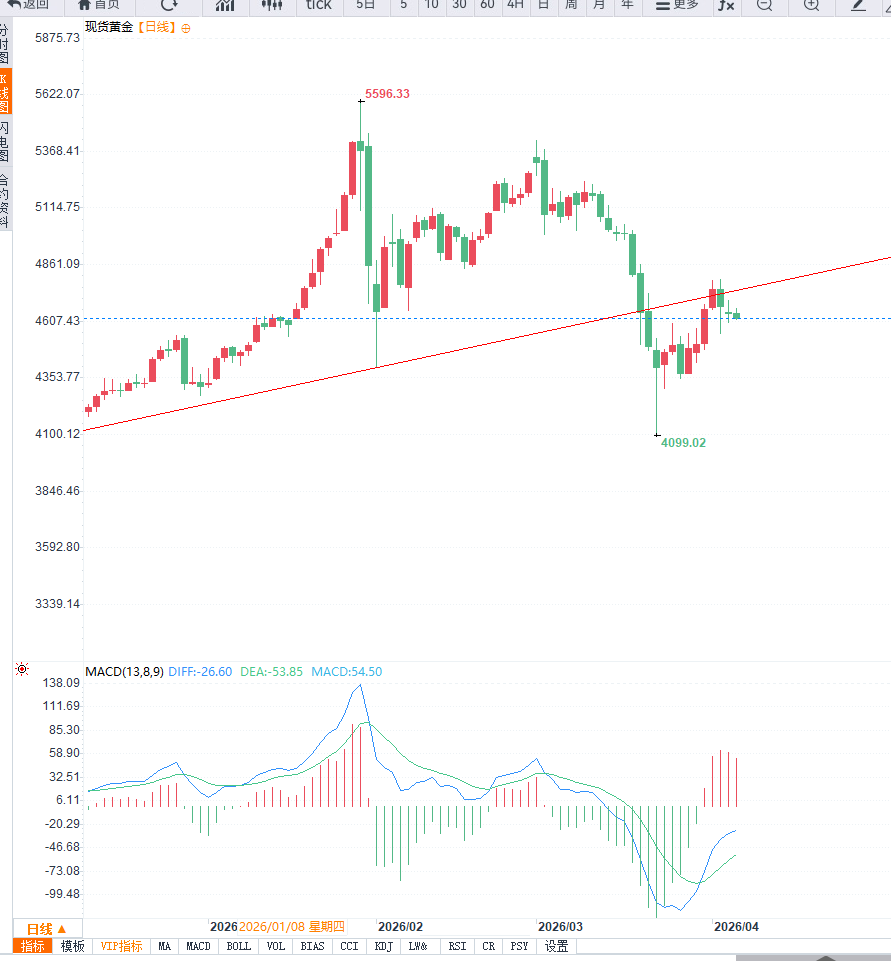
From a technical perspective, on the daily chart, gold encountered significant resistance after reaching a dense resistance zone during its previous upward surge, compounded by downward trendline pressure, forming a typical "false breakout + pullback" structure. The current price has fallen back below the resistance zone, indicating insufficient bullish momentum. Key resistance lies in the $4680-$4700 range , an area that combines previous highs and trendline resistance, making a significant breakout unlikely in the short term. Support lies at $4550 , with further support at $4400 ; a break below this level would confirm a continuation of the medium-term correction. Momentum indicators show the MACD is showing signs of a death cross, and the RSI has fallen from its high to neutral territory, indicating a significant weakening of upward momentum.
On the 4-hour chart, gold is exhibiting a downward trend with gradually lower highs, forming a short-term downtrend line. Multiple attempts to break through this trend line have failed, indicating strong selling pressure. The short-term moving average system has turned bearish, reinforcing the downward signal. Current short-term resistance is at $4650-$4680 ; if the rebound fails to break through this range, the pullback will likely continue. Key support is at $4550 ; a break below this level could accelerate the decline.
Editor's Summary:
The dominant driver in the current gold market is shifting from "geopolitical" to "interest rate and dollar" driven factors. While the situation in the Middle East still provides some support, its impact has significantly weakened, while the high-interest-rate environment and strong dollar continue to exert downward pressure on gold prices. From a technical perspective, gold has entered a mid-term correction phase, and it is unlikely to resume its upward trend until key resistance levels are broken. Going forward, close attention should be paid to the dollar's performance and changes in interest rate expectations; gold prices are expected to maintain a range-bound, slightly bearish pattern.
From a fundamental perspective, the situation in the Middle East remains centered around the Strait of Hormuz. US President Donald Trump's earlier deadline and tough stance initially boosted risk aversion. However, as the market gradually digested the associated risks, the marginal support from geopolitical factors for gold prices weakened significantly, failing to drive a sustained upward trend. This indicates that the market is currently more focused on macroeconomic variables rather than single event-driven factors.
Meanwhile, the macroeconomic environment is exerting significant downward pressure on gold. The Federal Reserve's policy expectations remain tight, and the market widely anticipates that interest rates will remain high for an extended period. Furthermore, the persistently high level of the US dollar index is reinforcing this downward pressure on gold. Since gold is priced in US dollars, a stronger dollar typically means gold becomes less attractive to non-dollar investors, thus suppressing price increases.
On the inflation front, persistently high oil prices have further reinforced market expectations of sticky inflation, which has also weakened expectations of interest rate cuts to some extent. Overall, the combination of "high interest rates + a strong dollar" is becoming the dominant factor in the current gold price trend, making it difficult for its safe-haven attributes to play a full role.
From a technical perspective, on the daily chart, gold encountered significant resistance after reaching a dense resistance zone during its previous upward surge, compounded by downward trendline pressure, forming a typical "false breakout + pullback" structure. The current price has fallen back below the resistance zone, indicating insufficient bullish momentum. Key resistance lies in the $4680-$4700 range , an area that combines previous highs and trendline resistance, making a significant breakout unlikely in the short term. Support lies at $4550 , with further support at $4400 ; a break below this level would confirm a continuation of the medium-term correction. Momentum indicators show the MACD is showing signs of a death cross, and the RSI has fallen from its high to neutral territory, indicating a significant weakening of upward momentum.
On the 4-hour chart, gold is exhibiting a downward trend with gradually lower highs, forming a short-term downtrend line. Multiple attempts to break through this trend line have failed, indicating strong selling pressure. The short-term moving average system has turned bearish, reinforcing the downward signal. Current short-term resistance is at $4650-$4680 ; if the rebound fails to break through this range, the pullback will likely continue. Key support is at $4550 ; a break below this level could accelerate the decline.
Editor's Summary:
The dominant driver in the current gold market is shifting from "geopolitical" to "interest rate and dollar" driven factors. While the situation in the Middle East still provides some support, its impact has significantly weakened, while the high-interest-rate environment and strong dollar continue to exert downward pressure on gold prices. From a technical perspective, gold has entered a mid-term correction phase, and it is unlikely to resume its upward trend until key resistance levels are broken. Going forward, close attention should be paid to the dollar's performance and changes in interest rate expectations; gold prices are expected to maintain a range-bound, slightly bearish pattern.
- Risk Warning and Disclaimer
- The market involves risk, and trading may not be suitable for all investors. This article is for reference only and does not constitute personal investment advice, nor does it take into account certain users’ specific investment objectives, financial situation, or other needs. Any investment decisions made based on this information are at your own risk.

