













Iran, having learned from Russia's experience, continues its blockade of the Strait of Hormuz, trapping Trump and oil prices.
2026-04-07 10:32:04
Just as the Trump administration sought to reopen the Strait of Hormuz without sending ground troops, attention turned to the Black Sea Grain Initiative, a UN-mediated agreement reached between Ukraine and Russia in 2022. This agreement briefly cleared a key maritime export route, but ultimately required military force to maintain its accessibility.
The agreement, reached after months of negotiations, aimed to restore Ukrainian grain exports. However, Russia repeatedly delayed inspections and refused to extend the agreement in 2023, causing maritime exports to be disrupted again. This exposed the limitations of diplomacy in wartime and highlighted the possibility that military means could alter the course of a confrontation.
The issue of right-of-way in the Strait of Hormuz cannot be fundamentally resolved through short-term diplomacy or limited military action. The global crude oil market is expected to face a prolonged period of high premiums, high volatility, and low predictability. On Tuesday (April 7th) during Asian trading hours, US crude oil prices fluctuated upwards, currently trading around $115 per barrel, with a daily increase of approximately 2.3%.
In 2024, Ukraine used unmanned surface vessels to attack the Russian Black Sea Fleet, destroying or damaging one-fifth of its ships and forcing the Russian Navy to withdraw from the shipping lane. Agricultural exports subsequently recovered rapidly, approaching pre-conflict levels.
According to data from the Ukrainian Ports Authority, the total volume of goods passing through Ukrainian ports surged from 62 million tons in 2023 to 97.2 million tons in 2024. Currently, approximately 90% of Ukrainian agricultural products are exported by sea, approaching the pre-conflict level of 94%. Despite Russia's continued use of drones and missiles to attack export hubs, military guarantees have become crucial for maintaining these routes.
Ukrainian Foreign Minister Andriy Sebiga stated, "What Iran is doing now in the Strait of Hormuz is exactly what Russia did in the Black Sea in the past. The problem is that Iran has studied Russia's mistakes and learned from them ."
The Strait of Hormuz, which supplied one-fifth of the world's oil before World War II, has been effectively closed by Iran through asymmetric means such as drones, missiles, and small speedboats. Iran insists on charging passage fees for vessels from non-friendly countries and is attempting to keep some ships out of the Persian Gulf.
EU High Representative for Foreign Affairs and Security Policy Kaya Karas discussed the possibility of replicating the Black Sea model in the Strait of Hormuz with UN Secretary-General António Guterres. However, Ukrainian officials pointed out that geographical differences and varying military capabilities make direct replication extremely difficult. The Strait of Hormuz is relatively narrow, and Iran's availability of land-based anti-ship missiles, drones, and swarms of fast boats significantly increases the difficulty of escorting ships .
Trump has repeatedly urged other countries to take back control of the Strait of Hormuz from Iran, and posted on Truth Social: "Summon your belated courage, go to the Strait of Hormuz and take it back." He also said that the United States only needs "a little more time" to easily open the Strait and "take the oil and make a fortune."
However, the experience in Ukraine shows that diplomatic agreements alone cannot maintain the security of passageways in the long term; they must be backed by continuous military guarantees. This provides an important lesson for the Trump administration, which seeks a quick end to the war and is unwilling to send ground troops .
Ukrainian President Volodymyr Zelenskyy stated that Gulf states want to learn from Ukraine's experience in developing a Black Sea corridor, but Kyiv has not been directly involved in efforts related to the Strait of Hormuz. He emphasized, "You remember dealing with the Russians—we reached an agreement, lifted the blockade, the agreement worked for a year, and then it expired. So the issue isn't just about lifting the blockade, but about maintaining that status quo, establishing rules, and ensuring that protective measures are in place ."
Yuri Vaskov, former Deputy Minister of Infrastructure of Ukraine, pointed out that in the early stages of the conflict, Ukraine used land routes and inland river ports as a contingency measure, but ultimately it still had to rely on force to ensure maritime exports.
The successes and failures of the Ukraine-Black Sea Grain Agreement offer important lessons for the Trump administration in handling the Strait of Hormuz issue: while diplomatic negotiations can temporarily clear the passage, maintaining its long-term openness requires military means to alter the balance of power . Iran, having learned from Russia's experience, has adopted asymmetric warfare tactics, making simple escort operations extremely difficult.
Trump wants to end the war quickly and reopen the Straits, but the case of Ukraine breaking the blockade with unmanned boats shows that diplomacy or short-term military action alone is not enough to completely solve the problem, and sustained military support may become the core of the final solution.
Q: Why did the Black Sea Grain Agreement ultimately fail?
A: The 2022 agreement, brokered by the United Nations, briefly restored Ukrainian grain exports. However, Russia repeatedly delayed inspections and refused to extend the agreement in 2023, causing maritime exports to be interrupted again. The lack of external authority to guarantee the safety of ships was the core reason for the agreement's failure. Ultimately, Ukraine forced the Russian fleet to withdraw through unmanned surface vessel operations.
Q: How can Ukraine use force to restore shipping lanes in the Black Sea?
A: In 2024, Ukrainian unmanned surface vessels launched precision strikes against the Russian Black Sea Fleet, destroying or damaging one-fifth of its ships and forcing the Russian Navy to withdraw from shipping lanes. Following this, agricultural exports recovered rapidly, with total cargo volume through ports reaching 97.2 million tons in 2024, approaching pre-conflict levels, and approximately 90% of agricultural products exported by sea.
Q: What are the key differences between the Strait of Hormuz and the Black Sea?
A: The Strait of Hormuz carries 20% of global oil shipments, making it far more important than the Black Sea's food supply route. The strait is also relatively narrow, allowing Iran to conduct asymmetric attacks using land-based anti-ship missiles, drones, and swarms of fast boats, making escorting navigators far more difficult than in the Black Sea. Geographical and military capability differences further complicate the direct replication of the Ukrainian experience.
Q: What lessons can Trump learn from the Ukraine experience?
A: Trump wants to quickly reopen the Straits without sending ground troops, but the Ukraine case shows that diplomatic agreements are difficult to maintain in the long term and must be backed by continuous military guarantees. Simply urging allies to seize the Straits or launching short-term strikes may not be enough; long-term protective measures are needed to prevent Iran from re-blockading the area.
Q: What is the practical significance of this experience for the current global energy market?
A: The disruption of the Strait of Hormuz has led to high oil prices and supply shortages. If navigation cannot be reopened by force or strong guarantees, diplomatic efforts may repeat the mistakes of the Black Sea Agreement. The global economy, especially energy-importing countries in Asia and Europe, will continue to face high oil prices and supply chain pressures until the issue of control of the strait is substantially resolved.
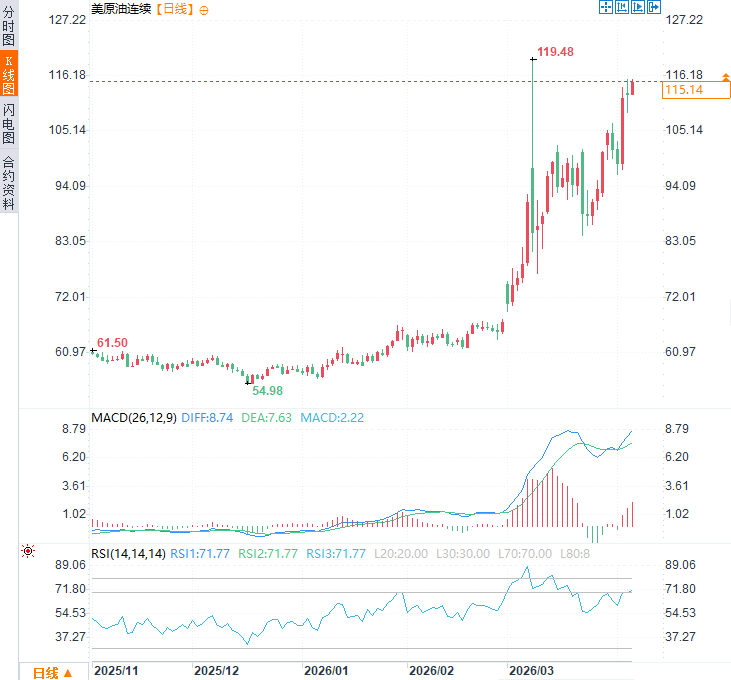
(US crude oil daily chart, source: FX678)
At 10:31 Beijing time, US crude oil futures were trading at $115.07 per barrel.
The agreement, reached after months of negotiations, aimed to restore Ukrainian grain exports. However, Russia repeatedly delayed inspections and refused to extend the agreement in 2023, causing maritime exports to be disrupted again. This exposed the limitations of diplomacy in wartime and highlighted the possibility that military means could alter the course of a confrontation.
The issue of right-of-way in the Strait of Hormuz cannot be fundamentally resolved through short-term diplomacy or limited military action. The global crude oil market is expected to face a prolonged period of high premiums, high volatility, and low predictability. On Tuesday (April 7th) during Asian trading hours, US crude oil prices fluctuated upwards, currently trading around $115 per barrel, with a daily increase of approximately 2.3%.
Ukrainian unmanned surface vessel breaks blockade
In 2024, Ukraine used unmanned surface vessels to attack the Russian Black Sea Fleet, destroying or damaging one-fifth of its ships and forcing the Russian Navy to withdraw from the shipping lane. Agricultural exports subsequently recovered rapidly, approaching pre-conflict levels.
According to data from the Ukrainian Ports Authority, the total volume of goods passing through Ukrainian ports surged from 62 million tons in 2023 to 97.2 million tons in 2024. Currently, approximately 90% of Ukrainian agricultural products are exported by sea, approaching the pre-conflict level of 94%. Despite Russia's continued use of drones and missiles to attack export hubs, military guarantees have become crucial for maintaining these routes.
Ukrainian Foreign Minister Andriy Sebiga stated, "What Iran is doing now in the Strait of Hormuz is exactly what Russia did in the Black Sea in the past. The problem is that Iran has studied Russia's mistakes and learned from them ."
Similarities between the Strait of Hormuz and the Black Sea
The Strait of Hormuz, which supplied one-fifth of the world's oil before World War II, has been effectively closed by Iran through asymmetric means such as drones, missiles, and small speedboats. Iran insists on charging passage fees for vessels from non-friendly countries and is attempting to keep some ships out of the Persian Gulf.
EU High Representative for Foreign Affairs and Security Policy Kaya Karas discussed the possibility of replicating the Black Sea model in the Strait of Hormuz with UN Secretary-General António Guterres. However, Ukrainian officials pointed out that geographical differences and varying military capabilities make direct replication extremely difficult. The Strait of Hormuz is relatively narrow, and Iran's availability of land-based anti-ship missiles, drones, and swarms of fast boats significantly increases the difficulty of escorting ships .
Trump's strategic dilemma
Trump has repeatedly urged other countries to take back control of the Strait of Hormuz from Iran, and posted on Truth Social: "Summon your belated courage, go to the Strait of Hormuz and take it back." He also said that the United States only needs "a little more time" to easily open the Strait and "take the oil and make a fortune."
However, the experience in Ukraine shows that diplomatic agreements alone cannot maintain the security of passageways in the long term; they must be backed by continuous military guarantees. This provides an important lesson for the Trump administration, which seeks a quick end to the war and is unwilling to send ground troops .
Zelensky's warning
Ukrainian President Volodymyr Zelenskyy stated that Gulf states want to learn from Ukraine's experience in developing a Black Sea corridor, but Kyiv has not been directly involved in efforts related to the Strait of Hormuz. He emphasized, "You remember dealing with the Russians—we reached an agreement, lifted the blockade, the agreement worked for a year, and then it expired. So the issue isn't just about lifting the blockade, but about maintaining that status quo, establishing rules, and ensuring that protective measures are in place ."
Yuri Vaskov, former Deputy Minister of Infrastructure of Ukraine, pointed out that in the early stages of the conflict, Ukraine used land routes and inland river ports as a contingency measure, but ultimately it still had to rely on force to ensure maritime exports.
Editor's Summary
The successes and failures of the Ukraine-Black Sea Grain Agreement offer important lessons for the Trump administration in handling the Strait of Hormuz issue: while diplomatic negotiations can temporarily clear the passage, maintaining its long-term openness requires military means to alter the balance of power . Iran, having learned from Russia's experience, has adopted asymmetric warfare tactics, making simple escort operations extremely difficult.
Trump wants to end the war quickly and reopen the Straits, but the case of Ukraine breaking the blockade with unmanned boats shows that diplomacy or short-term military action alone is not enough to completely solve the problem, and sustained military support may become the core of the final solution.
Frequently Asked Questions
Q: Why did the Black Sea Grain Agreement ultimately fail?
A: The 2022 agreement, brokered by the United Nations, briefly restored Ukrainian grain exports. However, Russia repeatedly delayed inspections and refused to extend the agreement in 2023, causing maritime exports to be interrupted again. The lack of external authority to guarantee the safety of ships was the core reason for the agreement's failure. Ultimately, Ukraine forced the Russian fleet to withdraw through unmanned surface vessel operations.
Q: How can Ukraine use force to restore shipping lanes in the Black Sea?
A: In 2024, Ukrainian unmanned surface vessels launched precision strikes against the Russian Black Sea Fleet, destroying or damaging one-fifth of its ships and forcing the Russian Navy to withdraw from shipping lanes. Following this, agricultural exports recovered rapidly, with total cargo volume through ports reaching 97.2 million tons in 2024, approaching pre-conflict levels, and approximately 90% of agricultural products exported by sea.
Q: What are the key differences between the Strait of Hormuz and the Black Sea?
A: The Strait of Hormuz carries 20% of global oil shipments, making it far more important than the Black Sea's food supply route. The strait is also relatively narrow, allowing Iran to conduct asymmetric attacks using land-based anti-ship missiles, drones, and swarms of fast boats, making escorting navigators far more difficult than in the Black Sea. Geographical and military capability differences further complicate the direct replication of the Ukrainian experience.
Q: What lessons can Trump learn from the Ukraine experience?
A: Trump wants to quickly reopen the Straits without sending ground troops, but the Ukraine case shows that diplomatic agreements are difficult to maintain in the long term and must be backed by continuous military guarantees. Simply urging allies to seize the Straits or launching short-term strikes may not be enough; long-term protective measures are needed to prevent Iran from re-blockading the area.
Q: What is the practical significance of this experience for the current global energy market?
A: The disruption of the Strait of Hormuz has led to high oil prices and supply shortages. If navigation cannot be reopened by force or strong guarantees, diplomatic efforts may repeat the mistakes of the Black Sea Agreement. The global economy, especially energy-importing countries in Asia and Europe, will continue to face high oil prices and supply chain pressures until the issue of control of the strait is substantially resolved.
(US crude oil daily chart, source: FX678)
At 10:31 Beijing time, US crude oil futures were trading at $115.07 per barrel.
- Risk Warning and Disclaimer
- The market involves risk, and trading may not be suitable for all investors. This article is for reference only and does not constitute personal investment advice, nor does it take into account certain users’ specific investment objectives, financial situation, or other needs. Any investment decisions made based on this information are at your own risk.

