Gold Trading Alert: Trump's Ultimatum Countdown Begins + Service Sector Inflation Soars! After Consolidating in the 4600-4700 Range, Will the Next Move Be a Breakout or a Pullback?
2026-04-07 07:45:21
When Trump quipped at a White House Easter event, "That night could be tomorrow night," global gold traders tensed instantly. On Monday (April 6), gold prices fluctuated between $4,600 and $4,700, ultimately closing at $4,650, a slight decrease of 0.55%. Behind this seemingly mild decline lies a complex game of maneuvering involving war, inflation, and interest rates.
On that very day, Iran formally rejected the US's request for a temporary ceasefire and, through mediator Pakistan, conveyed a ten-point proposal demanding a permanent end to the war, the lifting of sanctions, and the opening of the Strait of Hormuz in exchange for approximately $2 million in transit fees per ship. The deadline set by Trump was ticking away, approaching 8 p.m. Eastern Time on Tuesday (8:00 a.m. Wednesday Beijing Time).
The gold market is at a critical crossroads. On one hand, the nearly six-week-long Middle East war has boosted safe-haven demand; on the other hand, the inflationary pressures triggered by the war are forcing the Federal Reserve to maintain or even tighten monetary policy, which is putting fatal pressure on non-interest-bearing gold. Bulls and bears are fiercely battling in this smoke-filled battlefield. On Tuesday (April 7th) in early Asian trading, spot gold fluctuated narrowly, currently trading around $4655 per ounce.
Since the start of the war between the US, Israel, and Iran in late February, the Strait of Hormuz, a vital waterway carrying approximately one-fifth of the world's oil and liquefied natural gas, has been effectively blocked by Tehran. The Iranian Islamic Revolutionary Guard Corps even shot down a US F-15E fighter jet and successfully rescued a captured American pilot, greatly boosting the confidence of Iranian leaders.
The effects of war have permeated every corner of the global economy. Brent crude futures closed at $109.77 a barrel on Monday, while U.S. crude futures reached $112.41. The average retail gasoline price in the U.S. has surpassed $4 a gallon for the first time in nearly four years, directly impacting the lives of ordinary Americans.
Gold, as a traditional safe-haven asset, should have shone brightly in this conflict. However, reality is far more complex than textbooks suggest. Bart Melek, Global Head of Commodities Strategy at TD Securities, succinctly put it: "If the conflict continues, oil prices will slowly climb amid tightening supply, exacerbating inflationary pressures. This will leave central banks, especially the Federal Reserve, with less room to ease policy, and if energy prices rise further, it could even reignite discussions about interest rate hikes, which would be bearish for gold."
This passage reveals the core contradiction in the current gold market: while war does create safe-haven demand, the resulting inflationary consequences are destroying the low-interest-rate environment upon which gold relies for its survival. When the Federal Reserve may be forced to raise interest rates, the opportunity cost of holding gold will increase, and investors will naturally turn to assets that generate interest.
On the same day, a survey report released by the Institute for Supply Management (ISM) made these concerns even more concrete. The U.S. non-manufacturing purchasing managers' index (PMI) fell to 54.0 in March from 56.1 in February, below economists' expectations of 54.9, indicating that growth in the service sector is slowing. But what truly alarmed the market was another figure: the index measuring input prices for businesses surged 7.7 percentage points to 70.7, the highest level since October 2022 and the largest monthly increase in over 13 years.
What does this mean? It means that American businesses are facing enormous cost pressures. Businesses across multiple industries are reporting higher gasoline and diesel prices, as well as rising prices for construction products such as lumber, copper, and steel. Wholesalers are complaining of "significantly increased landed costs," while extended delivery times from suppliers are further straining the supply chain.
More worryingly, this inflationary pressure is not temporary. The ISM index, which measures input prices, has remained above 60 for 16 consecutive months, and now this is compounded by the energy shock from the war. Economists expect the inflationary impact of the war to become apparent in the March Consumer Price Index report, due Friday.
Meanwhile, the services employment index fell to its lowest level since the end of 2023, indicating a cooling job market. This contrasts sharply with the strong non-farm payroll data released last Friday—the U.S. economy added 178,000 jobs in March, almost three times the market expectation. This contradictory data reflects how war is distorting economic signals in complex ways.
Priscilla Thiagamoorthy, senior economist at BMO Capital Markets, aptly summarized the situation: "The service sector is still expanding, but headwinds are intensifying. With the job market slowing and inflationary pressures rising again, data suggests that while economic growth is slowing, price pressures remain stubborn. This puts the Federal Reserve in a dilemma."
This dilemma is fundamentally altering market expectations for interest rates. According to CME's FedWatch tool, most traders now believe there is zero chance of a Fed rate cut this year. Even more alarmingly, the US interest rate futures market has completely ruled out a rate cut in 2026, whereas just before the outbreak of the conflict in Iran on February 28, the market was anticipating a rate cut of approximately 55 basis points this year.
The latest data released on Monday shows that the probability of the Federal Reserve cutting interest rates by a cumulative 25 basis points by December is only 14.5%, while the probability of keeping rates unchanged is as high as 72.9%, and the probability of raising interest rates by a cumulative 25 basis points has risen to 12.5%. This means that the market has begun to seriously consider the possibility of the Federal Reserve raising interest rates again.
This is an extremely unfavorable environment for gold. There is a classic negative correlation between gold and interest rates: the higher the interest rate, the greater the opportunity cost of holding gold. When the market starts discussing interest rate hikes rather than cuts, gold's appeal diminishes significantly.
The performance of the US Treasury market also confirms this. On Monday, the benchmark 10-year Treasury yield fell slightly to 4.335%, but the shape of the yield curve is more noteworthy. The spread between the two-year and ten-year Treasury yields narrowed to 48.5 basis points, exhibiting a bullish flattening pattern, indicating that investors are still anticipating that the Federal Reserve may have to ease policy due to war-related growth concerns. However, at the same time, strong employment data and soaring inflation indicators are preventing such easing.
This is the dilemma gold currently faces: the market is worried about both the growth shock from war and runaway inflation triggered by it. Caught between these two concerns, gold is struggling to find a clear direction.
Amid this turmoil, U.S. stocks surprisingly closed higher on Monday. The Dow Jones Industrial Average rose 0.36%, the S&P 500 gained 0.45%, and the Nasdaq Composite climbed 0.54%. The dollar index weakened slightly to 99.99, a drop of about 0.2%. U.S. Treasury prices remained largely unchanged.
This apparent calm is unsettling. Ryan Detrick, chief market strategist at Carson Group, offered an explanation: “The reality is that we are gradually approaching some kind of solution, hopefully. The daily volatility and headlines are certainly disconcerting. But with the earnings season approaching, there is an optimistic atmosphere in the market, with the belief that U.S. companies will once again deliver very robust results.”
But a more likely reason is that the market is waiting for a clear directional signal. Jim Barnes, head of fixed income at Bryn Mawr Trust, put it more honestly: "The bond market currently lacks a clear direction, which indicates that investors are actually uncertain. There are a lot of news risks associated with deadlines. It's difficult for investors to trade on what might happen in the future because we've been down this path before—we've seen these ultimatums before."
This wait-and-see attitude was also evident in the gold market. Gold prices fluctuated by more than $100 on Monday, but ultimately closed only slightly lower, indicating that neither the bulls nor the bears had enough confidence to launch a decisive offensive.
To understand the current situation, a thorough analysis of Iran's ten-point proposal is essential. According to Iranian state media, this proposal, conveyed through Pakistan, includes core elements such as: guaranteeing Iran will no longer be attacked, halting Israeli attacks on Hezbollah in Lebanon, and fully lifting sanctions. In exchange, Iran will lift its de facto blockade of the Strait of Hormuz and charge approximately $2 million per vessel crossing it, splitting the revenue 50/50 with Oman on the other side of the strait.
Iran will use the proceeds to rebuild infrastructure destroyed in the US-Israeli attacks. Notably, Iranian state media emphasized that the proposal "rejects a ceasefire" and insists on "the necessity of a permanent end to the war based on Iran's demands." Following the downing of the US warplane and the successful rescue of the captured pilot, the confidence of Iranian leaders has clearly increased significantly.
But Trump rejected this response. At a press conference, he made a strong statement, claiming that the US military could destroy all of Iran's bridges and power plants in just "four hours," and announced that Monday's strikes would be the largest since the start of the war, with further intensification planned for Tuesday. Defense Secretary Hergsays was even more direct: Iran could be "annihilated" overnight, "and that night could be tomorrow night."
Whether this strategy of applying maximum pressure will work will be revealed Tuesday evening. But regardless of the outcome, the impact of this conflict on the global economy is already irreversible. Even if an agreement is reached, the $2 million passage fee per ship through the Strait of Hormuz will remain a long-term cost driver for energy prices.
For gold investors, there are three key events to watch closely in the coming week.
On Wednesday, the Federal Reserve will release the minutes of its March policy meeting. These minutes will reveal policymakers' true views on war and inflation, as well as their internal discussions about the future path of interest rates. If the minutes show strong concerns about inflation, expectations of interest rate hikes could intensify further, putting pressure on gold.
On Thursday, the U.S. will release personal consumption expenditure data, one of the Federal Reserve's preferred inflation indicators. If the data shows that inflationary pressures are accelerating, market expectations for an interest rate hike will be further solidified.
On Friday, the Consumer Price Index (CPI) will be officially released. Economists generally expect the inflationary impact of the war to be fully reflected in this report. If the CPI data is significantly higher than expected, gold will face a double blow from interest rate expectations.
Bart Melek of TD Securities cautioned investors: "The market focus may remain on the war and interest rates." Any changes in these two variables could trigger sharp fluctuations in gold prices.
The reason why gold is behaving so contradictorily in the current environment is that its dual nature is being pulled in opposite directions by market forces.
As a safe-haven asset, escalating war should have driven up gold prices. Iran's refusal to ceasefire, Trump's threat to "annihilate" its captors, and the expansion of US military strikes—these should have been positive news for gold. The fact that gold prices touched a high of $4706 on Monday was a true reflection of this safe-haven sentiment.
However, as a non-interest-bearing asset, gold is extremely sensitive to changes in interest rates. Its appeal diminishes when the market begins discussing the possibility of interest rate hikes. Current inflation data is forcing the market to seriously consider this possibility. The ISM input price index saw its largest increase in 13 years, oil prices broke through $110, and gasoline prices surpassed $4—these are clear signs that inflation is spiraling out of control.
This rift is reflected in gold prices, which fluctuated around the $4,700 level and ultimately closed slightly lower. Investors were hesitant to go long, fearing that rising interest rates would suppress gold prices; nor were they willing to go short, as the war could escalate at any moment.
Charu Chanana, Chief Investment Strategist at Saxo Singapore, summed it up most succinctly: "Each new ultimatum makes the turmoil seem longer, more intractable, and more negative in its impact on the macroeconomy."
The gold market is at a rare point of equilibrium between bulls and bears. War and inflation, safe-haven demand and interest rates, growth concerns and policy tightening—these conflicting forces are locking gold prices within a narrow trading range.
In the short term, the outcome of Trump's deadline on Tuesday evening will be decisive. If Iran yields and opens the Strait of Hormuz, oil prices could fall rapidly, inflationary pressures could ease, and the Federal Reserve could have room to cut interest rates, which would be beneficial for gold. If Iran maintains its stance and the US escalates its strikes, further expanding the war, then safe-haven demand could push up gold prices in the short term, but the ensuing inflationary shock and expectations of interest rate hikes will suppress gold in the medium term.
From a longer-term perspective, regardless of the war's outcome, the global energy supply chain has already suffered permanent damage. A $2 million toll per ship for passage through the Strait of Hormuz, if implemented, would permanently increase energy costs. Furthermore, the fact that US service sector input prices have remained above 60 for 16 consecutive months indicates that inflation has acquired an inherent stubbornness.
In this environment, gold investors need not to chase short-term fluctuations, but to judge long-term trends. Can the Federal Reserve control inflation without triggering a recession? Will the war spread to a wider region? Will the global de-dollarization process accelerate? The answers to these questions will determine whether gold returns to its all-time high of $5,000 or falls back below $4,000 in the coming year. At this moment, gold is holding its breath, awaiting its fate from the Middle East.
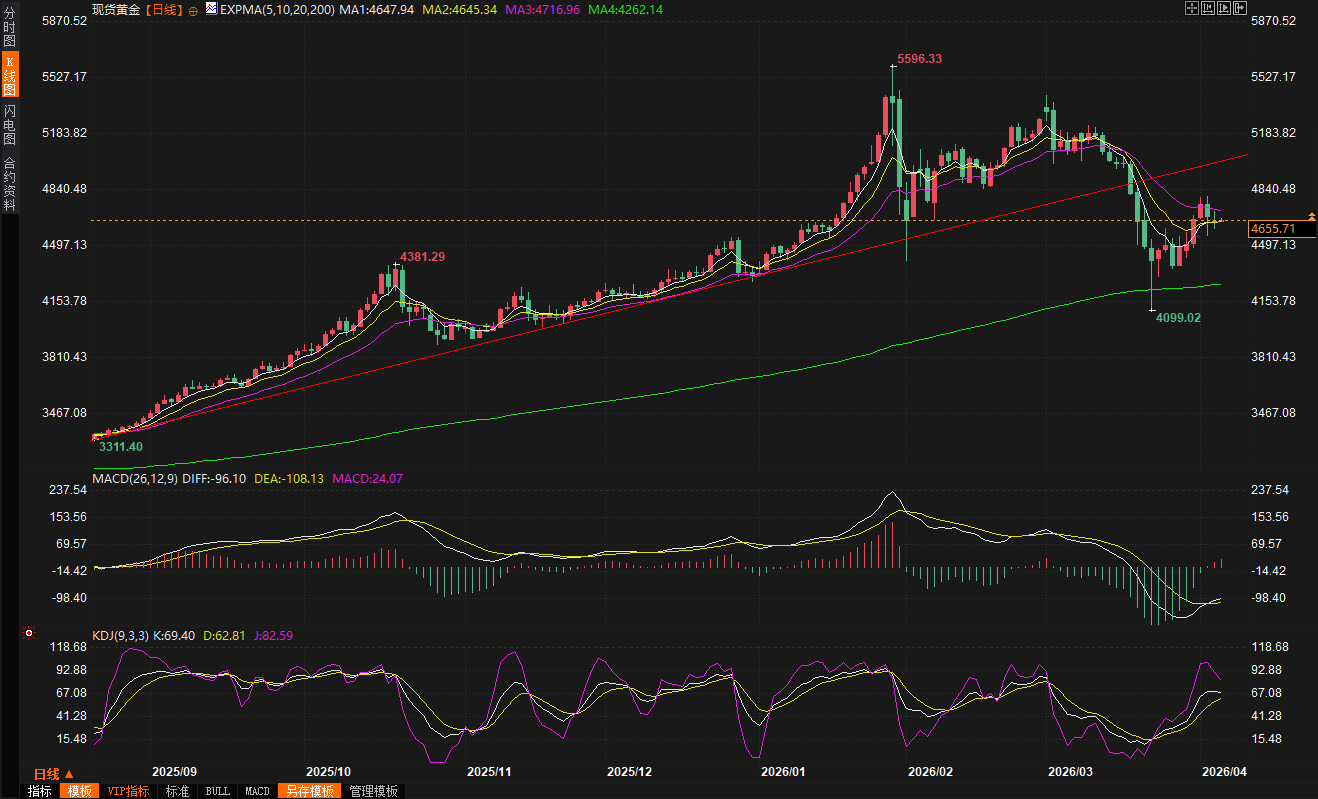
(Spot gold daily chart source: EasyForex)
At 07:42 Beijing time, spot gold was trading at $4655.38 per ounce.
On that very day, Iran formally rejected the US's request for a temporary ceasefire and, through mediator Pakistan, conveyed a ten-point proposal demanding a permanent end to the war, the lifting of sanctions, and the opening of the Strait of Hormuz in exchange for approximately $2 million in transit fees per ship. The deadline set by Trump was ticking away, approaching 8 p.m. Eastern Time on Tuesday (8:00 a.m. Wednesday Beijing Time).
The gold market is at a critical crossroads. On one hand, the nearly six-week-long Middle East war has boosted safe-haven demand; on the other hand, the inflationary pressures triggered by the war are forcing the Federal Reserve to maintain or even tighten monetary policy, which is putting fatal pressure on non-interest-bearing gold. Bulls and bears are fiercely battling in this smoke-filled battlefield. On Tuesday (April 7th) in early Asian trading, spot gold fluctuated narrowly, currently trading around $4655 per ounce.
The Specter of War: From the Strait of Hormuz to the Global Treasury
Since the start of the war between the US, Israel, and Iran in late February, the Strait of Hormuz, a vital waterway carrying approximately one-fifth of the world's oil and liquefied natural gas, has been effectively blocked by Tehran. The Iranian Islamic Revolutionary Guard Corps even shot down a US F-15E fighter jet and successfully rescued a captured American pilot, greatly boosting the confidence of Iranian leaders.
The effects of war have permeated every corner of the global economy. Brent crude futures closed at $109.77 a barrel on Monday, while U.S. crude futures reached $112.41. The average retail gasoline price in the U.S. has surpassed $4 a gallon for the first time in nearly four years, directly impacting the lives of ordinary Americans.
Gold, as a traditional safe-haven asset, should have shone brightly in this conflict. However, reality is far more complex than textbooks suggest. Bart Melek, Global Head of Commodities Strategy at TD Securities, succinctly put it: "If the conflict continues, oil prices will slowly climb amid tightening supply, exacerbating inflationary pressures. This will leave central banks, especially the Federal Reserve, with less room to ease policy, and if energy prices rise further, it could even reignite discussions about interest rate hikes, which would be bearish for gold."
This passage reveals the core contradiction in the current gold market: while war does create safe-haven demand, the resulting inflationary consequences are destroying the low-interest-rate environment upon which gold relies for its survival. When the Federal Reserve may be forced to raise interest rates, the opportunity cost of holding gold will increase, and investors will naturally turn to assets that generate interest.
Inflation Alarm: Service Sector Input Prices See Biggest Rise in Over 13 Years
On the same day, a survey report released by the Institute for Supply Management (ISM) made these concerns even more concrete. The U.S. non-manufacturing purchasing managers' index (PMI) fell to 54.0 in March from 56.1 in February, below economists' expectations of 54.9, indicating that growth in the service sector is slowing. But what truly alarmed the market was another figure: the index measuring input prices for businesses surged 7.7 percentage points to 70.7, the highest level since October 2022 and the largest monthly increase in over 13 years.
What does this mean? It means that American businesses are facing enormous cost pressures. Businesses across multiple industries are reporting higher gasoline and diesel prices, as well as rising prices for construction products such as lumber, copper, and steel. Wholesalers are complaining of "significantly increased landed costs," while extended delivery times from suppliers are further straining the supply chain.
More worryingly, this inflationary pressure is not temporary. The ISM index, which measures input prices, has remained above 60 for 16 consecutive months, and now this is compounded by the energy shock from the war. Economists expect the inflationary impact of the war to become apparent in the March Consumer Price Index report, due Friday.
Meanwhile, the services employment index fell to its lowest level since the end of 2023, indicating a cooling job market. This contrasts sharply with the strong non-farm payroll data released last Friday—the U.S. economy added 178,000 jobs in March, almost three times the market expectation. This contradictory data reflects how war is distorting economic signals in complex ways.
Priscilla Thiagamoorthy, senior economist at BMO Capital Markets, aptly summarized the situation: "The service sector is still expanding, but headwinds are intensifying. With the job market slowing and inflationary pressures rising again, data suggests that while economic growth is slowing, price pressures remain stubborn. This puts the Federal Reserve in a dilemma."
The Interest Rate Cage: The Fed's Hands Bound by War
This dilemma is fundamentally altering market expectations for interest rates. According to CME's FedWatch tool, most traders now believe there is zero chance of a Fed rate cut this year. Even more alarmingly, the US interest rate futures market has completely ruled out a rate cut in 2026, whereas just before the outbreak of the conflict in Iran on February 28, the market was anticipating a rate cut of approximately 55 basis points this year.
The latest data released on Monday shows that the probability of the Federal Reserve cutting interest rates by a cumulative 25 basis points by December is only 14.5%, while the probability of keeping rates unchanged is as high as 72.9%, and the probability of raising interest rates by a cumulative 25 basis points has risen to 12.5%. This means that the market has begun to seriously consider the possibility of the Federal Reserve raising interest rates again.
This is an extremely unfavorable environment for gold. There is a classic negative correlation between gold and interest rates: the higher the interest rate, the greater the opportunity cost of holding gold. When the market starts discussing interest rate hikes rather than cuts, gold's appeal diminishes significantly.
The performance of the US Treasury market also confirms this. On Monday, the benchmark 10-year Treasury yield fell slightly to 4.335%, but the shape of the yield curve is more noteworthy. The spread between the two-year and ten-year Treasury yields narrowed to 48.5 basis points, exhibiting a bullish flattening pattern, indicating that investors are still anticipating that the Federal Reserve may have to ease policy due to war-related growth concerns. However, at the same time, strong employment data and soaring inflation indicators are preventing such easing.
This is the dilemma gold currently faces: the market is worried about both the growth shock from war and runaway inflation triggered by it. Caught between these two concerns, gold is struggling to find a clear direction.
The Market's Appearance: The Unsettling Calm Behind the Stock Market Rise
Amid this turmoil, U.S. stocks surprisingly closed higher on Monday. The Dow Jones Industrial Average rose 0.36%, the S&P 500 gained 0.45%, and the Nasdaq Composite climbed 0.54%. The dollar index weakened slightly to 99.99, a drop of about 0.2%. U.S. Treasury prices remained largely unchanged.
This apparent calm is unsettling. Ryan Detrick, chief market strategist at Carson Group, offered an explanation: “The reality is that we are gradually approaching some kind of solution, hopefully. The daily volatility and headlines are certainly disconcerting. But with the earnings season approaching, there is an optimistic atmosphere in the market, with the belief that U.S. companies will once again deliver very robust results.”
But a more likely reason is that the market is waiting for a clear directional signal. Jim Barnes, head of fixed income at Bryn Mawr Trust, put it more honestly: "The bond market currently lacks a clear direction, which indicates that investors are actually uncertain. There are a lot of news risks associated with deadlines. It's difficult for investors to trade on what might happen in the future because we've been down this path before—we've seen these ultimatums before."
This wait-and-see attitude was also evident in the gold market. Gold prices fluctuated by more than $100 on Monday, but ultimately closed only slightly lower, indicating that neither the bulls nor the bears had enough confidence to launch a decisive offensive.
Iran's bargaining chips: the ten-point plan and a $2 million toll.
To understand the current situation, a thorough analysis of Iran's ten-point proposal is essential. According to Iranian state media, this proposal, conveyed through Pakistan, includes core elements such as: guaranteeing Iran will no longer be attacked, halting Israeli attacks on Hezbollah in Lebanon, and fully lifting sanctions. In exchange, Iran will lift its de facto blockade of the Strait of Hormuz and charge approximately $2 million per vessel crossing it, splitting the revenue 50/50 with Oman on the other side of the strait.
Iran will use the proceeds to rebuild infrastructure destroyed in the US-Israeli attacks. Notably, Iranian state media emphasized that the proposal "rejects a ceasefire" and insists on "the necessity of a permanent end to the war based on Iran's demands." Following the downing of the US warplane and the successful rescue of the captured pilot, the confidence of Iranian leaders has clearly increased significantly.
But Trump rejected this response. At a press conference, he made a strong statement, claiming that the US military could destroy all of Iran's bridges and power plants in just "four hours," and announced that Monday's strikes would be the largest since the start of the war, with further intensification planned for Tuesday. Defense Secretary Hergsays was even more direct: Iran could be "annihilated" overnight, "and that night could be tomorrow night."
Whether this strategy of applying maximum pressure will work will be revealed Tuesday evening. But regardless of the outcome, the impact of this conflict on the global economy is already irreversible. Even if an agreement is reached, the $2 million passage fee per ship through the Strait of Hormuz will remain a long-term cost driver for energy prices.
Future variables: Three key events are about to be revealed
For gold investors, there are three key events to watch closely in the coming week.
On Wednesday, the Federal Reserve will release the minutes of its March policy meeting. These minutes will reveal policymakers' true views on war and inflation, as well as their internal discussions about the future path of interest rates. If the minutes show strong concerns about inflation, expectations of interest rate hikes could intensify further, putting pressure on gold.
On Thursday, the U.S. will release personal consumption expenditure data, one of the Federal Reserve's preferred inflation indicators. If the data shows that inflationary pressures are accelerating, market expectations for an interest rate hike will be further solidified.
On Friday, the Consumer Price Index (CPI) will be officially released. Economists generally expect the inflationary impact of the war to be fully reflected in this report. If the CPI data is significantly higher than expected, gold will face a double blow from interest rate expectations.
Bart Melek of TD Securities cautioned investors: "The market focus may remain on the war and interest rates." Any changes in these two variables could trigger sharp fluctuations in gold prices.
Gold's dual nature is being torn apart.
The reason why gold is behaving so contradictorily in the current environment is that its dual nature is being pulled in opposite directions by market forces.
As a safe-haven asset, escalating war should have driven up gold prices. Iran's refusal to ceasefire, Trump's threat to "annihilate" its captors, and the expansion of US military strikes—these should have been positive news for gold. The fact that gold prices touched a high of $4706 on Monday was a true reflection of this safe-haven sentiment.
However, as a non-interest-bearing asset, gold is extremely sensitive to changes in interest rates. Its appeal diminishes when the market begins discussing the possibility of interest rate hikes. Current inflation data is forcing the market to seriously consider this possibility. The ISM input price index saw its largest increase in 13 years, oil prices broke through $110, and gasoline prices surpassed $4—these are clear signs that inflation is spiraling out of control.
This rift is reflected in gold prices, which fluctuated around the $4,700 level and ultimately closed slightly lower. Investors were hesitant to go long, fearing that rising interest rates would suppress gold prices; nor were they willing to go short, as the war could escalate at any moment.
Charu Chanana, Chief Investment Strategist at Saxo Singapore, summed it up most succinctly: "Each new ultimatum makes the turmoil seem longer, more intractable, and more negative in its impact on the macroeconomy."
Conclusion: At this crucial crossroads, patience is more important than direction.
The gold market is at a rare point of equilibrium between bulls and bears. War and inflation, safe-haven demand and interest rates, growth concerns and policy tightening—these conflicting forces are locking gold prices within a narrow trading range.
In the short term, the outcome of Trump's deadline on Tuesday evening will be decisive. If Iran yields and opens the Strait of Hormuz, oil prices could fall rapidly, inflationary pressures could ease, and the Federal Reserve could have room to cut interest rates, which would be beneficial for gold. If Iran maintains its stance and the US escalates its strikes, further expanding the war, then safe-haven demand could push up gold prices in the short term, but the ensuing inflationary shock and expectations of interest rate hikes will suppress gold in the medium term.
From a longer-term perspective, regardless of the war's outcome, the global energy supply chain has already suffered permanent damage. A $2 million toll per ship for passage through the Strait of Hormuz, if implemented, would permanently increase energy costs. Furthermore, the fact that US service sector input prices have remained above 60 for 16 consecutive months indicates that inflation has acquired an inherent stubbornness.
In this environment, gold investors need not to chase short-term fluctuations, but to judge long-term trends. Can the Federal Reserve control inflation without triggering a recession? Will the war spread to a wider region? Will the global de-dollarization process accelerate? The answers to these questions will determine whether gold returns to its all-time high of $5,000 or falls back below $4,000 in the coming year. At this moment, gold is holding its breath, awaiting its fate from the Middle East.
(Spot gold daily chart source: EasyForex)
At 07:42 Beijing time, spot gold was trading at $4655.38 per ounce.
- Risk Warning and Disclaimer
- The market involves risk, and trading may not be suitable for all investors. This article is for reference only and does not constitute personal investment advice, nor does it take into account certain users’ specific investment objectives, financial situation, or other needs. Any investment decisions made based on this information are at your own risk.