













Crude oil trading alert: US crude oil continues to fluctuate at high levels, with increasing divergence between bulls and bears near previous highs.
2026-04-07 09:14:28
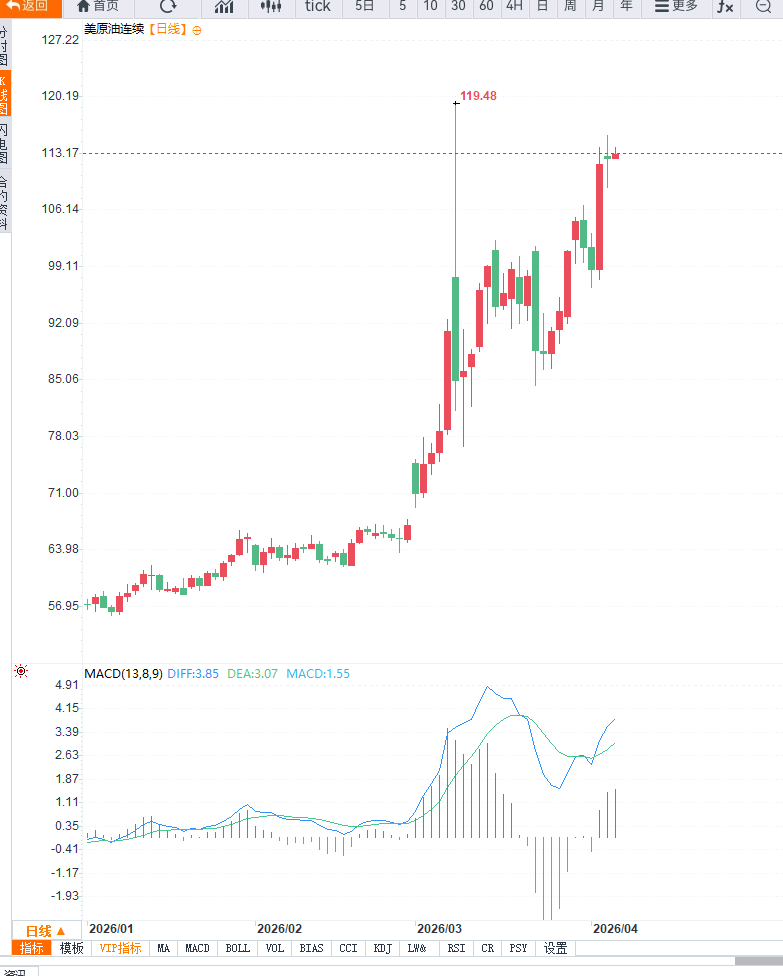
The international crude oil market experienced significantly increased volatility. During Tuesday's Asian trading session, WTI crude oil prices rose to around $113 , hitting a new high for the period. The core driver of this movement was the renewed tensions in the Middle East, particularly the ongoing uncertainty surrounding the Strait of Hormuz. As one of the world's most critical energy transport routes, the strait handles approximately 20% of global seaborne crude oil shipments , and restrictions on its passage have directly amplified market concerns about supply disruptions.

US President Donald Trump recently stated that he is "still not satisfied" with the progress of related negotiations and hinted at possible tougher measures. This statement quickly increased market risk aversion. Meanwhile, Iran signaled a possible expansion of its attacks on energy infrastructure, further escalating market concerns about the stability of energy supplies in the Middle East. Against this backdrop, the geopolitical risk premium in crude oil prices has risen significantly, becoming a core factor driving up oil prices.
On the other hand, there are also some hedging factors on the supply side. OPEC+ announced a slight increase in production of approximately 206,000 barrels per day in May, but given the current transportation constraints, there remains considerable uncertainty as to whether the new supply can smoothly enter the market. This means that although nominal supply has increased, the actual effective supply may not have improved significantly, thus weakening the downward pressure of increased production on oil prices.
In the short term, the market will continue to focus on changes in American Petroleum Institute (API) inventory data. If the data shows an unexpected decline in inventories, it will strengthen expectations of resilient demand and further support oil prices; conversely, if inventories unexpectedly accumulate, it could trigger a short-term pullback. From the current market structure, funds are more inclined to trade geopolitical risks than fundamental supply and demand balances, which significantly amplifies oil price volatility.
From a technical perspective, on the daily chart, WTI crude oil remains within an overall upward channel, but prices have approached previous highs, creating significant technical resistance. The key resistance level is currently in the $115-$118 range ; failure to break through this level could trigger profit-taking. Support levels are concentrated at the $105 and $100 psychological levels , forming a medium-term bullish defense. Momentum indicators suggest a slowdown in upward momentum, implying increased risk of chasing the rally in the short term.
On the 4-hour chart, oil prices are exhibiting a high-level consolidation structure, with the short-term trading range gradually narrowing, indicating increasing divergence between bulls and bears. Technically, the RSI is in a high-level consolidation range, without a clear overbought signal, but momentum is weakening, suggesting a slowdown in the upward pace. A break below $105 could open up room for a pullback; a break above $118 could potentially initiate a new trend.
Editor's Summary:
In summary, the current crude oil market is in a phase dominated by geopolitical risks and marginally influenced by fundamentals. The uncertainty surrounding the Middle East situation remains the core variable determining oil price direction, while while there are expectations of increased production on the supply side, it is unlikely to fully mitigate the impact of transportation disruptions in the short term. Technically, oil prices are approaching a key resistance area, and without breaking through previous highs, significant upward momentum remains insufficient. Going forward, close attention should be paid to the evolution of the geopolitical situation and changes in inventory data. Oil prices may continue to fluctuate widely at high levels, operating in an environment where risks and opportunities coexist.
US President Donald Trump recently stated that he is "still not satisfied" with the progress of related negotiations and hinted at possible tougher measures. This statement quickly increased market risk aversion. Meanwhile, Iran signaled a possible expansion of its attacks on energy infrastructure, further escalating market concerns about the stability of energy supplies in the Middle East. Against this backdrop, the geopolitical risk premium in crude oil prices has risen significantly, becoming a core factor driving up oil prices.
On the other hand, there are also some hedging factors on the supply side. OPEC+ announced a slight increase in production of approximately 206,000 barrels per day in May, but given the current transportation constraints, there remains considerable uncertainty as to whether the new supply can smoothly enter the market. This means that although nominal supply has increased, the actual effective supply may not have improved significantly, thus weakening the downward pressure of increased production on oil prices.
In the short term, the market will continue to focus on changes in American Petroleum Institute (API) inventory data. If the data shows an unexpected decline in inventories, it will strengthen expectations of resilient demand and further support oil prices; conversely, if inventories unexpectedly accumulate, it could trigger a short-term pullback. From the current market structure, funds are more inclined to trade geopolitical risks than fundamental supply and demand balances, which significantly amplifies oil price volatility.
From a technical perspective, on the daily chart, WTI crude oil remains within an overall upward channel, but prices have approached previous highs, creating significant technical resistance. The key resistance level is currently in the $115-$118 range ; failure to break through this level could trigger profit-taking. Support levels are concentrated at the $105 and $100 psychological levels , forming a medium-term bullish defense. Momentum indicators suggest a slowdown in upward momentum, implying increased risk of chasing the rally in the short term.
On the 4-hour chart, oil prices are exhibiting a high-level consolidation structure, with the short-term trading range gradually narrowing, indicating increasing divergence between bulls and bears. Technically, the RSI is in a high-level consolidation range, without a clear overbought signal, but momentum is weakening, suggesting a slowdown in the upward pace. A break below $105 could open up room for a pullback; a break above $118 could potentially initiate a new trend.
Editor's Summary:
In summary, the current crude oil market is in a phase dominated by geopolitical risks and marginally influenced by fundamentals. The uncertainty surrounding the Middle East situation remains the core variable determining oil price direction, while while there are expectations of increased production on the supply side, it is unlikely to fully mitigate the impact of transportation disruptions in the short term. Technically, oil prices are approaching a key resistance area, and without breaking through previous highs, significant upward momentum remains insufficient. Going forward, close attention should be paid to the evolution of the geopolitical situation and changes in inventory data. Oil prices may continue to fluctuate widely at high levels, operating in an environment where risks and opportunities coexist.
- Risk Warning and Disclaimer
- The market involves risk, and trading may not be suitable for all investors. This article is for reference only and does not constitute personal investment advice, nor does it take into account certain users’ specific investment objectives, financial situation, or other needs. Any investment decisions made based on this information are at your own risk.

