Explosive Investigation: Hormuz Not Blockaded by Torpedoes, Iran Secretly Charged Fees for Passage
2026-04-07 15:00:21
Sittrini's on-site investigation of the Strait of Hormuz: overturning market expectations of a blockade and revealing the true extent of navigation on the waterway.
Citrine Research, which garnered widespread market attention in February this year for its bearish report on artificial intelligence, has once again focused its research on the Strait of Hormuz with a direct and incisive approach.
To ascertain the true navigability of this crucial global oil transport route, the agency specifically assigned an anonymous analyst to travel by ship from the Musandem Peninsula in Oman to conduct an on-site investigation in the conflict zone.

The findings of this survey are highly disruptive—directly overturning the mainstream perception in the global market that the Taiwan Strait is almost completely blocked, and providing the market with a completely new perspective for analysis.
The analyst codenamed "Analyst No. 3" who participated in the investigation has successfully completed his mission and has recently returned safely to the uncontrolled area.
According to research reports and publicly available information published by Citrini on the Substack platform, global crude oil traders currently rely mainly on official tracking data such as satellite imagery and Automatic Identification System (AIS) to judge the shipping situation in the Strait, but such data has serious omissions.
Research has found that the satellite and ship tracking data relied upon by the market not only significantly underestimates the scale of the "shadow fleet" operations in the region, but also fails to capture a large number of ships that transit through the region using covert means: these ships evade official tracking by turning off their transponders, falsifying location data, and changing ship ownership registration information, and secretly pass through Iran's toll-based transit system, thus concealing their true navigation trajectory and ensuring their own safety.
This phenomenon directly led to the market completely ignoring the large volume of shipping traffic coordinated by Iran, resulting in a significant deviation in the assessment of the current state of navigation in the strait.
On-site monitoring data provides strong evidence of the navigation status of the Strait of Hormuz: ship traffic in the Strait of Hormuz has not been interrupted, and the recent traffic volume has shown a significant rebound, with an average of about 15 ships passing through per day.
More noteworthy is that 21 ships passed through the area smoothly last weekend, marking the highest traffic volume on this key waterway since the outbreak of this round of conflict.
Although current traffic volume is still far below normal levels, this data clearly shows that the current shipping disruptions are only localized and temporary, and not the complete closure of shipping that the market is worried about.
In addition, the survey also found that the volume of traffic through the Qeshm Strait is continuing to rise, further confirming the strait's flexibility in navigation.
Key information revealed by the investigation shows that the Iranian Revolutionary Guard is working intensively to draft new detailed rules for navigation in the Strait of Hormuz, clearly defining the scope of permitted passage for vessels. This means that future navigation in the Strait will follow a rule system led by Iran.
In terms of actual control, Iran did not implement a complete blockade, but instead adopted a "selective release" mechanism: oil tankers need to obtain prior approval before they can pass through the waters near Iran, forming what Siturinni called a "functional checkpoint" control model.
Authoritative institutions such as JPMorgan Chase have also concluded that, in practical terms, whether ships can safely pass through the Strait of Hormuz increasingly depends on Iran's negotiating conditions and tolerance limits.
If more countries choose to sign separate agreements with Iran on the safe passage of oil tankers, it will further strengthen Iran's control over this core global energy artery and its market bargaining power.
It should be noted that the conclusions of this survey have certain limitations: they are based on only a single field visit, and the relevant oral information (such as information obtained from interviews with local fishermen, cross-border workers, and regional officials) lacks independent third-party verification. In addition, the lack of transparency in information disclosure in the Strait of Hormuz region may affect the comprehensiveness of the conclusions.
Furthermore, considering the normal operation of Iran's own fleet, it can be inferred that the Strait of Hormuz was not blocked by torpedoes, nor were there any actual torpedo deployments, and passing ships did not face any immediate fatal risk from torpedoes.
New developments in the Taiwan Strait situation have impacted the crude oil market: oil prices jumped at the opening of futures trading this week, then retreated somewhat overnight, but remained at high levels.
Citrini Research points out that the market's previous assessment of the situation in the Straits fell into the linear logic trap of "oil prices falling when navigation resumes and soaring when blockades are imposed," while this survey shows that the situation is more complex.
The agency predicts that the shipping disruption will continue for a long time, and the crude oil market will factor in a persistent risk premium. Therefore, it is more optimistic about the forward WTI crude oil contract for December 2026 and expects that the traffic volume in the strait will recover to 50% of the pre-conflict level within the next 4 to 6 weeks.
While the strait is passable, it is subject to targeted controls by Iran, limiting navigation efficiency. However, the current double-digit weekly traffic volume still offers considerable flexibility. The initial impact on oil prices may be a one-off event depending on the navigation situation, but the overall oil price level will remain on an upward trend.
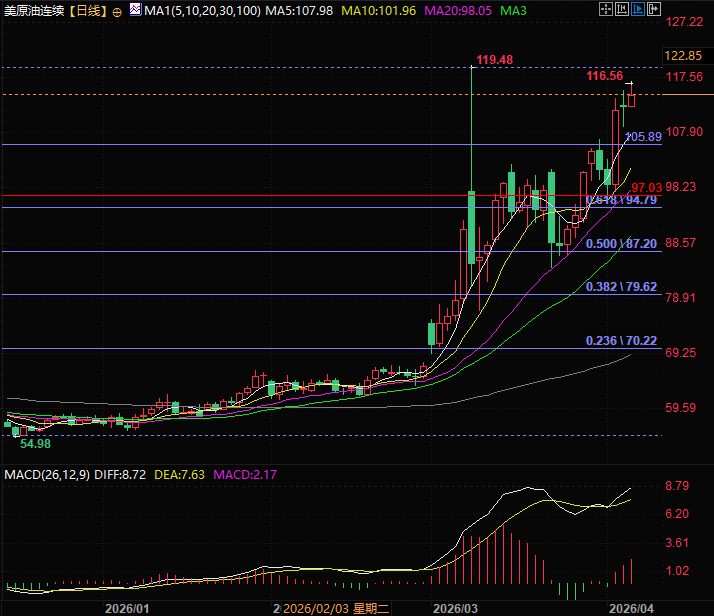
(WTI crude oil futures daily chart, source: EasyForex)
At 14:56 Beijing time, WTI crude oil futures were trading at $114.79 per barrel.
Citrine Research, which garnered widespread market attention in February this year for its bearish report on artificial intelligence, has once again focused its research on the Strait of Hormuz with a direct and incisive approach.
To ascertain the true navigability of this crucial global oil transport route, the agency specifically assigned an anonymous analyst to travel by ship from the Musandem Peninsula in Oman to conduct an on-site investigation in the conflict zone.
The findings of this survey are highly disruptive—directly overturning the mainstream perception in the global market that the Taiwan Strait is almost completely blocked, and providing the market with a completely new perspective for analysis.
The analyst codenamed "Analyst No. 3" who participated in the investigation has successfully completed his mission and has recently returned safely to the uncontrolled area.
Data Distortion Pain Points: Shadow Fleets and Covert Navigation Modes Exposed
According to research reports and publicly available information published by Citrini on the Substack platform, global crude oil traders currently rely mainly on official tracking data such as satellite imagery and Automatic Identification System (AIS) to judge the shipping situation in the Strait, but such data has serious omissions.
Research has found that the satellite and ship tracking data relied upon by the market not only significantly underestimates the scale of the "shadow fleet" operations in the region, but also fails to capture a large number of ships that transit through the region using covert means: these ships evade official tracking by turning off their transponders, falsifying location data, and changing ship ownership registration information, and secretly pass through Iran's toll-based transit system, thus concealing their true navigation trajectory and ensuring their own safety.
This phenomenon directly led to the market completely ignoring the large volume of shipping traffic coordinated by Iran, resulting in a significant deviation in the assessment of the current state of navigation in the strait.
The current situation regarding air traffic is clear: the rebound in traffic volume confirms that there was no complete closure of air routes.
On-site monitoring data provides strong evidence of the navigation status of the Strait of Hormuz: ship traffic in the Strait of Hormuz has not been interrupted, and the recent traffic volume has shown a significant rebound, with an average of about 15 ships passing through per day.
More noteworthy is that 21 ships passed through the area smoothly last weekend, marking the highest traffic volume on this key waterway since the outbreak of this round of conflict.
Although current traffic volume is still far below normal levels, this data clearly shows that the current shipping disruptions are only localized and temporary, and not the complete closure of shipping that the market is worried about.
In addition, the survey also found that the volume of traffic through the Qeshm Strait is continuing to rise, further confirming the strait's flexibility in navigation.
The core of the rules: Iran controls the discourse.
Key information revealed by the investigation shows that the Iranian Revolutionary Guard is working intensively to draft new detailed rules for navigation in the Strait of Hormuz, clearly defining the scope of permitted passage for vessels. This means that future navigation in the Strait will follow a rule system led by Iran.
In terms of actual control, Iran did not implement a complete blockade, but instead adopted a "selective release" mechanism: oil tankers need to obtain prior approval before they can pass through the waters near Iran, forming what Siturinni called a "functional checkpoint" control model.
Authoritative institutions such as JPMorgan Chase have also concluded that, in practical terms, whether ships can safely pass through the Strait of Hormuz increasingly depends on Iran's negotiating conditions and tolerance limits.
If more countries choose to sign separate agreements with Iran on the safe passage of oil tankers, it will further strengthen Iran's control over this core global energy artery and its market bargaining power.
There are currently no torpedoes in the reverse water area.
It should be noted that the conclusions of this survey have certain limitations: they are based on only a single field visit, and the relevant oral information (such as information obtained from interviews with local fishermen, cross-border workers, and regional officials) lacks independent third-party verification. In addition, the lack of transparency in information disclosure in the Strait of Hormuz region may affect the comprehensiveness of the conclusions.
Furthermore, considering the normal operation of Iran's own fleet, it can be inferred that the Strait of Hormuz was not blocked by torpedoes, nor were there any actual torpedo deployments, and passing ships did not face any immediate fatal risk from torpedoes.
Market Impact and Institutional Forecasts: Crude Oil Investment Strategy Under Long-Term Risk Premium
New developments in the Taiwan Strait situation have impacted the crude oil market: oil prices jumped at the opening of futures trading this week, then retreated somewhat overnight, but remained at high levels.
Citrini Research points out that the market's previous assessment of the situation in the Straits fell into the linear logic trap of "oil prices falling when navigation resumes and soaring when blockades are imposed," while this survey shows that the situation is more complex.
The agency predicts that the shipping disruption will continue for a long time, and the crude oil market will factor in a persistent risk premium. Therefore, it is more optimistic about the forward WTI crude oil contract for December 2026 and expects that the traffic volume in the strait will recover to 50% of the pre-conflict level within the next 4 to 6 weeks.
While the strait is passable, it is subject to targeted controls by Iran, limiting navigation efficiency. However, the current double-digit weekly traffic volume still offers considerable flexibility. The initial impact on oil prices may be a one-off event depending on the navigation situation, but the overall oil price level will remain on an upward trend.
(WTI crude oil futures daily chart, source: EasyForex)
At 14:56 Beijing time, WTI crude oil futures were trading at $114.79 per barrel.
- Risk Warning and Disclaimer
- The market involves risk, and trading may not be suitable for all investors. This article is for reference only and does not constitute personal investment advice, nor does it take into account certain users’ specific investment objectives, financial situation, or other needs. Any investment decisions made based on this information are at your own risk.