The US dollar index continued to fluctuate at high levels; a pullback should be anticipated near the resistance level.
2026-04-07 14:11:14
On Tuesday during Asian trading hours, the US dollar index rose to around 100.10 , continuing its recent rebound. The current dollar movement is mainly driven by safe-haven demand and interest rate expectations, maintaining relative strength against a complex macroeconomic backdrop.

From a core market driver perspective, the ongoing tensions in the Middle East are a significant contributor to the strengthening of the US dollar. Risks surrounding the Strait of Hormuz continue to escalate, with US President Donald Trump explicitly stating that the current ceasefire proposal is "insufficient" and threatening further action. This uncertainty has significantly increased global risk aversion, driving capital flows into the US dollar and thus supporting the rise of the dollar index.
Meanwhile, inflationary pressures from rising oil prices are once again influencing monetary policy expectations. As energy prices climb, market concerns about sticky inflation are intensifying. Federal Reserve officials have stated that further tightening of policy cannot be ruled out if inflation remains high. This statement has reinforced market expectations of "high interest rates persisting for longer," becoming a significant support factor for the US dollar.
However, economic data released some weak signals. According to data released by the Institute for Supply Management (ISM), the services PMI fell to 54.0 in March, lower than the previous reading and market expectations, indicating a weakening of expansion momentum in the services sector. This data limited the upside potential of the US dollar to some extent, but the overall impact was limited.
The market is currently awaiting US durable goods orders and ADP employment data, which will provide new guidance for short-term trends. In a geopolitical risk-driven environment, the marginal impact of the data may be weaker than risk sentiment itself.
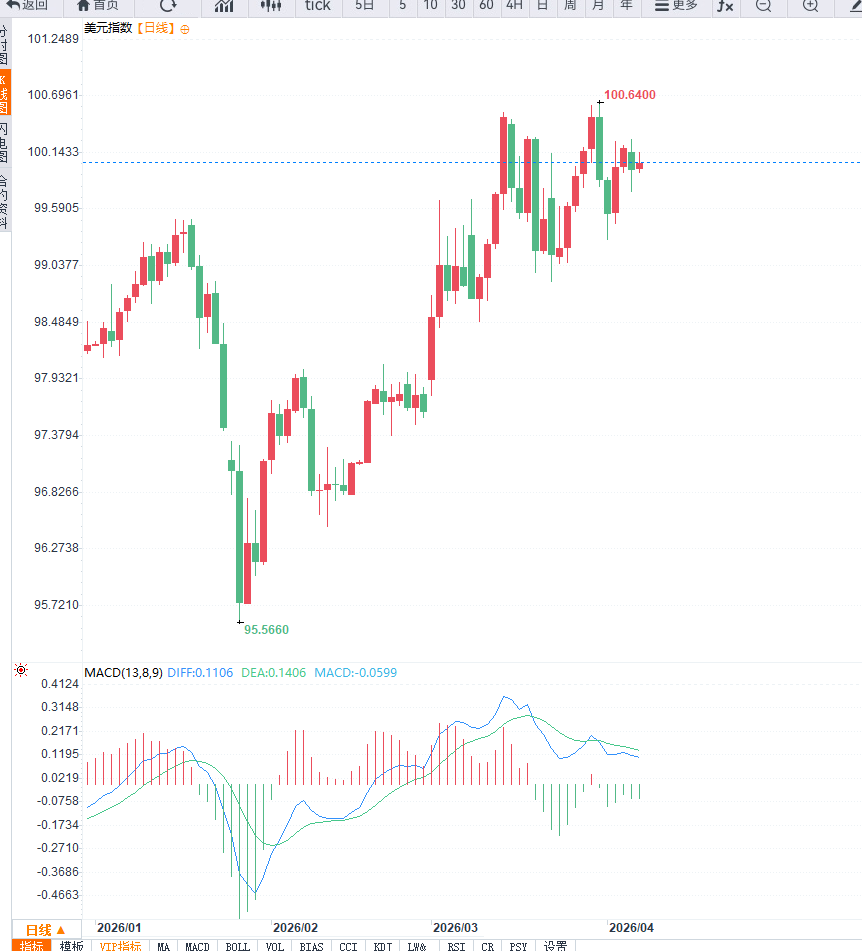
From a technical perspective, on the daily chart, the US dollar index has stabilized above the 100 level, indicating a strengthening short-term trend. The previous pullback lows have formed temporary support, and the price's return above key moving averages suggests a recovery in bullish momentum. The current key resistance level is at 101.00 , with further resistance at 102.00 ; support levels are at 99.50 , with further support at 98.80 . Momentum indicators show that upward momentum is gradually strengthening.
On the 4-hour chart, the US dollar index is showing an upward trend with gradually rising highs and lows. Short-term moving averages remain in a bullish alignment, and the RSI is trading in the mid-to-high range, indicating a short-term bullish bias. A break above 101.00 would further confirm the upward trend; a break below 99.50 could signal a correction phase.
Editor's Summary:
The core drivers of the current US dollar index are geopolitical risk aversion and interest rate expectations. The situation in the Middle East is increasing safe-haven demand, coupled with inflationary pressures from rising oil prices, leading the market to reassess the Federal Reserve's policy path, thus supporting the dollar's strength. Although some economic data is weak, its impact is limited under the prevailing risk sentiment. In the short term, the US dollar index may continue its volatile but upward trend, with its future direction depending on further developments in the geopolitical situation and economic data.
From a core market driver perspective, the ongoing tensions in the Middle East are a significant contributor to the strengthening of the US dollar. Risks surrounding the Strait of Hormuz continue to escalate, with US President Donald Trump explicitly stating that the current ceasefire proposal is "insufficient" and threatening further action. This uncertainty has significantly increased global risk aversion, driving capital flows into the US dollar and thus supporting the rise of the dollar index.
Meanwhile, inflationary pressures from rising oil prices are once again influencing monetary policy expectations. As energy prices climb, market concerns about sticky inflation are intensifying. Federal Reserve officials have stated that further tightening of policy cannot be ruled out if inflation remains high. This statement has reinforced market expectations of "high interest rates persisting for longer," becoming a significant support factor for the US dollar.
However, economic data released some weak signals. According to data released by the Institute for Supply Management (ISM), the services PMI fell to 54.0 in March, lower than the previous reading and market expectations, indicating a weakening of expansion momentum in the services sector. This data limited the upside potential of the US dollar to some extent, but the overall impact was limited.
The market is currently awaiting US durable goods orders and ADP employment data, which will provide new guidance for short-term trends. In a geopolitical risk-driven environment, the marginal impact of the data may be weaker than risk sentiment itself.
From a technical perspective, on the daily chart, the US dollar index has stabilized above the 100 level, indicating a strengthening short-term trend. The previous pullback lows have formed temporary support, and the price's return above key moving averages suggests a recovery in bullish momentum. The current key resistance level is at 101.00 , with further resistance at 102.00 ; support levels are at 99.50 , with further support at 98.80 . Momentum indicators show that upward momentum is gradually strengthening.
On the 4-hour chart, the US dollar index is showing an upward trend with gradually rising highs and lows. Short-term moving averages remain in a bullish alignment, and the RSI is trading in the mid-to-high range, indicating a short-term bullish bias. A break above 101.00 would further confirm the upward trend; a break below 99.50 could signal a correction phase.
Editor's Summary:
The core drivers of the current US dollar index are geopolitical risk aversion and interest rate expectations. The situation in the Middle East is increasing safe-haven demand, coupled with inflationary pressures from rising oil prices, leading the market to reassess the Federal Reserve's policy path, thus supporting the dollar's strength. Although some economic data is weak, its impact is limited under the prevailing risk sentiment. In the short term, the US dollar index may continue its volatile but upward trend, with its future direction depending on further developments in the geopolitical situation and economic data.
- Risk Warning and Disclaimer
- The market involves risk, and trading may not be suitable for all investors. This article is for reference only and does not constitute personal investment advice, nor does it take into account certain users’ specific investment objectives, financial situation, or other needs. Any investment decisions made based on this information are at your own risk.