The US dollar fluctuated at high levels, while gold remained under pressure and traded with a slightly weak bias for the third consecutive day.
2026-04-07 15:46:25
On Tuesday during the European session, spot gold continued its decline, fluctuating within the range of the previous trading day, maintaining a weak trend for the third consecutive day . Although the downward movement lacked significant volume, overall market sentiment remained bearish.

From a macroeconomic perspective, the strengthening US dollar is the core factor currently suppressing gold prices. As uncertainty in the Middle East escalates, the dollar, as a safe-haven asset, is attracting inflows, strengthening its status as the global reserve currency. Simultaneously, US economic data has shown some resilience, particularly the strong non-farm payroll data released earlier, further reinforcing market expectations that the Federal Reserve will maintain high interest rates, thus exerting sustained downward pressure on gold.
Meanwhile, rising inflation expectations have become a key variable. Driven by rising energy prices, the market widely anticipates renewed inflationary pressures. According to data from the Institute for Supply Management (ISM), the services price index rose to 70.7 , significantly higher than the previous reading, indicating increased cost pressures. This further reinforces market expectations of "interest rates remaining in place for longer," diminishing gold's appeal as a non-interest-bearing asset.
From a geopolitical perspective, the situation surrounding the Strait of Hormuz continues to escalate. US President Donald Trump has set a deadline for all parties involved to restore passage, threatening strong measures if this is not taken. While market concerns persist about an escalation of the conflict, safe-haven flows are primarily flowing into the US dollar rather than gold, limiting support for gold prices.
In addition, rising crude oil prices also indirectly put pressure on gold. Higher energy prices not only push up inflation expectations but also strengthen the likelihood of central banks maintaining tight monetary policies, making it difficult for gold to attract sustained buying interest.
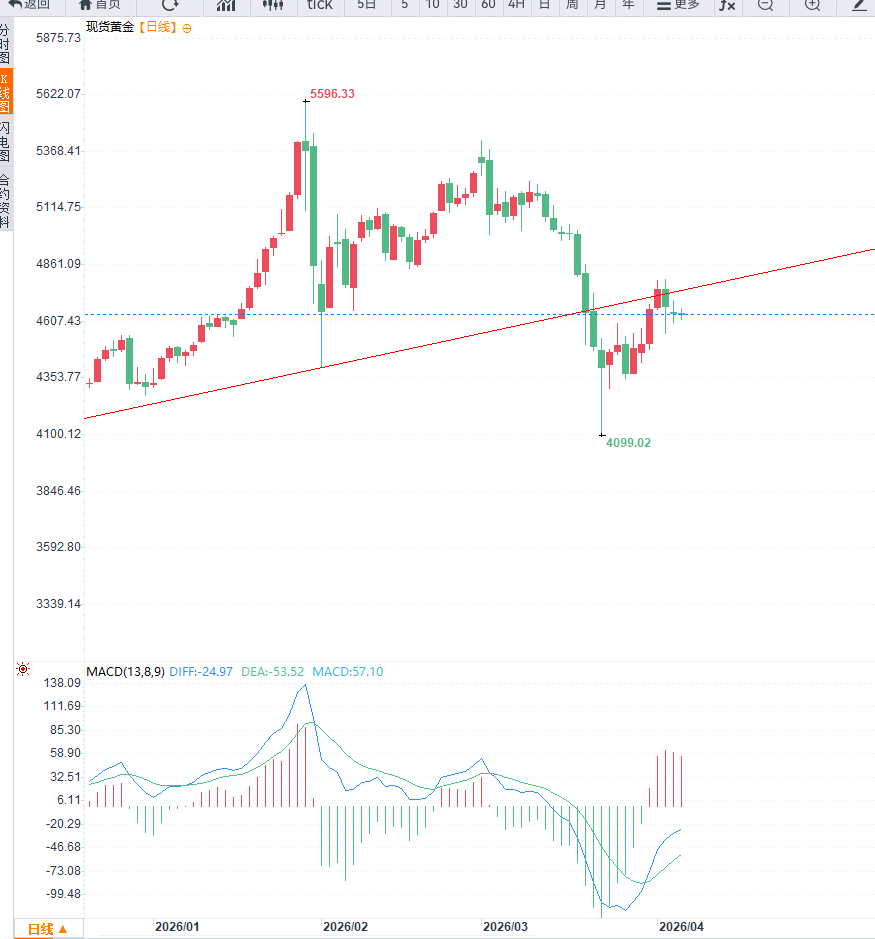
From a technical perspective, on the daily chart, gold has entered a consolidation phase. Multiple price rebounds have been met with resistance at previous levels, indicating significant selling pressure above. The short-term trend has shifted from strong to weak, and the structure presents a volatile but slightly bearish pattern. If it continues to trade below key resistance levels, the medium-term correction is likely to continue.
On the 4-hour chart, gold is in a downtrend, with prices consistently pressured by the 200-period moving average, forming a clear trend resistance. The current price is below this moving average, confirming a short-term bearish bias. The MACD indicator is below the zero line, with the histogram remaining negative, indicating that bearish momentum remains but has not significantly increased. The RSI is around 49 , in neutral to weak territory, suggesting the market is in a downward consolidation phase.
Regarding key levels, the initial resistance is at $4,600 , corresponding to the 38.2% Fibonacci retracement level. A break above this level could lead to a further test of the $4,760 area (50% retracement). However, until this range and the 200-period moving average are broken, any rallies should be viewed as opportunities to sell on rallies. Support is located around $4,600 ; a break below this level would target the $4,400 area, becoming the next target.
Editor's Summary:
The core logic of the current gold market lies in "a strong dollar + high interest rate expectations." Although geopolitical tensions persist, their support for gold is significantly weaker than before, with funds flowing more towards dollar assets. Rising inflationary pressures and expectations of tightening central bank policies are putting downward pressure on gold. In the short term, gold will remain in a consolidation phase until key resistance levels are broken, and it is expected to maintain a weak and volatile pattern, with the risk of further downside needing to be monitored.
From a macroeconomic perspective, the strengthening US dollar is the core factor currently suppressing gold prices. As uncertainty in the Middle East escalates, the dollar, as a safe-haven asset, is attracting inflows, strengthening its status as the global reserve currency. Simultaneously, US economic data has shown some resilience, particularly the strong non-farm payroll data released earlier, further reinforcing market expectations that the Federal Reserve will maintain high interest rates, thus exerting sustained downward pressure on gold.
Meanwhile, rising inflation expectations have become a key variable. Driven by rising energy prices, the market widely anticipates renewed inflationary pressures. According to data from the Institute for Supply Management (ISM), the services price index rose to 70.7 , significantly higher than the previous reading, indicating increased cost pressures. This further reinforces market expectations of "interest rates remaining in place for longer," diminishing gold's appeal as a non-interest-bearing asset.
From a geopolitical perspective, the situation surrounding the Strait of Hormuz continues to escalate. US President Donald Trump has set a deadline for all parties involved to restore passage, threatening strong measures if this is not taken. While market concerns persist about an escalation of the conflict, safe-haven flows are primarily flowing into the US dollar rather than gold, limiting support for gold prices.
In addition, rising crude oil prices also indirectly put pressure on gold. Higher energy prices not only push up inflation expectations but also strengthen the likelihood of central banks maintaining tight monetary policies, making it difficult for gold to attract sustained buying interest.
From a technical perspective, on the daily chart, gold has entered a consolidation phase. Multiple price rebounds have been met with resistance at previous levels, indicating significant selling pressure above. The short-term trend has shifted from strong to weak, and the structure presents a volatile but slightly bearish pattern. If it continues to trade below key resistance levels, the medium-term correction is likely to continue.
On the 4-hour chart, gold is in a downtrend, with prices consistently pressured by the 200-period moving average, forming a clear trend resistance. The current price is below this moving average, confirming a short-term bearish bias. The MACD indicator is below the zero line, with the histogram remaining negative, indicating that bearish momentum remains but has not significantly increased. The RSI is around 49 , in neutral to weak territory, suggesting the market is in a downward consolidation phase.
Regarding key levels, the initial resistance is at $4,600 , corresponding to the 38.2% Fibonacci retracement level. A break above this level could lead to a further test of the $4,760 area (50% retracement). However, until this range and the 200-period moving average are broken, any rallies should be viewed as opportunities to sell on rallies. Support is located around $4,600 ; a break below this level would target the $4,400 area, becoming the next target.
Editor's Summary:
The core logic of the current gold market lies in "a strong dollar + high interest rate expectations." Although geopolitical tensions persist, their support for gold is significantly weaker than before, with funds flowing more towards dollar assets. Rising inflationary pressures and expectations of tightening central bank policies are putting downward pressure on gold. In the short term, gold will remain in a consolidation phase until key resistance levels are broken, and it is expected to maintain a weak and volatile pattern, with the risk of further downside needing to be monitored.
- Risk Warning and Disclaimer
- The market involves risk, and trading may not be suitable for all investors. This article is for reference only and does not constitute personal investment advice, nor does it take into account certain users’ specific investment objectives, financial situation, or other needs. Any investment decisions made based on this information are at your own risk.