The US-Iran conflict may be starting to extend to civilian infrastructure.
2026-04-07 16:53:25
The Israel Defense Forces confirmed that they have attacked a petrochemical complex in Shiraz, Iran. This facility is one of the few remaining key sites in Iran capable of producing critical chemical components for explosives and materials for ballistic missiles, and its strategic importance has become even more critical after the Israeli strikes on Iran's largest petrochemical plant and the Mahshar petrochemical complex.
Meanwhile, Iran's Khorramabad airport was also attacked by a coalition of US and Israeli forces, further highlighting the intensity and scope of the confrontation between the two sides.
This attack marks a shift in the US-Iran conflict beyond a simple military standoff, targeting Iran's core civilian infrastructure related to energy and military industries. It not only severely damaged Iran's domestic industrial system but also directly threatened the security of the global energy supply chain, becoming a key trigger for market sentiment and asset price volatility.
The surge in energy prices triggered by the escalating conflict is completely reversing the direction of the Federal Reserve's monetary policy.
On Monday, key officials at the Federal Reserve made it clear that if inflation continues to hover above the central bank’s 2% target, raising interest rates may become a necessary measure—a clear signal that even as the ongoing conflict in Iran continues to impact global energy markets, some policymakers are quietly reversing their previous inclination to cut interest rates.
Cleveland Federal Reserve President Beth Hammark's remarks came as the war entered its sixth week, gasoline prices soared across the United States, and market concerns about the U.S. economic outlook intensified.
The emergence of expectations for interest rate hikes stands in stark contrast to the Federal Reserve's policy trajectory of cutting benchmark interest rates three times at the end of last year.
More importantly, this move could put the Federal Reserve in direct confrontation with President Donald Trump, who has previously publicly called for a significant reduction in interest rates to 1%.
Meanwhile, JPMorgan Chase CEO Jamie Dimon warned in his annual shareholder letter released Monday that the conflict could trigger “sustained and significant volatility in oil and commodity prices,” which in turn could push up inflation and ultimately cause interest rates to climb above current market expectations, further limiting the Federal Reserve’s policy adjustment space.
In an interview with the Associated Press, Hammark revealed that while she prefers the Federal Reserve to keep benchmark interest rates stable "for a considerable period of time," she also acknowledged that the future policy path largely depends on how well the economy adapts to the rising energy costs caused by the war.
She stated, "I can foresee two scenarios: if the labor market deteriorates significantly, we may need to cut interest rates... or if inflation persists above the target level, we may have to raise interest rates."
Hammark added that "inflation has been above target for more than five years, and if inflation rises further, it will mean that it is "moving in the wrong direction from the 2% target."
The Cleveland Fed's own forecasts indicate that inflation may rise to 3.5% this month—the highest level since 2024.
Economists surveyed by FactSet expect the annual inflation rate to jump to 3.1% in March from 2.4% in February, with monthly consumer prices rising by 0.8%—the largest monthly increase in nearly four years, as inflationary pressures continue to transmit to the real economy.
Escalating conflict between the US and Iran and the risk of navigation in the Strait of Hormuz have become the core drivers of volatility in the crude oil market.
Data from the American Automobile Association shows that as of Monday, the average price of gasoline across the United States was $4.12 per gallon, up 80 cents from a month ago, with prices in some parts of California soaring to $10 per gallon, significantly increasing the cost of travel for people.
This round of price increases is directly related to Iran's closure of the Strait of Hormuz, a narrow waterway that carries about 20% of the world's oil shipments and is a core node in the global energy artery.
As the conflict escalated, insurance companies either raised premiums or suspended coverage for tankers traveling along the route; shipping companies, in turn, diverted their vessels to Africa, which not only extended transit times by several weeks but also significantly increased logistics costs, further driving up global crude oil trade costs.
GasBuddy’s head of oil analysis, Patrick DeHaan, warned on Monday that even if a ceasefire agreement is reached, oil prices will not fall immediately.
He pointed out that the key variable lies in whether the Strait of Hormuz can truly achieve safe navigation—only when oil tankers resume passage will the market react accordingly, and the short-term high oil price trend is unlikely to reverse quickly.
Faced with the escalating conflict, the international community has actively promoted mediation, but the hardline stances of both the US and Iran have led to a stalemate in the process.
Two unnamed Middle Eastern officials told the Associated Press that Egypt, Pakistan, and Turkey have submitted a proposal to Iran and the United States calling for a 45-day ceasefire and the reopening of the Strait of Hormuz.
However, the Associated Press reported that Iran has explicitly rejected the ceasefire proposal and insists on a permanent end to the war. It has also put forward core conditions, including a comprehensive ceasefire in the Middle East, the withdrawal of US troops from the Gulf, and Iranian control over the right of passage through the Strait of Hormuz. Iran refuses to exchange a "temporary ceasefire" for the opening of the strait.
Meanwhile, before issuing his ultimatum on Tuesday, Trump appeared to expand the scope of the strikes from civilian targets to the whole of Iran, saying that "the whole country could be completely destroyed overnight, and that night could be tomorrow," further escalating regional tensions.
President Donald Trump posted on TruthSocial on Friday: "Give us just a little more time and we can easily open the Strait of Hormuz, seize oil resources, and make a fortune. This would be an energy boom for the world."
JPMorgan Chase CEO Jamie Dimon said on Monday: "We are facing the risk of continued sharp fluctuations in oil and commodity prices due to the conflict in Iran, and the global supply chain will also be restructured, which may lead to stronger inflation stickiness and ultimately interest rates may be higher than the current market expectations."
Patrick DeHaan, head of oil analysis at GasBuddy, noted on the X platform: "A ceasefire itself has almost no direct impact on oil prices unless it fundamentally changes the current de facto blockade of the Strait of Hormuz."
He further added, "Only when the Strait of Hormuz is fully open to navigation, and after market confidence is restored, safety verification is completed, and ships begin to pass through normally, will oil prices gradually fall as confidence recovers."
White House Press Secretary Carolyn Levitt recently stated, "Once Operation Epic Fury's national security objectives are fully achieved, the American people will see oil and gas prices fall rapidly, possibly even below pre-operation levels."
The U.S. government will release the Federal Reserve's preferred inflation indicator for February on Thursday, followed by the full March Consumer Price Index on Friday. This will be the first key report to fully reflect the impact of war-induced energy cost increases on inflation, and may directly determine the pace of the Fed's subsequent monetary policy, becoming a core anchor for market trading.
Analysts generally warn that even if a ceasefire agreement is reached, the decline in gasoline prices will lag behind the trend in crude oil prices, as verification of safe passage for oil tankers may take days or even weeks, and shipping volumes in the Strait of Hormuz will gradually recover.
In the short term, the global energy market will continue to be in a state of high risk premium, and fluctuations in crude oil prices may further spread to the stock market and foreign exchange market, triggering a chain reaction in global asset prices.
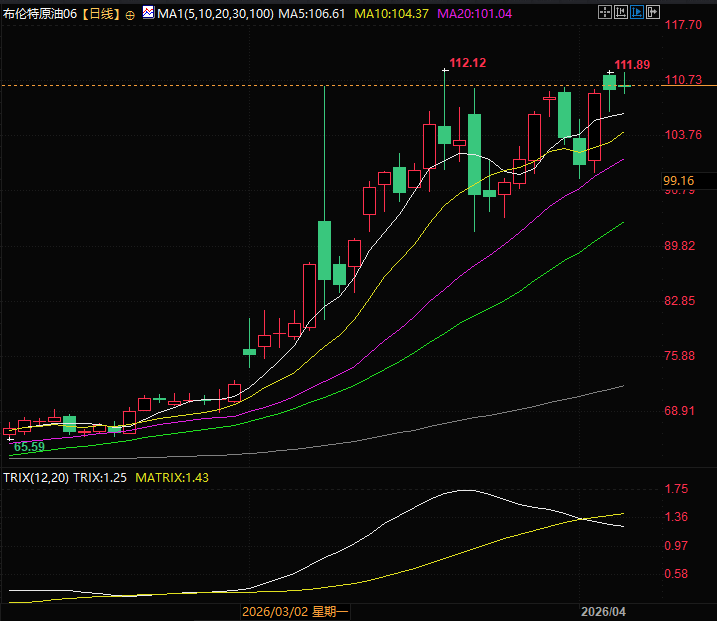
(Brent crude oil June futures contract daily chart, source: FX678)
At 16:52 Beijing time, the Brent crude oil June futures contract was trading at $109.90 per barrel.
Meanwhile, Iran's Khorramabad airport was also attacked by a coalition of US and Israeli forces, further highlighting the intensity and scope of the confrontation between the two sides.
This attack marks a shift in the US-Iran conflict beyond a simple military standoff, targeting Iran's core civilian infrastructure related to energy and military industries. It not only severely damaged Iran's domestic industrial system but also directly threatened the security of the global energy supply chain, becoming a key trigger for market sentiment and asset price volatility.
High inflation is forcing the Federal Reserve to shift its policy, with a fierce battle between expectations of interest rate hikes and demands for rate cuts.
The surge in energy prices triggered by the escalating conflict is completely reversing the direction of the Federal Reserve's monetary policy.
On Monday, key officials at the Federal Reserve made it clear that if inflation continues to hover above the central bank’s 2% target, raising interest rates may become a necessary measure—a clear signal that even as the ongoing conflict in Iran continues to impact global energy markets, some policymakers are quietly reversing their previous inclination to cut interest rates.
Cleveland Federal Reserve President Beth Hammark's remarks came as the war entered its sixth week, gasoline prices soared across the United States, and market concerns about the U.S. economic outlook intensified.
The emergence of expectations for interest rate hikes stands in stark contrast to the Federal Reserve's policy trajectory of cutting benchmark interest rates three times at the end of last year.
More importantly, this move could put the Federal Reserve in direct confrontation with President Donald Trump, who has previously publicly called for a significant reduction in interest rates to 1%.
Meanwhile, JPMorgan Chase CEO Jamie Dimon warned in his annual shareholder letter released Monday that the conflict could trigger “sustained and significant volatility in oil and commodity prices,” which in turn could push up inflation and ultimately cause interest rates to climb above current market expectations, further limiting the Federal Reserve’s policy adjustment space.
Key Points Analysis
In an interview with the Associated Press, Hammark revealed that while she prefers the Federal Reserve to keep benchmark interest rates stable "for a considerable period of time," she also acknowledged that the future policy path largely depends on how well the economy adapts to the rising energy costs caused by the war.
She stated, "I can foresee two scenarios: if the labor market deteriorates significantly, we may need to cut interest rates... or if inflation persists above the target level, we may have to raise interest rates."
Hammark added that "inflation has been above target for more than five years, and if inflation rises further, it will mean that it is "moving in the wrong direction from the 2% target."
The Cleveland Fed's own forecasts indicate that inflation may rise to 3.5% this month—the highest level since 2024.
Economists surveyed by FactSet expect the annual inflation rate to jump to 3.1% in March from 2.4% in February, with monthly consumer prices rising by 0.8%—the largest monthly increase in nearly four years, as inflationary pressures continue to transmit to the real economy.
Crude oil market experiences dramatic fluctuations: The Strait of Hormuz crisis becomes a key variable.
Escalating conflict between the US and Iran and the risk of navigation in the Strait of Hormuz have become the core drivers of volatility in the crude oil market.
Data from the American Automobile Association shows that as of Monday, the average price of gasoline across the United States was $4.12 per gallon, up 80 cents from a month ago, with prices in some parts of California soaring to $10 per gallon, significantly increasing the cost of travel for people.
This round of price increases is directly related to Iran's closure of the Strait of Hormuz, a narrow waterway that carries about 20% of the world's oil shipments and is a core node in the global energy artery.
As the conflict escalated, insurance companies either raised premiums or suspended coverage for tankers traveling along the route; shipping companies, in turn, diverted their vessels to Africa, which not only extended transit times by several weeks but also significantly increased logistics costs, further driving up global crude oil trade costs.
GasBuddy’s head of oil analysis, Patrick DeHaan, warned on Monday that even if a ceasefire agreement is reached, oil prices will not fall immediately.
He pointed out that the key variable lies in whether the Strait of Hormuz can truly achieve safe navigation—only when oil tankers resume passage will the market react accordingly, and the short-term high oil price trend is unlikely to reverse quickly.
International mediation stalled, US-Iran standoff continues
Faced with the escalating conflict, the international community has actively promoted mediation, but the hardline stances of both the US and Iran have led to a stalemate in the process.
Two unnamed Middle Eastern officials told the Associated Press that Egypt, Pakistan, and Turkey have submitted a proposal to Iran and the United States calling for a 45-day ceasefire and the reopening of the Strait of Hormuz.
However, the Associated Press reported that Iran has explicitly rejected the ceasefire proposal and insists on a permanent end to the war. It has also put forward core conditions, including a comprehensive ceasefire in the Middle East, the withdrawal of US troops from the Gulf, and Iranian control over the right of passage through the Strait of Hormuz. Iran refuses to exchange a "temporary ceasefire" for the opening of the strait.
Meanwhile, before issuing his ultimatum on Tuesday, Trump appeared to expand the scope of the strikes from civilian targets to the whole of Iran, saying that "the whole country could be completely destroyed overnight, and that night could be tomorrow," further escalating regional tensions.
Statements from all parties: Conflict impacts economic and energy landscape
President Donald Trump posted on TruthSocial on Friday: "Give us just a little more time and we can easily open the Strait of Hormuz, seize oil resources, and make a fortune. This would be an energy boom for the world."
JPMorgan Chase CEO Jamie Dimon said on Monday: "We are facing the risk of continued sharp fluctuations in oil and commodity prices due to the conflict in Iran, and the global supply chain will also be restructured, which may lead to stronger inflation stickiness and ultimately interest rates may be higher than the current market expectations."
Patrick DeHaan, head of oil analysis at GasBuddy, noted on the X platform: "A ceasefire itself has almost no direct impact on oil prices unless it fundamentally changes the current de facto blockade of the Strait of Hormuz."
He further added, "Only when the Strait of Hormuz is fully open to navigation, and after market confidence is restored, safety verification is completed, and ships begin to pass through normally, will oil prices gradually fall as confidence recovers."
White House Press Secretary Carolyn Levitt recently stated, "Once Operation Epic Fury's national security objectives are fully achieved, the American people will see oil and gas prices fall rapidly, possibly even below pre-operation levels."
Going forward, market focus will be on inflation data setting the tone for policy and the direction of oil prices.
The U.S. government will release the Federal Reserve's preferred inflation indicator for February on Thursday, followed by the full March Consumer Price Index on Friday. This will be the first key report to fully reflect the impact of war-induced energy cost increases on inflation, and may directly determine the pace of the Fed's subsequent monetary policy, becoming a core anchor for market trading.
Analysts generally warn that even if a ceasefire agreement is reached, the decline in gasoline prices will lag behind the trend in crude oil prices, as verification of safe passage for oil tankers may take days or even weeks, and shipping volumes in the Strait of Hormuz will gradually recover.
In the short term, the global energy market will continue to be in a state of high risk premium, and fluctuations in crude oil prices may further spread to the stock market and foreign exchange market, triggering a chain reaction in global asset prices.
(Brent crude oil June futures contract daily chart, source: FX678)
At 16:52 Beijing time, the Brent crude oil June futures contract was trading at $109.90 per barrel.
- Risk Warning and Disclaimer
- The market involves risk, and trading may not be suitable for all investors. This article is for reference only and does not constitute personal investment advice, nor does it take into account certain users’ specific investment objectives, financial situation, or other needs. Any investment decisions made based on this information are at your own risk.