USD/JPY approaches 161; Trump's Iran deadline in focus.
2026-04-07 18:20:58
On Tuesday (April 7), during the European session, the USD/JPY pair maintained a firm but volatile pattern, trading between 159.45 and 159.92, with an intraday high of 159.628. The overall market exhibited a "top-down" characteristic, with the dollar receiving safe-haven support due to the approaching deadline for Trump's Iran negotiations. However, Japanese Finance Minister Katayama's pledge to strengthen G7 coordination and intervention limited further upside potential. Meanwhile, the 30-day logarithmic correlation coefficient between USD/JPY and EUR/JPY was well below +0.5, indicating a weakening correlation and reduced market linkage.
In summary, although upside risks remain, the volatility premium in the options market is at a low level. The market generally expects the daily chart to eventually break through the 161 level, but in the short term, it is difficult to achieve a sustained one-sided rise due to the threat of continued intervention.
Reuters market analyst Martin Miller said: "The daily chart for the dollar against the yen suggests that it may eventually break through the 161 level, especially if the conversion line and the baseline are aligned positively."
Fundamental analysis
The interest rate differential between the US and Japan remains a core factor supporting the US dollar. The US Federal Reserve maintains relatively high interest rates, while the Bank of Japan's policy is relatively cautious, resulting in the interest rate differential continuing to provide positive support for the dollar. This week, the Fed's March meeting minutes and the US March CPI data will be the market focus. If the data is hawkish, it will further strengthen the dollar's strength.
Regarding the Bank of Japan, market bets on a short-term interest rate hike by the BoJ have cooled somewhat due to domestic economic data. Overall, the divergence in central bank monetary policies remains the main fundamental driver of the USD/JPY exchange rate.
Economic data
Japan's overall household spending fell 1.7% year-on-year in February, far worse than the market expectation of -0.7%, and further deteriorated from January's -1%. This unexpectedly weak data reflects a sluggish recovery in domestic consumption in Japan, which may force traders to lower their expectations for a hawkish policy from the Bank of Japan, putting downward pressure on the yen in the short term.
Geopolitical factors
The approaching deadline set by Trump regarding Iran became a significant catalyst for market activity today. US President Trump threatened to destroy Iranian power facilities and bridges if Iran did not reopen the Strait of Hormuz by 8 p.m. (Eastern Time) on Tuesday, and even suggested potentially resolving the issue "overnight." Geopolitical tensions increased demand for the US dollar as a safe haven, while also keeping the market wary of oil supply risks.
Currently, the VIX volatility index and US stocks (especially the Nasdaq) have not experienced sharp fluctuations, but the uncertainty of the situation in the Middle East remains a key variable affecting risk appetite.
mainstream view
Mainstream media generally believe that the US dollar will remain strong in the short term but its upside is limited. United Overseas Bank (UOB) analysts Quek Ser Leang and Lee Sue Ann pointed out: "The underlying tone for USD/JPY remains strong, but it is expected to trade in the 159.40-159.95 range, with a broader range of 158.80-160.45 over the next 1-3 weeks. While there is a chance to break through 159.45 in the long term, the high of 162.00 will act as upward resistance."
FXStreet analyst Sagar Dua said the USD/JPY pair held steady around 160.00 during the European session, with uncertainty surrounding the situation in Iran keeping the market cautious, and weak Japanese household spending data further dampening BoJ's hawkish bets.
Technical Analysis
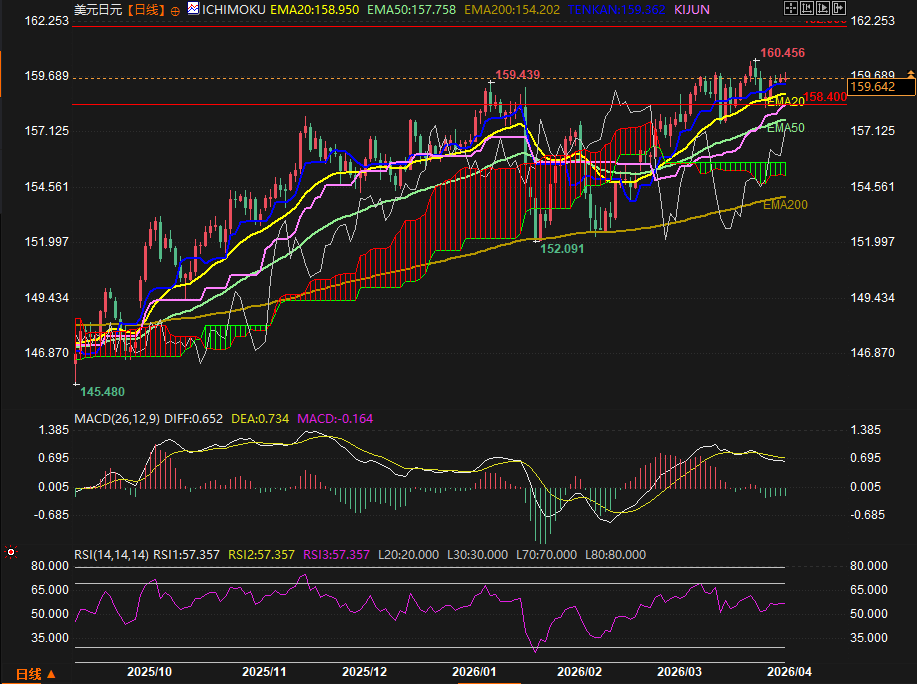
(USD/JPY daily chart source: FX678)
The daily chart shows the Ichimoku Cloud conversion line and baseline aligned in a bullish pattern, indicating an overall bullish market structure. The price is currently trading in the upper half of an ascending parallel channel, and the 20-day exponential moving average (EMA) continues to rise, providing support.
The RSI indicator is around 58, above the 50 line, indicating that upward momentum still exists but is not yet overbought. Short-term support is located near the lower channel line at 158.40; a break below this level would likely lead to a further decline to 157.70. The first resistance level is the upper channel line at 160.90; a break above this level could confirm a move towards 162.00.
Calendar reminders
There are no major US and Japanese economic data releases today (April 7).
Key focus this week (Beijing time):
The minutes of the Federal Reserve's March meeting (the specific release time is to be determined, usually on Wednesday or Thursday evening).
US March CPI data (expected to be released on Wednesday or Thursday)
The above data will directly impact expectations regarding the Federal Reserve's policy, and investors are advised to pay attention to it in advance.
Summary and Outlook
Considering market conditions, fundamentals, geopolitical factors, and technical indicators, the USD/JPY pair is expected to maintain a slightly bullish trend in the short term, potentially challenging the 161 level. However, the threat of Japanese intervention and geopolitical uncertainties continue to pose upward resistance. Investors should closely monitor this week's Federal Reserve data and developments in the Middle East, adjusting their positions accordingly.
Frequently Asked Questions
Question 1: What is the core impact of Trump's Iran deadline on the USD/JPY exchange rate?
Answer: Trump's explicit threat of military action if Iran does not reopen the Strait of Hormuz within the stipulated time directly escalated geopolitical risks, prompting capital inflows into the US dollar as a safe-haven asset, thus supporting the strengthening of the dollar against the yen. However, it also serves as a reminder to the market that escalating conflict could trigger fluctuations in oil prices, indirectly affecting global risk appetite.
Question 2: Why did Japan's February household spending data have a negative impact on the yen?
Answer: Household spending is a key indicator of domestic consumption in Japan. The actual decline of 1.7% was far worse than expected, indicating a weak consumption recovery. This will weaken market confidence in further monetary tightening by the Bank of Japan, reducing the attractiveness of the yen and thus putting downward pressure on the USD/JPY exchange rate.
Question 3: How will the US-Japan interest rate differential continue to play a role in the current environment?
Answer: The interest rate differential between the US maintaining relatively high interest rates and Japan's relatively loose monetary policy remains fundamentally unchanged. As long as the Federal Reserve is not in a hurry to cut interest rates significantly, this interest rate differential will continue to support the USD/JPY exchange rate. Even if short-term geopolitical events dominate the market, the interest rate differential remains the core anchoring factor for medium- to long-term pricing.
Question 4: Why is the correlation between USD/JPY and EUR/JPY breaking down?
Answer: Historically, USD/JPY and EUR/JPY have often moved in tandem, but currently, their 30-day correlation coefficient is far below 0.5, indicating that their driving factors are beginning to diverge. The US dollar is more influenced by US policy and geopolitical factors, while Eurozone economic data and ECB policies have an independent impact on EUR/JPY, leading to a weakening of their correlation.
Question 5: What background factors should investors focus on in the current environment?
Answer: In addition to exchange rate fluctuations themselves, it's crucial to pay attention to the Federal Reserve's meeting minutes and CPI data this week (which will determine the medium-term direction of the US dollar), the progress of Japan's domestic consumption recovery (affecting expectations for the Bank of Japan's policy), and the latest developments in the Middle East. These factors collectively form the key context for judging the short-term direction and risks of the USD/JPY exchange rate, helping investors avoid being misled by a single event.
In summary, although upside risks remain, the volatility premium in the options market is at a low level. The market generally expects the daily chart to eventually break through the 161 level, but in the short term, it is difficult to achieve a sustained one-sided rise due to the threat of continued intervention.
Reuters market analyst Martin Miller said: "The daily chart for the dollar against the yen suggests that it may eventually break through the 161 level, especially if the conversion line and the baseline are aligned positively."
Fundamental analysis
The interest rate differential between the US and Japan remains a core factor supporting the US dollar. The US Federal Reserve maintains relatively high interest rates, while the Bank of Japan's policy is relatively cautious, resulting in the interest rate differential continuing to provide positive support for the dollar. This week, the Fed's March meeting minutes and the US March CPI data will be the market focus. If the data is hawkish, it will further strengthen the dollar's strength.
Regarding the Bank of Japan, market bets on a short-term interest rate hike by the BoJ have cooled somewhat due to domestic economic data. Overall, the divergence in central bank monetary policies remains the main fundamental driver of the USD/JPY exchange rate.
Economic data
Japan's overall household spending fell 1.7% year-on-year in February, far worse than the market expectation of -0.7%, and further deteriorated from January's -1%. This unexpectedly weak data reflects a sluggish recovery in domestic consumption in Japan, which may force traders to lower their expectations for a hawkish policy from the Bank of Japan, putting downward pressure on the yen in the short term.
Geopolitical factors
The approaching deadline set by Trump regarding Iran became a significant catalyst for market activity today. US President Trump threatened to destroy Iranian power facilities and bridges if Iran did not reopen the Strait of Hormuz by 8 p.m. (Eastern Time) on Tuesday, and even suggested potentially resolving the issue "overnight." Geopolitical tensions increased demand for the US dollar as a safe haven, while also keeping the market wary of oil supply risks.
Currently, the VIX volatility index and US stocks (especially the Nasdaq) have not experienced sharp fluctuations, but the uncertainty of the situation in the Middle East remains a key variable affecting risk appetite.
mainstream view
Mainstream media generally believe that the US dollar will remain strong in the short term but its upside is limited. United Overseas Bank (UOB) analysts Quek Ser Leang and Lee Sue Ann pointed out: "The underlying tone for USD/JPY remains strong, but it is expected to trade in the 159.40-159.95 range, with a broader range of 158.80-160.45 over the next 1-3 weeks. While there is a chance to break through 159.45 in the long term, the high of 162.00 will act as upward resistance."
FXStreet analyst Sagar Dua said the USD/JPY pair held steady around 160.00 during the European session, with uncertainty surrounding the situation in Iran keeping the market cautious, and weak Japanese household spending data further dampening BoJ's hawkish bets.
Technical Analysis
(USD/JPY daily chart source: FX678)
The daily chart shows the Ichimoku Cloud conversion line and baseline aligned in a bullish pattern, indicating an overall bullish market structure. The price is currently trading in the upper half of an ascending parallel channel, and the 20-day exponential moving average (EMA) continues to rise, providing support.
The RSI indicator is around 58, above the 50 line, indicating that upward momentum still exists but is not yet overbought. Short-term support is located near the lower channel line at 158.40; a break below this level would likely lead to a further decline to 157.70. The first resistance level is the upper channel line at 160.90; a break above this level could confirm a move towards 162.00.
Calendar reminders
There are no major US and Japanese economic data releases today (April 7).
Key focus this week (Beijing time):
The minutes of the Federal Reserve's March meeting (the specific release time is to be determined, usually on Wednesday or Thursday evening).
US March CPI data (expected to be released on Wednesday or Thursday)
The above data will directly impact expectations regarding the Federal Reserve's policy, and investors are advised to pay attention to it in advance.
Summary and Outlook
Considering market conditions, fundamentals, geopolitical factors, and technical indicators, the USD/JPY pair is expected to maintain a slightly bullish trend in the short term, potentially challenging the 161 level. However, the threat of Japanese intervention and geopolitical uncertainties continue to pose upward resistance. Investors should closely monitor this week's Federal Reserve data and developments in the Middle East, adjusting their positions accordingly.
Frequently Asked Questions
Question 1: What is the core impact of Trump's Iran deadline on the USD/JPY exchange rate?
Answer: Trump's explicit threat of military action if Iran does not reopen the Strait of Hormuz within the stipulated time directly escalated geopolitical risks, prompting capital inflows into the US dollar as a safe-haven asset, thus supporting the strengthening of the dollar against the yen. However, it also serves as a reminder to the market that escalating conflict could trigger fluctuations in oil prices, indirectly affecting global risk appetite.
Question 2: Why did Japan's February household spending data have a negative impact on the yen?
Answer: Household spending is a key indicator of domestic consumption in Japan. The actual decline of 1.7% was far worse than expected, indicating a weak consumption recovery. This will weaken market confidence in further monetary tightening by the Bank of Japan, reducing the attractiveness of the yen and thus putting downward pressure on the USD/JPY exchange rate.
Question 3: How will the US-Japan interest rate differential continue to play a role in the current environment?
Answer: The interest rate differential between the US maintaining relatively high interest rates and Japan's relatively loose monetary policy remains fundamentally unchanged. As long as the Federal Reserve is not in a hurry to cut interest rates significantly, this interest rate differential will continue to support the USD/JPY exchange rate. Even if short-term geopolitical events dominate the market, the interest rate differential remains the core anchoring factor for medium- to long-term pricing.
Question 4: Why is the correlation between USD/JPY and EUR/JPY breaking down?
Answer: Historically, USD/JPY and EUR/JPY have often moved in tandem, but currently, their 30-day correlation coefficient is far below 0.5, indicating that their driving factors are beginning to diverge. The US dollar is more influenced by US policy and geopolitical factors, while Eurozone economic data and ECB policies have an independent impact on EUR/JPY, leading to a weakening of their correlation.
Question 5: What background factors should investors focus on in the current environment?
Answer: In addition to exchange rate fluctuations themselves, it's crucial to pay attention to the Federal Reserve's meeting minutes and CPI data this week (which will determine the medium-term direction of the US dollar), the progress of Japan's domestic consumption recovery (affecting expectations for the Bank of Japan's policy), and the latest developments in the Middle East. These factors collectively form the key context for judging the short-term direction and risks of the USD/JPY exchange rate, helping investors avoid being misled by a single event.
- Risk Warning and Disclaimer
- The market involves risk, and trading may not be suitable for all investors. This article is for reference only and does not constitute personal investment advice, nor does it take into account certain users’ specific investment objectives, financial situation, or other needs. Any investment decisions made based on this information are at your own risk.