AUD/USD Outlook: Energy Shock Shifts Market Focus from RBA to Global Risks
2026-04-07 19:07:17
On Tuesday (April 7), the deadline for Iran to reopen the Strait of Hormuz was the core risk event affecting the Australian dollar against the US dollar during the European trading session. Trump warned that if Iran failed to comply by 8:00 PM Eastern Time on Tuesday, the US military would strike Iranian power plants and bridges. This scenario signifies a clear escalation of geopolitical conflict and a significant increase in the risk of a long-term disruption to energy supplies.

This risk has continued to overshadow the economic fundamentals in Australia that should have been beneficial to the Australian dollar.
Australian inflation surges, but consumer spending remains resilient.
The conflict with Iran has exacerbated Australia's inflation problem. The Melbourne Institute's inflation gauge surged 1.3% month-on-month in March, the largest monthly increase on record, while the year-on-year growth rate rose to 4.3%. Rising oil prices are the main driver of this round of inflation, but if the situation continues, inflation may have a second transmission effect through wages and inflation expectations.
Meanwhile, household consumption remained resilient. Data from the Australian Bureau of Statistics in February showed that nominal consumption rose 0.3% month-on-month, with discretionary services remaining the main driver.
It is precisely this combination of inflation and consumption that has led traders to price in the possibility of further rate hikes by the Reserve Bank of Australia (RBA), even amid significant downward pressure on economic activity. The market anticipates a roughly 75% probability of a 25 basis point rate hike by the RBA in May. If implemented, this would mark the third consecutive rate hike, bringing the cash rate back to 4.35%, the peak level of the previous tightening cycle. Furthermore, the market is still pricing in the possibility of further rate increases.
Normally, such fundamentals should support a stronger Australian dollar against the US dollar, but this is not the case in the current situation.
Market risk appetite drives the AUD/USD exchange rate.
Regarding the deadline for the Strait of Hormuz, the market widely expects Trump to once again push for de-escalation; otherwise, the Australian dollar would have already fallen sharply. Although market movements suggest a higher probability of de-escalation, the key for the Australian dollar lies in the distribution of outcomes across different scenarios.
An escalation of the conflict would directly threaten energy supplies, drag down global economic growth, and consequently suppress the Australian dollar's appreciation against the US dollar. Even if this scenario is unlikely, its impact on exchange rates would be extremely severe should it materialize.
The above judgment is also confirmed by correlation analysis: In the past week, the correlation between the Australian dollar and the US dollar and the two-year interest rate spread between Australia and the US dollar fell to -0.25, and in the past month and the past quarter, it was only 0.15 and 0.13, respectively, and the correlation has basically failed; in contrast, its correlation with the yield of US Treasury bonds is much stronger.
The most sensitive factor for the Australian dollar at present is market risk appetite. Over the past week, the correlation between the Australian dollar and the Nasdaq and S&P 500 stock index futures was close to 0.9, indicating that as market focus shifts from the initial energy price shock to its impact on global growth, the Australian dollar is still trading according to the logic of a pro-cyclical asset.
Energy risks are changing the logic of macro trading.
Since the outbreak of the conflict, energy channels have been a core factor influencing the Australian dollar's performance: initially, the Australian dollar outperformed other currencies due to improved terms of commodity trade, but later returned to its traditional role as a barometer of market risk appetite and the global economic outlook.
The US is far less affected by energy supply disruptions than Australia, so the US market is more focused on inflation; moreover, the US is largely energy-self-sufficient, ensuring supply even with rising prices. Australia, on the other hand, is heavily reliant on imports for diesel, gasoline, and jet fuel, and its market concerns extend beyond oil price inflation to include the impact of actual supply shortages on economic activity.
This explains why rising energy prices and increasing expectations of a Reserve Bank of Australia (RBA) rate hike have failed to translate into a stronger Australian dollar. Coupled with a deteriorating macroeconomic environment and high market volatility, the Australian dollar continues to face upward resistance.
Technical Analysis: No Need for Overly Complex Interpretation
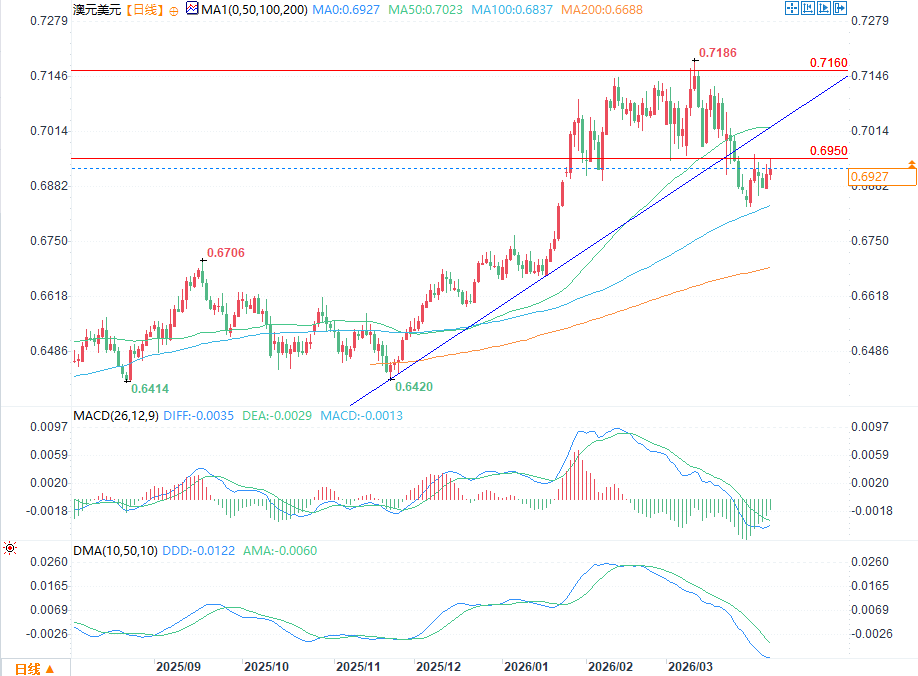
(AUD/USD daily chart source: FX678)
In the short term, technical signals will almost certainly be overshadowed by geopolitical developments, with the key factor being whether Trump can once again facilitate a de-escalation of the conflict.
If the situation eases, 0.6950 will be the first key resistance level. This price level has acted as both support and resistance multiple times recently, with sharp reversals occurring after the exchange rate broke through it. Therefore, risk management should be the top priority. If the price can effectively hold above 0.6950, it will test the 50-day moving average, which is also the last key resistance level before attempting to break above the March high of 0.7160.
If the US military strikes Iranian infrastructure and the conflict escalates significantly, the risk of a long-term disruption to energy supplies will increase, putting significant downward pressure on the Australian dollar against the US dollar. The bears' targets are 0.6835 (100-day moving average), 0.6800, and the 200-day moving average.
From a momentum perspective, both the 14-period Relative Strength Index (RSI) and the Moving Average Convergence Divergence (MACD) have moved away from their recent lows, but purely technical analysis still favors selling on rallies. The RSI remains below the 50 neutral line, and while the MACD may cross above the signal line, it remains deep in negative territory.
At 19:05 Beijing time, the Australian dollar/US dollar exchange rate was 0.6928/29, up 0.19%.
This risk has continued to overshadow the economic fundamentals in Australia that should have been beneficial to the Australian dollar.
Australian inflation surges, but consumer spending remains resilient.
The conflict with Iran has exacerbated Australia's inflation problem. The Melbourne Institute's inflation gauge surged 1.3% month-on-month in March, the largest monthly increase on record, while the year-on-year growth rate rose to 4.3%. Rising oil prices are the main driver of this round of inflation, but if the situation continues, inflation may have a second transmission effect through wages and inflation expectations.
Meanwhile, household consumption remained resilient. Data from the Australian Bureau of Statistics in February showed that nominal consumption rose 0.3% month-on-month, with discretionary services remaining the main driver.
It is precisely this combination of inflation and consumption that has led traders to price in the possibility of further rate hikes by the Reserve Bank of Australia (RBA), even amid significant downward pressure on economic activity. The market anticipates a roughly 75% probability of a 25 basis point rate hike by the RBA in May. If implemented, this would mark the third consecutive rate hike, bringing the cash rate back to 4.35%, the peak level of the previous tightening cycle. Furthermore, the market is still pricing in the possibility of further rate increases.
Normally, such fundamentals should support a stronger Australian dollar against the US dollar, but this is not the case in the current situation.
Market risk appetite drives the AUD/USD exchange rate.
Regarding the deadline for the Strait of Hormuz, the market widely expects Trump to once again push for de-escalation; otherwise, the Australian dollar would have already fallen sharply. Although market movements suggest a higher probability of de-escalation, the key for the Australian dollar lies in the distribution of outcomes across different scenarios.
An escalation of the conflict would directly threaten energy supplies, drag down global economic growth, and consequently suppress the Australian dollar's appreciation against the US dollar. Even if this scenario is unlikely, its impact on exchange rates would be extremely severe should it materialize.
The above judgment is also confirmed by correlation analysis: In the past week, the correlation between the Australian dollar and the US dollar and the two-year interest rate spread between Australia and the US dollar fell to -0.25, and in the past month and the past quarter, it was only 0.15 and 0.13, respectively, and the correlation has basically failed; in contrast, its correlation with the yield of US Treasury bonds is much stronger.
The most sensitive factor for the Australian dollar at present is market risk appetite. Over the past week, the correlation between the Australian dollar and the Nasdaq and S&P 500 stock index futures was close to 0.9, indicating that as market focus shifts from the initial energy price shock to its impact on global growth, the Australian dollar is still trading according to the logic of a pro-cyclical asset.
Energy risks are changing the logic of macro trading.
Since the outbreak of the conflict, energy channels have been a core factor influencing the Australian dollar's performance: initially, the Australian dollar outperformed other currencies due to improved terms of commodity trade, but later returned to its traditional role as a barometer of market risk appetite and the global economic outlook.
The US is far less affected by energy supply disruptions than Australia, so the US market is more focused on inflation; moreover, the US is largely energy-self-sufficient, ensuring supply even with rising prices. Australia, on the other hand, is heavily reliant on imports for diesel, gasoline, and jet fuel, and its market concerns extend beyond oil price inflation to include the impact of actual supply shortages on economic activity.
This explains why rising energy prices and increasing expectations of a Reserve Bank of Australia (RBA) rate hike have failed to translate into a stronger Australian dollar. Coupled with a deteriorating macroeconomic environment and high market volatility, the Australian dollar continues to face upward resistance.
Technical Analysis: No Need for Overly Complex Interpretation
(AUD/USD daily chart source: FX678)
In the short term, technical signals will almost certainly be overshadowed by geopolitical developments, with the key factor being whether Trump can once again facilitate a de-escalation of the conflict.
If the situation eases, 0.6950 will be the first key resistance level. This price level has acted as both support and resistance multiple times recently, with sharp reversals occurring after the exchange rate broke through it. Therefore, risk management should be the top priority. If the price can effectively hold above 0.6950, it will test the 50-day moving average, which is also the last key resistance level before attempting to break above the March high of 0.7160.
If the US military strikes Iranian infrastructure and the conflict escalates significantly, the risk of a long-term disruption to energy supplies will increase, putting significant downward pressure on the Australian dollar against the US dollar. The bears' targets are 0.6835 (100-day moving average), 0.6800, and the 200-day moving average.
From a momentum perspective, both the 14-period Relative Strength Index (RSI) and the Moving Average Convergence Divergence (MACD) have moved away from their recent lows, but purely technical analysis still favors selling on rallies. The RSI remains below the 50 neutral line, and while the MACD may cross above the signal line, it remains deep in negative territory.
At 19:05 Beijing time, the Australian dollar/US dollar exchange rate was 0.6928/29, up 0.19%.
- Risk Warning and Disclaimer
- The market involves risk, and trading may not be suitable for all investors. This article is for reference only and does not constitute personal investment advice, nor does it take into account certain users’ specific investment objectives, financial situation, or other needs. Any investment decisions made based on this information are at your own risk.