The Strait of Hormuz remains closed, and escalating conflict with Iran pushes up energy costs.
2026-04-08 00:41:55
Oil prices continued to climb during the European trading session on Tuesday (April 7), with West Texas Intermediate (WTI) crude oil on track to close at its highest level since June 2022 for the fourth consecutive trading day. This followed US President Trump's ultimatum to Iran, demanding the opening of the Strait of Hormuz by the end of Tuesday, or he would strike Iranian power plants and other infrastructure. However, Iran has not shown any signs of accepting the ultimatum, and the regional conflict continues to escalate.
Benchmark oil prices diverge, with market-pricing prioritizing immediate supply.
International benchmark oil prices diverged, with the market focusing primarily on the immediate supply gap. Brent crude futures fell 0.11% to $119.52 a barrel, while WTI crude rose 2.3% to $115 a barrel.
Normally, WTI crude oil is priced at a discount to Brent crude, but currently, the May WTI contract (with a closer delivery date than the June Brent contract) is trading at a significant premium, clearly reflecting the market's extreme thirst for immediate crude oil supply. Saxo Bank analyst Ole Hansen points out that this change in relative value essentially means the market is paying a high premium for the "immediacy" of supply.
Geopolitical conflicts escalate, shipping in the Strait of Hormuz freezes
The Strait of Hormuz, which handles approximately 20% of the world's oil and liquefied natural gas transport, remains completely closed. Meanwhile, Iran is under intense attack on its railways, highway bridges, airports, petrochemical plants, and power transmission lines, with explosions reported on its main oil export terminal, Kharg Island. In retaliation, the Iranian Revolutionary Guard attacked the Jubail petrochemical complex in Saudi Arabia, a core hub for Saudi Arabia's downstream oil industry.
Despite reports from Pakistani sources that the US and Iran are still working to facilitate dialogue, President Trump warned that "the entire civilization could perish tonight." Disruptions to oil exports from the Gulf region have led to a sharp tightening of global supply. While OPEC+ agreed to increase production by 206,000 barrels per day in May, this increase is virtually ineffective given the closure of the Strait of Hormuz.
Data shows that crude oil exports from Saudi Arabia's Yanbu port fell 15% week-on-week. Iraq has stated that it has the capacity to restore crude oil exports to 3.4 million barrels per day within a week once the conflict ends and the Straits of Hormuz reopen.
Some oil-producing countries profited handsomely, while others suffered heavy losses.
According to a Reuters analysis, oil-producing countries such as Iran, Oman, and Saudi Arabia, which are still able to maintain exports, are reaping huge financial benefits from soaring oil prices; while other Gulf oil-producing countries are losing billions of dollars due to blocked exports.
In response to the impact of oil price shocks, China has once again limited the increase in domestic gasoline and diesel prices to half of the normal level. Japanese Finance Minister Satsuki Katayama stated that Japan will maintain close communication with G7 countries to jointly assess the impact of the Middle East conflict on national fiscal policies.
Increased inflationary pressures in the US put the Federal Reserve's interest rate cut path to the test.
Derek Halpenny, head of research at MUFG, pointed out that the Middle East conflict has driven up oil and gasoline prices, which will significantly push up US inflation.
Data forecasts indicate that the US CPI is expected to surge to 1.0% month-on-month in March, up from 0.3% in February, marking the largest monthly increase since June 2022. Meanwhile, the ISM Services Preference Payments Index jumped from 63.0 to 70.7, the largest monthly increase since 2012. US gasoline prices surged 36.2% in March and continue to climb daily into April. Currently, US employment indicators are showing signs of weakening, but consumer confidence has not yet been significantly impacted.
MUFG believes that although the upcoming FOMC March meeting minutes may send a more hawkish signal, given the still weak fundamentals of US economic growth, the bank still expects the Fed to implement two rate cuts in 2026.
TD Securities' commodities team warned that supply shocks in the Persian Gulf region will support oil prices at high levels in the long term. Even if the conflict ends quickly, the energy supply deficit and low inventory levels will keep crude oil, refined products, and LNG prices in the $90-$100 per barrel range throughout 2027. If the conflict continues, there is a possibility that oil prices could rise by more than $50.
Market focus shifts to inventory data
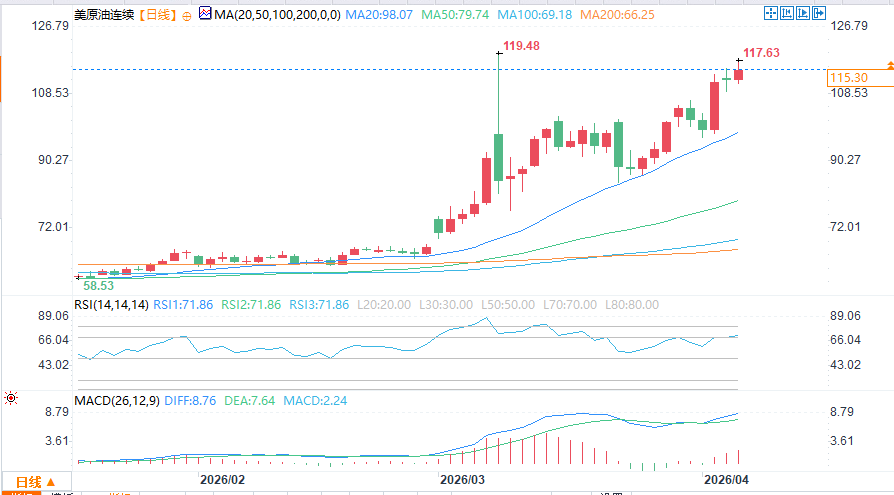
(WTI crude oil daily chart source: FX678)
This week, market attention will be focused on U.S. crude oil inventory data. The American Petroleum Institute (API) will release its weekly inventory report on Tuesday evening, while data from the U.S. Energy Information Administration (EIA) will be released on Wednesday. Analysts generally expect U.S. commercial crude oil inventories to have decreased by 1.6 million barrels last week.
The energy price shock triggered by the conflict has rapidly spread to the global economy. In the coming months, consumer protection measures, policy differences among central banks, and the continued tightness in global crude oil supply will be the core themes dominating international markets.
Benchmark oil prices diverge, with market-pricing prioritizing immediate supply.
International benchmark oil prices diverged, with the market focusing primarily on the immediate supply gap. Brent crude futures fell 0.11% to $119.52 a barrel, while WTI crude rose 2.3% to $115 a barrel.
Normally, WTI crude oil is priced at a discount to Brent crude, but currently, the May WTI contract (with a closer delivery date than the June Brent contract) is trading at a significant premium, clearly reflecting the market's extreme thirst for immediate crude oil supply. Saxo Bank analyst Ole Hansen points out that this change in relative value essentially means the market is paying a high premium for the "immediacy" of supply.
Geopolitical conflicts escalate, shipping in the Strait of Hormuz freezes
The Strait of Hormuz, which handles approximately 20% of the world's oil and liquefied natural gas transport, remains completely closed. Meanwhile, Iran is under intense attack on its railways, highway bridges, airports, petrochemical plants, and power transmission lines, with explosions reported on its main oil export terminal, Kharg Island. In retaliation, the Iranian Revolutionary Guard attacked the Jubail petrochemical complex in Saudi Arabia, a core hub for Saudi Arabia's downstream oil industry.
Despite reports from Pakistani sources that the US and Iran are still working to facilitate dialogue, President Trump warned that "the entire civilization could perish tonight." Disruptions to oil exports from the Gulf region have led to a sharp tightening of global supply. While OPEC+ agreed to increase production by 206,000 barrels per day in May, this increase is virtually ineffective given the closure of the Strait of Hormuz.
Data shows that crude oil exports from Saudi Arabia's Yanbu port fell 15% week-on-week. Iraq has stated that it has the capacity to restore crude oil exports to 3.4 million barrels per day within a week once the conflict ends and the Straits of Hormuz reopen.
Some oil-producing countries profited handsomely, while others suffered heavy losses.
According to a Reuters analysis, oil-producing countries such as Iran, Oman, and Saudi Arabia, which are still able to maintain exports, are reaping huge financial benefits from soaring oil prices; while other Gulf oil-producing countries are losing billions of dollars due to blocked exports.
In response to the impact of oil price shocks, China has once again limited the increase in domestic gasoline and diesel prices to half of the normal level. Japanese Finance Minister Satsuki Katayama stated that Japan will maintain close communication with G7 countries to jointly assess the impact of the Middle East conflict on national fiscal policies.
Increased inflationary pressures in the US put the Federal Reserve's interest rate cut path to the test.
Derek Halpenny, head of research at MUFG, pointed out that the Middle East conflict has driven up oil and gasoline prices, which will significantly push up US inflation.
Data forecasts indicate that the US CPI is expected to surge to 1.0% month-on-month in March, up from 0.3% in February, marking the largest monthly increase since June 2022. Meanwhile, the ISM Services Preference Payments Index jumped from 63.0 to 70.7, the largest monthly increase since 2012. US gasoline prices surged 36.2% in March and continue to climb daily into April. Currently, US employment indicators are showing signs of weakening, but consumer confidence has not yet been significantly impacted.
MUFG believes that although the upcoming FOMC March meeting minutes may send a more hawkish signal, given the still weak fundamentals of US economic growth, the bank still expects the Fed to implement two rate cuts in 2026.
TD Securities' commodities team warned that supply shocks in the Persian Gulf region will support oil prices at high levels in the long term. Even if the conflict ends quickly, the energy supply deficit and low inventory levels will keep crude oil, refined products, and LNG prices in the $90-$100 per barrel range throughout 2027. If the conflict continues, there is a possibility that oil prices could rise by more than $50.
Market focus shifts to inventory data
(WTI crude oil daily chart source: FX678)
This week, market attention will be focused on U.S. crude oil inventory data. The American Petroleum Institute (API) will release its weekly inventory report on Tuesday evening, while data from the U.S. Energy Information Administration (EIA) will be released on Wednesday. Analysts generally expect U.S. commercial crude oil inventories to have decreased by 1.6 million barrels last week.
The energy price shock triggered by the conflict has rapidly spread to the global economy. In the coming months, consumer protection measures, policy differences among central banks, and the continued tightness in global crude oil supply will be the core themes dominating international markets.
- Risk Warning and Disclaimer
- The market involves risk, and trading may not be suitable for all investors. This article is for reference only and does not constitute personal investment advice, nor does it take into account certain users’ specific investment objectives, financial situation, or other needs. Any investment decisions made based on this information are at your own risk.