One chart: The Baltic Dry Index hit a new high in over a month, driven by gains across all ship types.
2026-04-08 00:17:49
The latest data shows that the Baltic Dry Index (BDI) reached 2095 points on April 7, 2026, a new high since March 5, 2026, up 1.40% month-on-month, marking the third consecutive day of increase (including zero growth). Looking at the short-term charts, the recent 11 BDI data points show: 6 positive increases, 5 negative increases, and 0 zero increases. Specifically, the Panamax Freight Index (BPI) was 1802 points, up 1.01% from the previous value; the Capesize Freight Index (BCI) was 3148 points, up 2.01%; and the Supramax Freight Index (BSI) was 1231 points, up 0.57%. For detailed 720-day and 10-year trend charts of the Baltic Dry Index and its three main sub-indices, please refer to the specially designed charts.
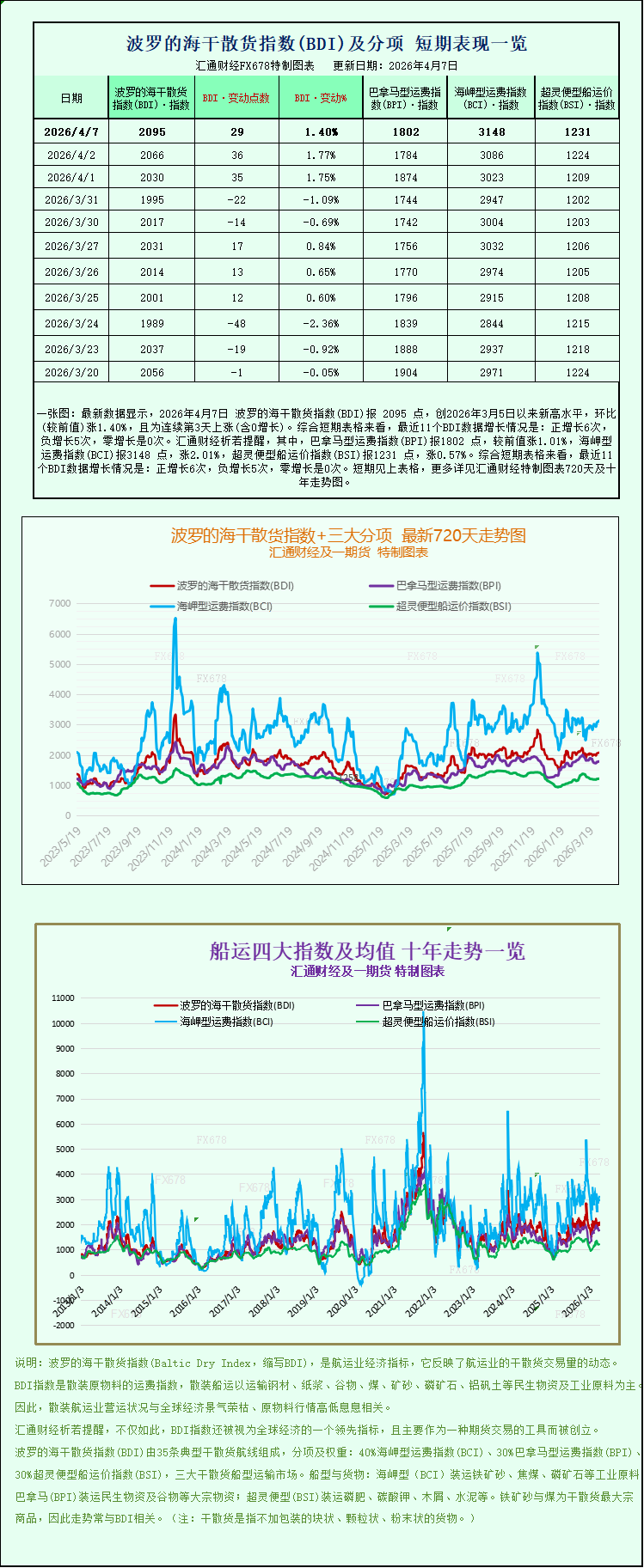
Driven by strong freight rates across all major vessel types, the Baltic Dry Index continued its steady upward trend, reaching a new high in more than a month, indicating a significant rebound in market activity.
The Baltic Dry Index, a key indicator for monitoring freight rates for dry bulk commodities such as iron ore, coal, and grains globally, climbed to its highest level in over a month during Tuesday's trading session. This surge was not driven by a single vessel type, but rather by a simultaneous increase in freight rates across all vessel classes, including Capesize, Panamax, and Supramax, reflecting a recovery in overall demand and trading sentiment in the dry bulk shipping market.
Among them, the Baltic Dry Index, which comprehensively reflects the freight rate trends of Capesize, Panamax and Supramax vessels, rose 29 points on the day, with an overall increase of 1.8%, and finally closed at 2095 points, the highest level since March 5 this year, indicating a significant upward shift in the center of gravity of market freight rates.
As one of the main vessel types in the dry bulk shipping market, the Capesize index performed particularly well, surging 62 points, or nearly 2%, to close at 3148 points, also a new high in over a month. This type of vessel mainly carries 150,000-tonnage bulk dry cargoes, with core commodities including iron ore and thermal coal, among other basic industrial raw materials. The rise in its freight rates directly reflects the recovery in demand for upstream raw material transportation. Driven by freight rates, the average daily charter rate income for Capesize vessels also increased, rising by $557 to $25,045, leading to a continued improvement in shipowner profitability.
Meanwhile, the spot and futures markets for commodities also provided support for shipping rates. International iron ore futures prices continued their upward trend on Tuesday, achieving gains for the third consecutive trading day. Following the long weekend holiday, the Chinese market, the world's largest importer of iron ore, resumed normal trading. Capital inflows and restocking demand gradually materialized. Coupled with market investors' continued focus on developments in the Middle East and their awaiting further clarity on a solution to the conflict involving Iran, risk aversion and trading expectations jointly drove up both raw material prices and shipping demand.
The Panamax index, representing medium-sized dry bulk carriers, also rose steadily, gaining 18 points, or 1%, to close at 1802 points. This type of vessel primarily carries 60,000 to 70,000 tons of bulk cargo such as coal and grain, and is a crucial carrier for global food and energy transportation. The rise in freight rates reflects a steady recovery in demand for food and energy bulk cargo transportation. As a result, the average daily profit of Panamax vessels increased by $164 to $16,220, indicating a steady improvement in the operating efficiency of medium-sized vessels.
In addition, the Supramax bulk carrier index also saw a slight increase, rising 7 points, or 0.6%, to close at 1231 points. These vessels are suitable for small-volume, multi-port bulk cargo transportation, and the moderate increase in freight rates indicates a recovery in demand in this segment, further consolidating the upward trend in the overall dry bulk shipping market.
Driven by strong freight rates across all major vessel types, the Baltic Dry Index continued its steady upward trend, reaching a new high in more than a month, indicating a significant rebound in market activity.
The Baltic Dry Index, a key indicator for monitoring freight rates for dry bulk commodities such as iron ore, coal, and grains globally, climbed to its highest level in over a month during Tuesday's trading session. This surge was not driven by a single vessel type, but rather by a simultaneous increase in freight rates across all vessel classes, including Capesize, Panamax, and Supramax, reflecting a recovery in overall demand and trading sentiment in the dry bulk shipping market.
Among them, the Baltic Dry Index, which comprehensively reflects the freight rate trends of Capesize, Panamax and Supramax vessels, rose 29 points on the day, with an overall increase of 1.8%, and finally closed at 2095 points, the highest level since March 5 this year, indicating a significant upward shift in the center of gravity of market freight rates.
As one of the main vessel types in the dry bulk shipping market, the Capesize index performed particularly well, surging 62 points, or nearly 2%, to close at 3148 points, also a new high in over a month. This type of vessel mainly carries 150,000-tonnage bulk dry cargoes, with core commodities including iron ore and thermal coal, among other basic industrial raw materials. The rise in its freight rates directly reflects the recovery in demand for upstream raw material transportation. Driven by freight rates, the average daily charter rate income for Capesize vessels also increased, rising by $557 to $25,045, leading to a continued improvement in shipowner profitability.
Meanwhile, the spot and futures markets for commodities also provided support for shipping rates. International iron ore futures prices continued their upward trend on Tuesday, achieving gains for the third consecutive trading day. Following the long weekend holiday, the Chinese market, the world's largest importer of iron ore, resumed normal trading. Capital inflows and restocking demand gradually materialized. Coupled with market investors' continued focus on developments in the Middle East and their awaiting further clarity on a solution to the conflict involving Iran, risk aversion and trading expectations jointly drove up both raw material prices and shipping demand.
The Panamax index, representing medium-sized dry bulk carriers, also rose steadily, gaining 18 points, or 1%, to close at 1802 points. This type of vessel primarily carries 60,000 to 70,000 tons of bulk cargo such as coal and grain, and is a crucial carrier for global food and energy transportation. The rise in freight rates reflects a steady recovery in demand for food and energy bulk cargo transportation. As a result, the average daily profit of Panamax vessels increased by $164 to $16,220, indicating a steady improvement in the operating efficiency of medium-sized vessels.
In addition, the Supramax bulk carrier index also saw a slight increase, rising 7 points, or 0.6%, to close at 1231 points. These vessels are suitable for small-volume, multi-port bulk cargo transportation, and the moderate increase in freight rates indicates a recovery in demand in this segment, further consolidating the upward trend in the overall dry bulk shipping market.
- Risk Warning and Disclaimer
- The market involves risk, and trading may not be suitable for all investors. This article is for reference only and does not constitute personal investment advice, nor does it take into account certain users’ specific investment objectives, financial situation, or other needs. Any investment decisions made based on this information are at your own risk.