Gold continued its rebound as geopolitical tensions eased and the US dollar weakened.
2026-04-08 09:52:18
The international gold market continued its upward trend in Asian trading on Wednesday, with prices briefly approaching $4,815 per ounce , demonstrating resilience in a complex macroeconomic environment. Despite a temporary easing of tensions in the Middle East and US President Trump's announcement of a two-week suspension of military action against Iran, gold did not experience a significant pullback; instead, it attracted some funds for repositioning.

One precious metals analyst pointed out: "The current rise in gold prices is not only driven by safe-haven demand, but also by inflation expectations and policy uncertainty."
In the context of this event, the ceasefire arrangement comes with conditions: Iran must restore passage through the Strait of Hormuz, and further negotiations will take place in Pakistan. This news has alleviated market concerns about energy supply disruptions to some extent, but it has not completely eliminated uncertainty. The Strait of Hormuz handles approximately 20% of global maritime energy transport , and its operational status remains a key variable of market focus.
Meanwhile, the previous surge in crude oil prices has driven up global energy costs. Rising energy prices often push up inflation expectations through transmission mechanisms, thus supporting gold prices. Since gold is considered an important asset for hedging against inflation, demand for it typically increases during periods of rising price pressure. This is one of the key reasons why gold has been able to maintain its high levels despite easing risks.
Some institutions believe that "energy shocks may prolong the inflation decline cycle, which will limit the room for central banks to cut interest rates, thereby indirectly affecting the price of gold."
From a macroeconomic perspective, the market is reassessing the Federal Reserve's policy path. Inflationary pressures from rising energy prices are limiting the scope for monetary policy easing. Market surveys indicate that the market currently expects a roughly 40% probability of an interest rate cut this year. This uncertainty creates a complex interplay between interest rates and safe-haven demand for gold. On one hand, a high-interest-rate environment diminishes gold's appeal; on the other hand, inflation and uncertainty support its price.
Furthermore, market risk sentiment has not fully stabilized. Although the short-term ceasefire has eased tensions, the outcome of the negotiations remains highly uncertain. If the situation deteriorates again, safe-haven funds could quickly flow back into the gold market, pushing prices further up. Therefore, the current gold price movement exhibits a clear "dual-driven structure," namely, the combined effect of safe-haven demand and inflation expectations.
From a technical perspective, the daily chart shows that gold remains in a strong upward channel, with prices holding at high levels and the overall trend intact. Key support lies around $4750 , the lower edge of the recent trading range; resistance is concentrated around $4850 , a break above which could open up further upside potential. Momentum-wise, bulls still dominate, but upward momentum has slowed. The 4-hour chart shows a short-term consolidation pattern at high levels, with prices oscillating within a range. If prices stabilize after testing support, further upward movement is possible; however, a break below $4750 could trigger a technical correction.
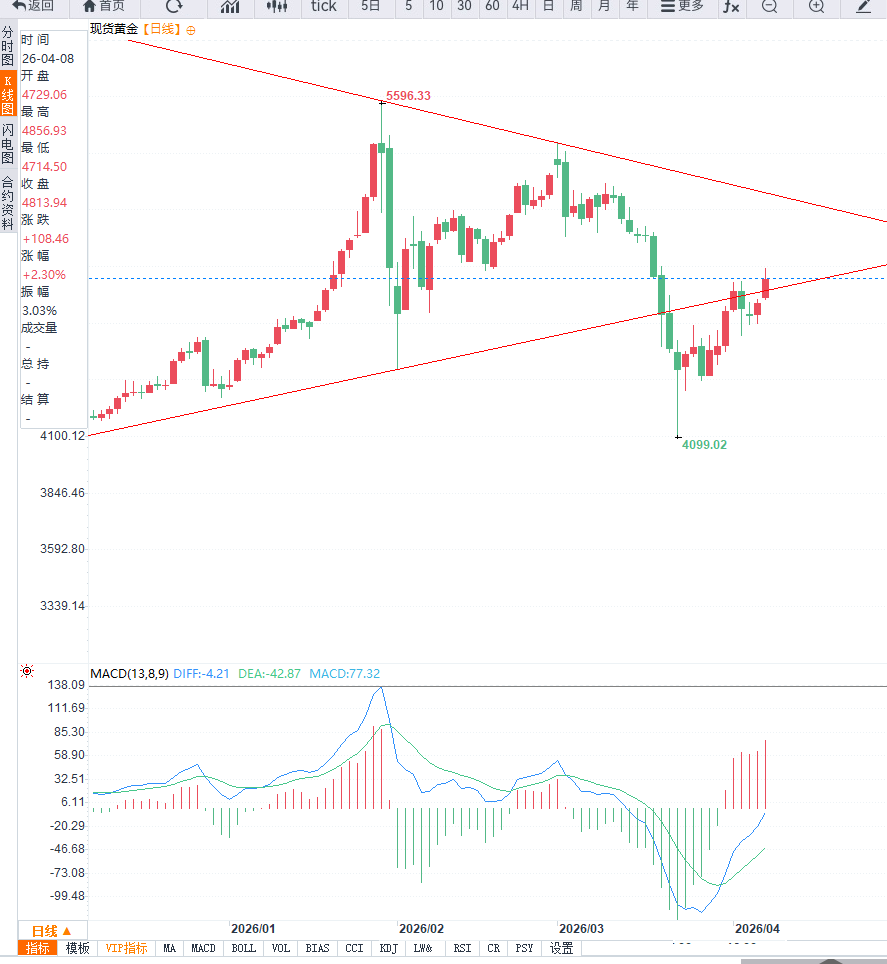
Overall, gold is currently at a critical juncture where macroeconomic variables are intertwined. While safe-haven demand has cooled somewhat, it has not disappeared, while inflation expectations continue to provide support, keeping prices in a high range.
Editor's Summary : The core driver of this round of gold price increases has shifted from a single safe-haven logic to a dual structure of "inflation expectations + policy uncertainty." Although the short-term easing of the Middle East situation has weakened some safe-haven demand, inflationary pressures from rising energy prices have provided new support for gold. Future trends will depend on two key variables: whether the geopolitical situation remains stable and whether the Federal Reserve's policy shifts towards clear easing. Under the influence of multiple factors, gold may maintain high-level fluctuations in the short term, but still possesses upward potential in the medium to long term. However, the risk of a pullback due to changes in interest rate expectations should be noted.
One precious metals analyst pointed out: "The current rise in gold prices is not only driven by safe-haven demand, but also by inflation expectations and policy uncertainty."
In the context of this event, the ceasefire arrangement comes with conditions: Iran must restore passage through the Strait of Hormuz, and further negotiations will take place in Pakistan. This news has alleviated market concerns about energy supply disruptions to some extent, but it has not completely eliminated uncertainty. The Strait of Hormuz handles approximately 20% of global maritime energy transport , and its operational status remains a key variable of market focus.
Meanwhile, the previous surge in crude oil prices has driven up global energy costs. Rising energy prices often push up inflation expectations through transmission mechanisms, thus supporting gold prices. Since gold is considered an important asset for hedging against inflation, demand for it typically increases during periods of rising price pressure. This is one of the key reasons why gold has been able to maintain its high levels despite easing risks.
Some institutions believe that "energy shocks may prolong the inflation decline cycle, which will limit the room for central banks to cut interest rates, thereby indirectly affecting the price of gold."
From a macroeconomic perspective, the market is reassessing the Federal Reserve's policy path. Inflationary pressures from rising energy prices are limiting the scope for monetary policy easing. Market surveys indicate that the market currently expects a roughly 40% probability of an interest rate cut this year. This uncertainty creates a complex interplay between interest rates and safe-haven demand for gold. On one hand, a high-interest-rate environment diminishes gold's appeal; on the other hand, inflation and uncertainty support its price.
Furthermore, market risk sentiment has not fully stabilized. Although the short-term ceasefire has eased tensions, the outcome of the negotiations remains highly uncertain. If the situation deteriorates again, safe-haven funds could quickly flow back into the gold market, pushing prices further up. Therefore, the current gold price movement exhibits a clear "dual-driven structure," namely, the combined effect of safe-haven demand and inflation expectations.
From a technical perspective, the daily chart shows that gold remains in a strong upward channel, with prices holding at high levels and the overall trend intact. Key support lies around $4750 , the lower edge of the recent trading range; resistance is concentrated around $4850 , a break above which could open up further upside potential. Momentum-wise, bulls still dominate, but upward momentum has slowed. The 4-hour chart shows a short-term consolidation pattern at high levels, with prices oscillating within a range. If prices stabilize after testing support, further upward movement is possible; however, a break below $4750 could trigger a technical correction.
Overall, gold is currently at a critical juncture where macroeconomic variables are intertwined. While safe-haven demand has cooled somewhat, it has not disappeared, while inflation expectations continue to provide support, keeping prices in a high range.
Editor's Summary : The core driver of this round of gold price increases has shifted from a single safe-haven logic to a dual structure of "inflation expectations + policy uncertainty." Although the short-term easing of the Middle East situation has weakened some safe-haven demand, inflationary pressures from rising energy prices have provided new support for gold. Future trends will depend on two key variables: whether the geopolitical situation remains stable and whether the Federal Reserve's policy shifts towards clear easing. Under the influence of multiple factors, gold may maintain high-level fluctuations in the short term, but still possesses upward potential in the medium to long term. However, the risk of a pullback due to changes in interest rate expectations should be noted.
- Risk Warning and Disclaimer
- The market involves risk, and trading may not be suitable for all investors. This article is for reference only and does not constitute personal investment advice, nor does it take into account certain users’ specific investment objectives, financial situation, or other needs. Any investment decisions made based on this information are at your own risk.