Falling oil prices weighed on the Canadian dollar, potentially signaling a medium-term correction in the USD/CAD exchange rate.
2026-04-08 13:57:00
The US dollar continued its decline against the Canadian dollar in Asian trading on Wednesday, falling to around 1.3835 , mainly driven by a weaker dollar. This followed signs of easing tensions in the Middle East, with the US announcing a two-week suspension of military action against Iran, significantly reducing market risk aversion and consequently decreasing demand for the dollar as a safe-haven asset.
One foreign exchange market analyst said, "As geopolitical risks ease, the safe-haven premium for the US dollar has been given back, and its short-term trend has turned weaker."
Judging from the developments, Iran has accepted a two-week ceasefire and plans to hold negotiations in Pakistan, while also indicating that it will restore passage through key shipping lanes under coordination. This statement has eased market concerns about energy supply disruptions. The Strait of Hormuz handles approximately 20% of global maritime energy transport , and its expected restoration directly impacts global asset prices.
Against this backdrop, crude oil prices fell sharply, dropping below the $100 mark . This change put significant pressure on the Canadian dollar. As a major resource-based currency, the Canadian dollar's performance is highly correlated with crude oil prices; falling oil prices typically mean lower export revenue expectations, thus weakening the Canadian dollar's performance.
Some institutions have pointed out that "the decline in oil prices has weakened the fundamental support for the Canadian dollar, limiting the downside potential of the USD/CAD exchange rate."
Meanwhile, market focus is gradually shifting to the upcoming release of the Federal Reserve meeting minutes. These minutes will provide crucial clues about the policy path, especially given the backdrop of volatile energy prices, as the market seeks to understand policymakers' assessment of inflation and the economic outlook. If the minutes release a hawkish signal, it could support the dollar in the short term, thus limiting further declines in the exchange rate.
From a market sentiment perspective, the current exchange rate movement exhibits a typical "two-factor driven" pattern: on the one hand, the US dollar is weakening due to decreased safe-haven demand; on the other hand, the Canadian dollar is under pressure due to falling oil prices. This hedging relationship results in an overall weak and volatile exchange rate pattern, rather than a one-sided trend.
From a technical perspective, the daily chart shows that the USD/CAD pair has entered a downward channel after falling from its highs and is currently approaching a key support area. The 1.3800 level is a significant support level ; a break below this level could lead to a further decline towards the 1.3700 area . Resistance is concentrated around 1.3950 , which acts as resistance for any short-term rebound. In terms of momentum, bears are in control but their strength is limited. Looking at the 4-hour chart, the pair is exhibiting a downward trend; if the rebound fails to break through 1.3950, the short-term outlook remains weak. However, if oil prices continue to weaken, putting pressure on the Canadian dollar, a technical rebound is possible.
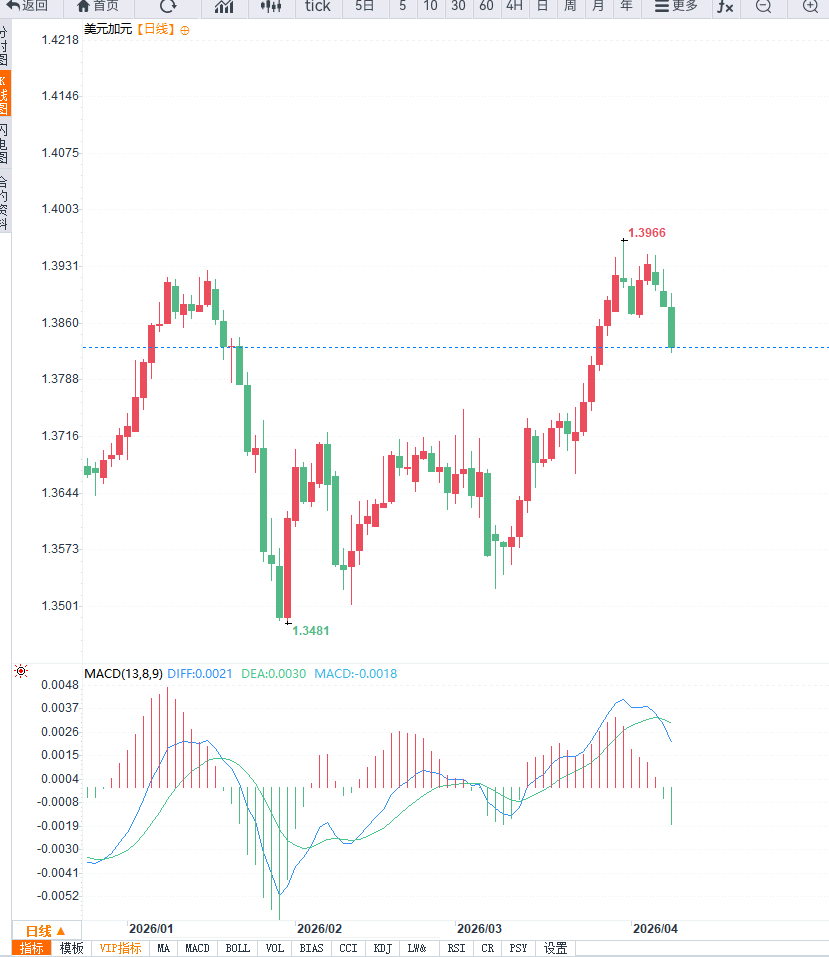
Overall, the USD/CAD pair is currently in a phase of interplay among multiple factors, and short-term volatility may intensify. The direction still needs confirmation from new fundamental signals.
Editor's Summary : The core reason for the recent decline in the USD/CAD exchange rate is the weakening of the US dollar due to easing geopolitical tensions. However, the sharp drop in oil prices has dragged down the Canadian dollar, limiting the downside potential. In the short term, the exchange rate will continue to be influenced by both the US dollar and oil prices, exhibiting a volatile pattern. The future trend hinges on two key factors: whether the situation in the Middle East remains stable and whether oil prices can stabilize and rebound. Meanwhile, the Federal Reserve's policy signals will also be an important variable. Overall, the short-term outlook is volatile, while the medium-term direction still needs further clarification of the macroeconomic environment.
One foreign exchange market analyst said, "As geopolitical risks ease, the safe-haven premium for the US dollar has been given back, and its short-term trend has turned weaker."
Judging from the developments, Iran has accepted a two-week ceasefire and plans to hold negotiations in Pakistan, while also indicating that it will restore passage through key shipping lanes under coordination. This statement has eased market concerns about energy supply disruptions. The Strait of Hormuz handles approximately 20% of global maritime energy transport , and its expected restoration directly impacts global asset prices.
Against this backdrop, crude oil prices fell sharply, dropping below the $100 mark . This change put significant pressure on the Canadian dollar. As a major resource-based currency, the Canadian dollar's performance is highly correlated with crude oil prices; falling oil prices typically mean lower export revenue expectations, thus weakening the Canadian dollar's performance.
Some institutions have pointed out that "the decline in oil prices has weakened the fundamental support for the Canadian dollar, limiting the downside potential of the USD/CAD exchange rate."
Meanwhile, market focus is gradually shifting to the upcoming release of the Federal Reserve meeting minutes. These minutes will provide crucial clues about the policy path, especially given the backdrop of volatile energy prices, as the market seeks to understand policymakers' assessment of inflation and the economic outlook. If the minutes release a hawkish signal, it could support the dollar in the short term, thus limiting further declines in the exchange rate.
From a market sentiment perspective, the current exchange rate movement exhibits a typical "two-factor driven" pattern: on the one hand, the US dollar is weakening due to decreased safe-haven demand; on the other hand, the Canadian dollar is under pressure due to falling oil prices. This hedging relationship results in an overall weak and volatile exchange rate pattern, rather than a one-sided trend.
From a technical perspective, the daily chart shows that the USD/CAD pair has entered a downward channel after falling from its highs and is currently approaching a key support area. The 1.3800 level is a significant support level ; a break below this level could lead to a further decline towards the 1.3700 area . Resistance is concentrated around 1.3950 , which acts as resistance for any short-term rebound. In terms of momentum, bears are in control but their strength is limited. Looking at the 4-hour chart, the pair is exhibiting a downward trend; if the rebound fails to break through 1.3950, the short-term outlook remains weak. However, if oil prices continue to weaken, putting pressure on the Canadian dollar, a technical rebound is possible.
Overall, the USD/CAD pair is currently in a phase of interplay among multiple factors, and short-term volatility may intensify. The direction still needs confirmation from new fundamental signals.
Editor's Summary : The core reason for the recent decline in the USD/CAD exchange rate is the weakening of the US dollar due to easing geopolitical tensions. However, the sharp drop in oil prices has dragged down the Canadian dollar, limiting the downside potential. In the short term, the exchange rate will continue to be influenced by both the US dollar and oil prices, exhibiting a volatile pattern. The future trend hinges on two key factors: whether the situation in the Middle East remains stable and whether oil prices can stabilize and rebound. Meanwhile, the Federal Reserve's policy signals will also be an important variable. Overall, the short-term outlook is volatile, while the medium-term direction still needs further clarification of the macroeconomic environment.
- Risk Warning and Disclaimer
- The market involves risk, and trading may not be suitable for all investors. This article is for reference only and does not constitute personal investment advice, nor does it take into account certain users’ specific investment objectives, financial situation, or other needs. Any investment decisions made based on this information are at your own risk.