The ceasefire eased supply concerns and suppressed oil prices, but uncertainty remains regarding the resumption of shipping, and oil prices may remain volatile at high levels.
2026-04-08 15:28:31
The international crude oil market saw a significant correction following the ceasefire announcement, with Brent crude prices falling to $92 per barrel at one point, while WTI crude fell below the $100 mark , reflecting the market's rapid repricing of supply risks.
The Danske Bank research team stated, "The ceasefire provided short-term relief to the market, but the sustainability of the oil price decline depends on whether energy transportation truly resumes."
The core driver of this oil price decline was the temporary easing of tensions in the Middle East. The US announcement of a two-week suspension of military operations against Iran, providing a window for diplomatic negotiations, quickly boosted market risk appetite and weakened the risk premium previously incurred due to the escalation of the conflict.
At the same time, the financial markets as a whole showed a clear interconnected effect. U.S. Treasury yields fell by more than 10 basis points across the board, and the euro rebounded to around 1.17 against the dollar, indicating that funds flowed from safe-haven assets to risk assets, further intensifying downward pressure on oil prices.
However, from a fundamental perspective, the current decline in oil prices remains highly uncertain. The market generally believes the key lies in whether energy transportation can return to normal levels. The Strait of Hormuz handles approximately 20% of global seaborne crude oil transport , and its navigation status directly determines the global supply structure.
One analyst pointed out: "If shipping fails to recover, the current decline in oil prices will lack sustainability."
It is worth noting that even if a ceasefire agreement is reached, the actual restoration of supplies will still face multiple challenges. On the one hand, the relevant infrastructure was damaged during the conflict and will be difficult to fully restore in the short term; on the other hand, Iran's proposal to charge fees for ships passing through the strait may increase transportation costs and affect the efficiency of passage, thereby limiting the speed of supply restoration.
Furthermore, the ceasefire agreement itself remains highly uncertain. The current arrangement is only a two-week temporary measure, and the two sides still have differences on core issues. If negotiations stall or tensions escalate again, the market could quickly re-priced in the risk premium, driving a rebound in oil prices.
From a technical perspective, the daily chart shows that oil prices experienced a sharp correction after a rapid rise, entering a high-level consolidation phase. The current price has broken below short-term trend support, indicating a significant weakening of bullish momentum. The $90 area below forms key support; a break below this level could lead to further declines towards $85 . Resistance is concentrated around the $100 mark , which continues to act as significant resistance. Observing the 4-hour chart, prices are showing a consolidation structure after a rapid decline, suggesting a potential short-term range-bound movement.
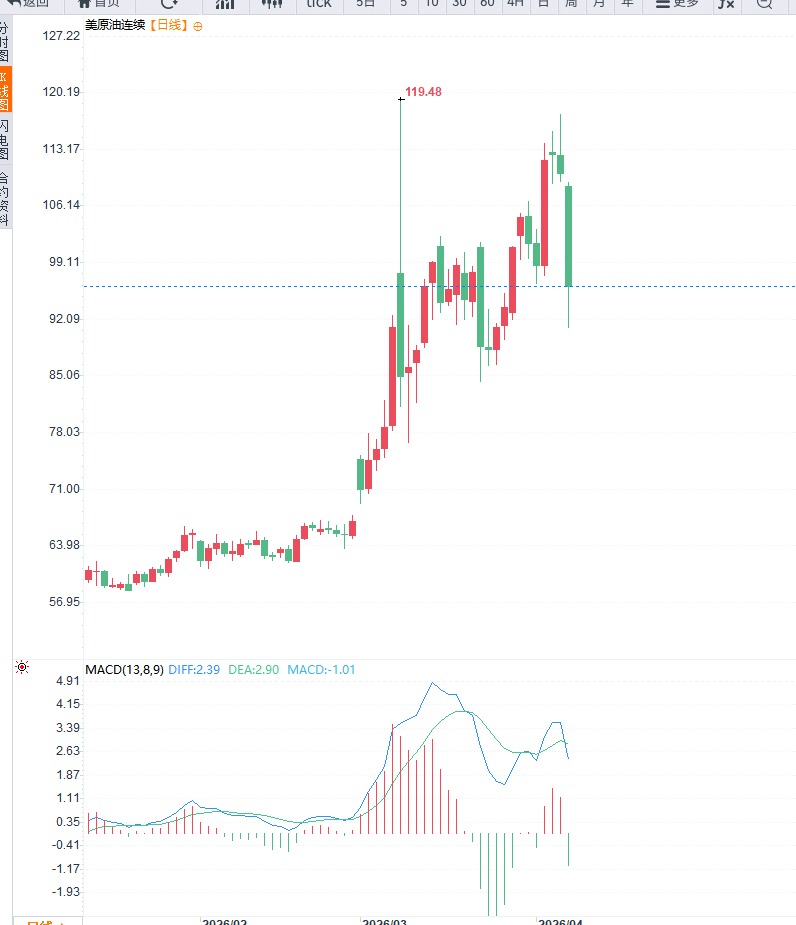
Overall, the current oil price trend exhibits a typical pattern of "emotion-driven decline + support from uncertain fundamentals," and short-term volatility may remain high.
Editor's Summary : The recent sharp decline in oil prices was primarily driven by the release of risk premiums triggered by the ceasefire announcement. However, from a supply and demand perspective, the market still faces significant uncertainty. The resumption of shipping in the Strait of Hormuz is the core variable determining the medium-term direction of oil prices, and clear progress remains lacking. In the short term, oil prices may maintain a high-level fluctuation pattern. As sentiment gradually dissipates, the market will refocus on the actual recovery of supply. If the recovery of shipping falls short of expectations, oil prices may regain support; conversely, they are expected to gradually return to a lower range.
The Danske Bank research team stated, "The ceasefire provided short-term relief to the market, but the sustainability of the oil price decline depends on whether energy transportation truly resumes."
The core driver of this oil price decline was the temporary easing of tensions in the Middle East. The US announcement of a two-week suspension of military operations against Iran, providing a window for diplomatic negotiations, quickly boosted market risk appetite and weakened the risk premium previously incurred due to the escalation of the conflict.
At the same time, the financial markets as a whole showed a clear interconnected effect. U.S. Treasury yields fell by more than 10 basis points across the board, and the euro rebounded to around 1.17 against the dollar, indicating that funds flowed from safe-haven assets to risk assets, further intensifying downward pressure on oil prices.
However, from a fundamental perspective, the current decline in oil prices remains highly uncertain. The market generally believes the key lies in whether energy transportation can return to normal levels. The Strait of Hormuz handles approximately 20% of global seaborne crude oil transport , and its navigation status directly determines the global supply structure.
One analyst pointed out: "If shipping fails to recover, the current decline in oil prices will lack sustainability."
It is worth noting that even if a ceasefire agreement is reached, the actual restoration of supplies will still face multiple challenges. On the one hand, the relevant infrastructure was damaged during the conflict and will be difficult to fully restore in the short term; on the other hand, Iran's proposal to charge fees for ships passing through the strait may increase transportation costs and affect the efficiency of passage, thereby limiting the speed of supply restoration.
Furthermore, the ceasefire agreement itself remains highly uncertain. The current arrangement is only a two-week temporary measure, and the two sides still have differences on core issues. If negotiations stall or tensions escalate again, the market could quickly re-priced in the risk premium, driving a rebound in oil prices.
From a technical perspective, the daily chart shows that oil prices experienced a sharp correction after a rapid rise, entering a high-level consolidation phase. The current price has broken below short-term trend support, indicating a significant weakening of bullish momentum. The $90 area below forms key support; a break below this level could lead to further declines towards $85 . Resistance is concentrated around the $100 mark , which continues to act as significant resistance. Observing the 4-hour chart, prices are showing a consolidation structure after a rapid decline, suggesting a potential short-term range-bound movement.
Overall, the current oil price trend exhibits a typical pattern of "emotion-driven decline + support from uncertain fundamentals," and short-term volatility may remain high.
Editor's Summary : The recent sharp decline in oil prices was primarily driven by the release of risk premiums triggered by the ceasefire announcement. However, from a supply and demand perspective, the market still faces significant uncertainty. The resumption of shipping in the Strait of Hormuz is the core variable determining the medium-term direction of oil prices, and clear progress remains lacking. In the short term, oil prices may maintain a high-level fluctuation pattern. As sentiment gradually dissipates, the market will refocus on the actual recovery of supply. If the recovery of shipping falls short of expectations, oil prices may regain support; conversely, they are expected to gradually return to a lower range.
- Risk Warning and Disclaimer
- The market involves risk, and trading may not be suitable for all investors. This article is for reference only and does not constitute personal investment advice, nor does it take into account certain users’ specific investment objectives, financial situation, or other needs. Any investment decisions made based on this information are at your own risk.