The safe-haven dollar loses favor, ceasefire agreement reshapes the currency market.
2026-04-08 18:41:00
On Wednesday (April 8), during the European session, the US dollar index saw a significant pullback, weakening for the third consecutive trading day. The US dollar index (DXY) touched a low of 98.838, a new low since March 11, and fell by about 2.2%-3% from its March high. The euro rose 0.9% to 1.1698, the pound rose 1% to 1.3428, the dollar fell nearly 1% against the yen to 158.12, and the New Zealand dollar surged 1.7% to 0.5825. The core reason for this dollar performance was the last-minute two-week ceasefire agreement reached between the US and Iran, which led to a rapid recovery in risk appetite and a sharp drop in safe-haven demand.
Fundamental analysis
Geopolitical risks have eased significantly : a ceasefire agreement was reached between the US and Iran, with Iran agreeing to allow ships to pass safely through the Strait of Hormuz (accounting for about one-fifth of the world's oil shipping routes) during the ceasefire. Brent crude oil plunged 13.4% to $94.68 per barrel, while risk assets (stocks and bonds) surged in tandem, completely reversing the stagflationary investment logic of the past month.
Falling oil prices ease inflationary pressures : The decline in energy prices directly reduces global inflation expectations, and the stagflationary environment previously characterized by a sharp decline in the yield curve, weak stock markets, and a strong dollar is expected to be alleviated in the short term.
Central bank policy signals have diverged : The Reserve Bank of New Zealand maintained its policy rate at 2.25% for the second consecutive meeting, but significantly raised its Q2 2026 CPI forecast from 2.8% to 4.2%, explicitly stating that rising energy prices have led to a "significant change in the situation," and that it will raise interest rates "decisively and promptly" should a second wave of inflation occur, demonstrating a hawkish stance. This is seen as a template for action that many central banks may take in the second quarter. As for the Federal Reserve, Philip Jefferson recently stated that current monetary policy is "very appropriate," but the market's probability of a rate cut in December has risen to about 50% (before the ceasefire, a rate cut was almost not expected).
The safe-haven appeal of the US dollar has temporarily weakened : In March, the US dollar was the main winner due to its status as a net energy exporter, but now the ceasefire news has caused its safe-haven premium to quickly subside.
mainstream view
Reuters: The dollar index fell to a one-month low, major currencies rebounded across the board, and traders renewed their bets on the Federal Reserve implementing easing measures in December. The ceasefire agreement boosted risk appetite, but caution is still needed over the next 14 days.
Rabobank: Michael Every and Basvan Geffen believe that the temporary ceasefire significantly reduced risk premiums, but this is only a short-term "breathing room," with at least two weeks of uncertainty remaining. Scenario ranges from "best-case scenario (end of war)" to "worst-case scenario (ceasefire collapse)," with a current preference for the baseline scenario of "mid-April end of war and gradual reopening of the Strait of Hormuz," but they emphasize that the risk of a "Trump always backs down" (TACO) trade still exists.
Technical Analysis
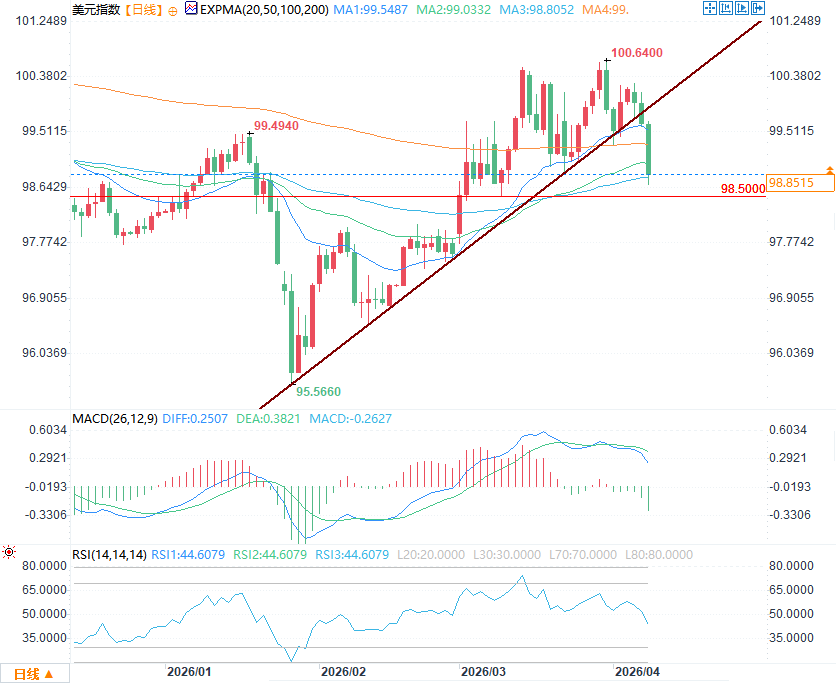
(US Dollar Index Daily Chart Source: FX678)
The DXY weakened for the third consecutive trading day, hitting a low of 98.838, a new low since March 11. It is expected to further test the key support level of 98.50. However, the strong upward trend of more than 3% in March has not been completely reversed, and there is still a possibility of fluctuations in the short term. It is necessary to pay attention to whether it can hold the psychological level of 98.00.
Major currencies generally rebounded against the US dollar, with high-beta commodity currencies (such as the New Zealand dollar) recovering about 40% of their losses, and low-beta currencies rebounding by 0.5%-1.0%. The 50% retracement level has become an initial reasonable target.
The situation remains shrouded in "fog of war," lacking clear signs of a breakthrough. Attention should be paid to subsequent ship traffic data to verify the extent of the reopening of the Hormuz.
Financial Calendar (Beijing Time)
There are few major data releases today, and the US economic calendar is light.
Tonight's focus: The release of the Federal Reserve FOMC meeting minutes at 02:00 AM on April 9th (pay attention to the discussion on current policy and hints at the path of interest rate cuts).
Released: Reserve Bank of New Zealand interest rate decision (unchanged at 2.25%, statement leaning hawkish).
Reminder: Pay attention to vessel traffic data in the Strait of Hormuz (a significant increase would further negatively impact oil prices).
Frequently Asked Questions
Q1: What are the core contents of the US-Iran ceasefire agreement?
A: The two sides reached an agreement less than two hours before Trump's ultimatum deadline, with Iran agreeing to suspend the blockade of the Strait of Hormuz for two weeks to ensure the safe passage of ships. This was the most direct trigger for the immediate rebound in market risk appetite.
Q2: Why did oil prices plummet by 13.4%?
A: The Strait of Hormuz is a vital choke point for global oil transportation. The ceasefire news eliminated the risk of an immediate blockade, relieved market panic about supply disruptions, and caused Brent crude oil to quickly fall back to near pre-war levels, while also alleviating concerns about global stagflation.
Q3: Why did expectations for a Fed rate cut suddenly rise again?
A: Before the ceasefire, the market had almost no expectation of an interest rate cut. After the ceasefire, oil prices plummeted and inflationary pressures eased, leading traders to repric the probability of a December rate cut to around 50%. However, Federal Reserve officials still emphasized that the current policy is "perfectly appropriate," and actual action will depend on subsequent data.
Q4: What is the biggest uncertainty in the market over the next 14 days?
A: The ceasefire is only a temporary agreement, not a permanent peace. Whether ships actually pass through the strait on a large scale, whether negotiations are extended, and whether there is a "Trump backing down" or an escalation of the conflict will determine whether risk appetite can be sustained and whether the US dollar will regain its safe-haven status.
Fundamental analysis
Geopolitical risks have eased significantly : a ceasefire agreement was reached between the US and Iran, with Iran agreeing to allow ships to pass safely through the Strait of Hormuz (accounting for about one-fifth of the world's oil shipping routes) during the ceasefire. Brent crude oil plunged 13.4% to $94.68 per barrel, while risk assets (stocks and bonds) surged in tandem, completely reversing the stagflationary investment logic of the past month.
Falling oil prices ease inflationary pressures : The decline in energy prices directly reduces global inflation expectations, and the stagflationary environment previously characterized by a sharp decline in the yield curve, weak stock markets, and a strong dollar is expected to be alleviated in the short term.
Central bank policy signals have diverged : The Reserve Bank of New Zealand maintained its policy rate at 2.25% for the second consecutive meeting, but significantly raised its Q2 2026 CPI forecast from 2.8% to 4.2%, explicitly stating that rising energy prices have led to a "significant change in the situation," and that it will raise interest rates "decisively and promptly" should a second wave of inflation occur, demonstrating a hawkish stance. This is seen as a template for action that many central banks may take in the second quarter. As for the Federal Reserve, Philip Jefferson recently stated that current monetary policy is "very appropriate," but the market's probability of a rate cut in December has risen to about 50% (before the ceasefire, a rate cut was almost not expected).
The safe-haven appeal of the US dollar has temporarily weakened : In March, the US dollar was the main winner due to its status as a net energy exporter, but now the ceasefire news has caused its safe-haven premium to quickly subside.
mainstream view
Reuters: The dollar index fell to a one-month low, major currencies rebounded across the board, and traders renewed their bets on the Federal Reserve implementing easing measures in December. The ceasefire agreement boosted risk appetite, but caution is still needed over the next 14 days.
Rabobank: Michael Every and Basvan Geffen believe that the temporary ceasefire significantly reduced risk premiums, but this is only a short-term "breathing room," with at least two weeks of uncertainty remaining. Scenario ranges from "best-case scenario (end of war)" to "worst-case scenario (ceasefire collapse)," with a current preference for the baseline scenario of "mid-April end of war and gradual reopening of the Strait of Hormuz," but they emphasize that the risk of a "Trump always backs down" (TACO) trade still exists.
Technical Analysis
(US Dollar Index Daily Chart Source: FX678)
The DXY weakened for the third consecutive trading day, hitting a low of 98.838, a new low since March 11. It is expected to further test the key support level of 98.50. However, the strong upward trend of more than 3% in March has not been completely reversed, and there is still a possibility of fluctuations in the short term. It is necessary to pay attention to whether it can hold the psychological level of 98.00.
Major currencies generally rebounded against the US dollar, with high-beta commodity currencies (such as the New Zealand dollar) recovering about 40% of their losses, and low-beta currencies rebounding by 0.5%-1.0%. The 50% retracement level has become an initial reasonable target.
The situation remains shrouded in "fog of war," lacking clear signs of a breakthrough. Attention should be paid to subsequent ship traffic data to verify the extent of the reopening of the Hormuz.
Financial Calendar (Beijing Time)
There are few major data releases today, and the US economic calendar is light.
Tonight's focus: The release of the Federal Reserve FOMC meeting minutes at 02:00 AM on April 9th (pay attention to the discussion on current policy and hints at the path of interest rate cuts).
Released: Reserve Bank of New Zealand interest rate decision (unchanged at 2.25%, statement leaning hawkish).
Reminder: Pay attention to vessel traffic data in the Strait of Hormuz (a significant increase would further negatively impact oil prices).
Frequently Asked Questions
Q1: What are the core contents of the US-Iran ceasefire agreement?
A: The two sides reached an agreement less than two hours before Trump's ultimatum deadline, with Iran agreeing to suspend the blockade of the Strait of Hormuz for two weeks to ensure the safe passage of ships. This was the most direct trigger for the immediate rebound in market risk appetite.
Q2: Why did oil prices plummet by 13.4%?
A: The Strait of Hormuz is a vital choke point for global oil transportation. The ceasefire news eliminated the risk of an immediate blockade, relieved market panic about supply disruptions, and caused Brent crude oil to quickly fall back to near pre-war levels, while also alleviating concerns about global stagflation.
Q3: Why did expectations for a Fed rate cut suddenly rise again?
A: Before the ceasefire, the market had almost no expectation of an interest rate cut. After the ceasefire, oil prices plummeted and inflationary pressures eased, leading traders to repric the probability of a December rate cut to around 50%. However, Federal Reserve officials still emphasized that the current policy is "perfectly appropriate," and actual action will depend on subsequent data.
Q4: What is the biggest uncertainty in the market over the next 14 days?
A: The ceasefire is only a temporary agreement, not a permanent peace. Whether ships actually pass through the strait on a large scale, whether negotiations are extended, and whether there is a "Trump backing down" or an escalation of the conflict will determine whether risk appetite can be sustained and whether the US dollar will regain its safe-haven status.
- Risk Warning and Disclaimer
- The market involves risk, and trading may not be suitable for all investors. This article is for reference only and does not constitute personal investment advice, nor does it take into account certain users’ specific investment objectives, financial situation, or other needs. Any investment decisions made based on this information are at your own risk.