Two-week countdown to the Iranian ceasefire: Global bond markets, barely able to breathe a sigh of relief, have fallen into a "high-interest-rate trap."
2026-04-08 20:34:22
On Wednesday (April 8th), after weeks of turmoil, global financial markets reached a delicate turning point. According to the latest market developments, the two-week ceasefire agreement reached between the United States and Iran officially entered a observation period. This news not only significantly alleviated supply anxieties in the oil market but also directly reshaped the volatility axis of the global bond market. In the past 24 hours, the rapid decline in risk aversion led to an outflow of safe-haven funds from the sovereign bond market, prompting a significant downward correction in global government bond yields in the short term.
However, while the ceasefire agreement has provided breathing room for the global economy, the weeks-long blockade of the Strait of Hormuz has already caused irreversible short-term shocks to global supply chains. This shock has manifested at the macro level as extremely resilient inflation expectations, making bond market investors hesitant to bet on a shift in monetary policy even as the situation stabilizes. Today, US and Japanese Treasury bonds showed a high degree of correlation, but the underlying pricing logic has shifted from simple "geopolitical risk compensation" to a reaffirmation of a "long-term high-interest-rate environment."
From a fundamental perspective, the 14-day ceasefire agreement includes a controlled opening of the Strait of Hormuz and a temporary cessation of hostilities by all parties. According to mainstream market opinion , despite Iran's promise to provide safe passage, the more than 1,000 merchant ships stuck in and around the strait—including approximately 187 oil tankers fully loaded with crude oil and refined products—are expected to take weeks or even months to fully disperse. This logistical "blockage" means that the decline in energy costs will be slow and delayed.
For the US Treasury market, the current pricing focus is on the self-fulfilling of inflation expectations. Although Brent crude oil futures prices fell below $100 after the agreement was signed, the risk of double-dip inflation triggered by the earlier surge in energy prices has raised serious concerns among central banks worldwide. The decisions of the Reserve Bank of India and the Reserve Bank of New Zealand to maintain their interest rates today, and their subsequent indications of a rate hike, all confirm that global monetary policy is entering a phase of "defensive rate hike preparation." Against this backdrop, the decline in US Treasury yields is more likely a technical profit-taking move than a trend reversal in the bull market.
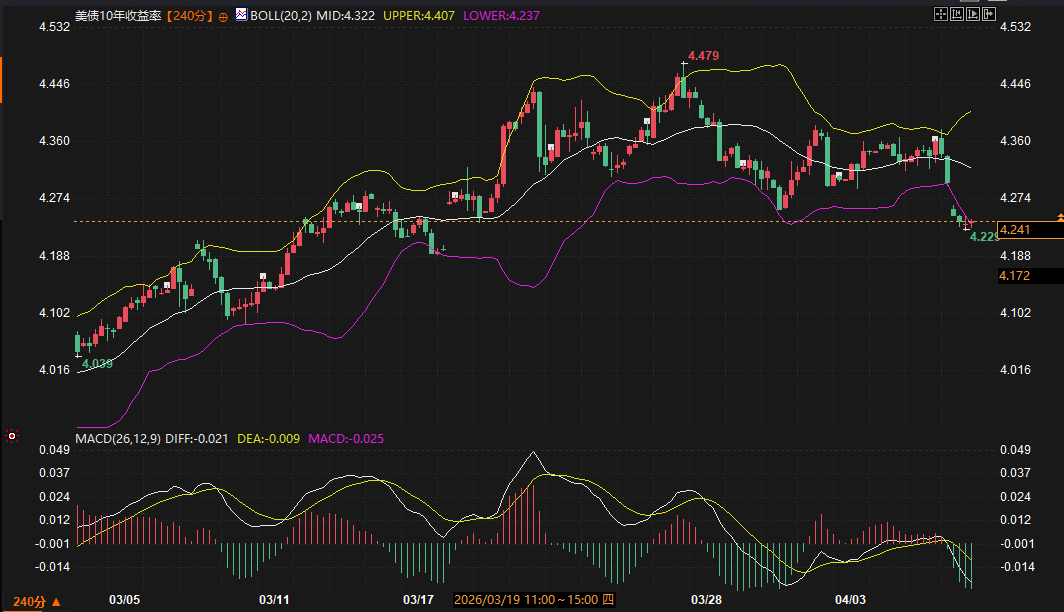
From a technical perspective, referencing the 10-year US Treasury yield (240-minute timeframe) contract, this instrument reached a high of 4.479 on March 28th and has recently been undergoing a sustained downward trend. The current price is around 4.241 , a level that has officially broken below the lower Bollinger Band (4.237) . Technically, the MACD (26, 12, 9) shows both the DIFF and DEA in negative territory, with the green bars continuing to expand, indicating strong bearish momentum. However, given that the price is currently in a significantly oversold zone and approaching the previous key support level of 4.220 , the market is highly susceptible to a short-term rebound driven by short covering at this current level.
The key focus during the trading session will be the release of the minutes from the March policy meeting tonight. If the minutes reinforce the stance of "maintaining high interest rates for longer," it will conflict with the current logic of risk aversion and market decline.
Turning to the Japanese bond market, JGBs exhibited a clear "bull market flattening" pattern today. Given Japan's heavy reliance on energy imports, the easing of tensions with Iran has significantly reduced pressure on Japanese import prices. The yield on 10-year Japanese government bonds briefly touched a low of 2.355% . Nevertheless, a strategist from a well-known institution pointed out that the Bank of Japan still has ample reason to adjust its interest rate policy in April, as domestic wage growth and domestic demand-driven inflation have formed a closed loop.
Looking ahead, the global bond market is at an extremely sensitive juncture. The short-term ceasefire agreement is more like a stress test window than a final outcome. From a military perspective, the US may further strengthen its asset deployments in the relevant waters over the next two weeks to ensure substantial control over shipping lanes. This implicit military standoff means that risk premiums will not be fully priced into the bond market.
At the macroeconomic data level, the market will revert to interpreting comments from Federal Reserve officials and inflation data. Given the lingering expectations of a global trade chain restructuring triggered by tariff rhetoric, coupled with energy security concerns stemming from geopolitical instability, global bond market investors should exercise restraint. We believe that US Treasury yields may fluctuate widely within the 4.23% to 4.27% range in the short term. From a strategic perspective, since major central banks worldwide have largely shelved their interest rate cut options due to inflation stickiness, every significant rebound in the bond market is likely to face selling pressure.
Question 1: Why is it that a two-week ceasefire agreement has failed to bring US Treasury yields back to their pre-conflict lows?
Answer: This is determined by both "geopolitical risk memory" and "inflationary inertia." First, a two-week timeframe is too short to restore logistical credit in the Strait of Hormuz, and market participants are generally concerned that this is merely a respite before a new round of escalation. Second, the oil price surge during the conflict has already been transmitted to production and consumption, and this double-inflation effect cannot be immediately eliminated by a short-term political agreement. Therefore, the bond market must factor in a higher "inflation risk premium" when pricing, which significantly raises the yield floor.
Question 2: What factors have dominated the recent trend in the Japanese bond market?
Answer: Japanese bonds are currently affected by three factors: First, the external geopolitical environment, especially the impact of the Middle East situation on Japan's energy costs; second, the Bank of Japan's liquidity management at the beginning of the fiscal year, with today's bond repurchase operation showing strong selling interest in ultra-long-term government bonds; and third, policy expectations, although the global geopolitical situation has eased somewhat, the structural improvement in domestic inflation in Japan has provided the Bank of Japan with external space to raise interest rates, leading to a continued flattening of the Japanese bond yield curve.
Question 3: The 10-year US Treasury yield is currently in an "oversold" state. Does this mean we should immediately be bullish on bond prices?
Answer: In technical analysis, "oversold" means that prices have fallen below the statistically normal range, and there is indeed a need for a rebound or consolidation. However, fundamental policy developments (such as the Fed minutes and global supply chain tensions caused by the Russia-Ukraine situation) remain hawkish, meaning that the downside potential for yields is limited by the policy floor. Investors should view oversold conditions as a signal of short covering rather than a confirmation of a trend reversal.
Question 4: If the Strait of Hormuz is fully reopened, what special significance will it have for the Asian bond market?
Answer: Asian countries (such as India, Japan, and Southeast Asian economies) are major buyers of Middle Eastern energy. The full opening of the Straits will directly improve these countries' trade balances and fiscal situations by reducing import inflationary pressures. This will typically alleviate the pressure on Asian central banks to follow the Federal Reserve's interest rate hikes in order to maintain their currencies' stability, thus providing a more stable monetary environment for Asian domestic bond markets.
Question 5: Under the current circumstances, how should we assess the long-term constraints of inflation stickiness on monetary policy?
Answer: While a ceasefire may temporarily suppress energy prices, the fragility of global supply chains has become glaringly apparent. Coupled with the escalating protectionism triggered by current tariff rhetoric and the instability in food and industrial raw material supplies due to the Russia-Ukraine conflict, the world has entered an era of structurally high inflation. This means that even if geopolitical risks are completely resolved, major central banks will find it difficult to return to the extremely low interest rates of the past. The new normal for the bond market will be an overall upward shift in the yield curve.
However, while the ceasefire agreement has provided breathing room for the global economy, the weeks-long blockade of the Strait of Hormuz has already caused irreversible short-term shocks to global supply chains. This shock has manifested at the macro level as extremely resilient inflation expectations, making bond market investors hesitant to bet on a shift in monetary policy even as the situation stabilizes. Today, US and Japanese Treasury bonds showed a high degree of correlation, but the underlying pricing logic has shifted from simple "geopolitical risk compensation" to a reaffirmation of a "long-term high-interest-rate environment."
In-depth analysis of geopolitical dynamics and bond market pricing logic
From a fundamental perspective, the 14-day ceasefire agreement includes a controlled opening of the Strait of Hormuz and a temporary cessation of hostilities by all parties. According to mainstream market opinion , despite Iran's promise to provide safe passage, the more than 1,000 merchant ships stuck in and around the strait—including approximately 187 oil tankers fully loaded with crude oil and refined products—are expected to take weeks or even months to fully disperse. This logistical "blockage" means that the decline in energy costs will be slow and delayed.
For the US Treasury market, the current pricing focus is on the self-fulfilling of inflation expectations. Although Brent crude oil futures prices fell below $100 after the agreement was signed, the risk of double-dip inflation triggered by the earlier surge in energy prices has raised serious concerns among central banks worldwide. The decisions of the Reserve Bank of India and the Reserve Bank of New Zealand to maintain their interest rates today, and their subsequent indications of a rate hike, all confirm that global monetary policy is entering a phase of "defensive rate hike preparation." Against this backdrop, the decline in US Treasury yields is more likely a technical profit-taking move than a trend reversal in the bull market.
From a technical perspective, referencing the 10-year US Treasury yield (240-minute timeframe) contract, this instrument reached a high of 4.479 on March 28th and has recently been undergoing a sustained downward trend. The current price is around 4.241 , a level that has officially broken below the lower Bollinger Band (4.237) . Technically, the MACD (26, 12, 9) shows both the DIFF and DEA in negative territory, with the green bars continuing to expand, indicating strong bearish momentum. However, given that the price is currently in a significantly oversold zone and approaching the previous key support level of 4.220 , the market is highly susceptible to a short-term rebound driven by short covering at this current level.
The key focus during the trading session will be the release of the minutes from the March policy meeting tonight. If the minutes reinforce the stance of "maintaining high interest rates for longer," it will conflict with the current logic of risk aversion and market decline.
Turning to the Japanese bond market, JGBs exhibited a clear "bull market flattening" pattern today. Given Japan's heavy reliance on energy imports, the easing of tensions with Iran has significantly reduced pressure on Japanese import prices. The yield on 10-year Japanese government bonds briefly touched a low of 2.355% . Nevertheless, a strategist from a well-known institution pointed out that the Bank of Japan still has ample reason to adjust its interest rate policy in April, as domestic wage growth and domestic demand-driven inflation have formed a closed loop.
Future Trend Outlook: The New Normal of the Bond Market Under Multiple Games
Looking ahead, the global bond market is at an extremely sensitive juncture. The short-term ceasefire agreement is more like a stress test window than a final outcome. From a military perspective, the US may further strengthen its asset deployments in the relevant waters over the next two weeks to ensure substantial control over shipping lanes. This implicit military standoff means that risk premiums will not be fully priced into the bond market.
At the macroeconomic data level, the market will revert to interpreting comments from Federal Reserve officials and inflation data. Given the lingering expectations of a global trade chain restructuring triggered by tariff rhetoric, coupled with energy security concerns stemming from geopolitical instability, global bond market investors should exercise restraint. We believe that US Treasury yields may fluctuate widely within the 4.23% to 4.27% range in the short term. From a strategic perspective, since major central banks worldwide have largely shelved their interest rate cut options due to inflation stickiness, every significant rebound in the bond market is likely to face selling pressure.
Frequently Asked Questions
Question 1: Why is it that a two-week ceasefire agreement has failed to bring US Treasury yields back to their pre-conflict lows?
Answer: This is determined by both "geopolitical risk memory" and "inflationary inertia." First, a two-week timeframe is too short to restore logistical credit in the Strait of Hormuz, and market participants are generally concerned that this is merely a respite before a new round of escalation. Second, the oil price surge during the conflict has already been transmitted to production and consumption, and this double-inflation effect cannot be immediately eliminated by a short-term political agreement. Therefore, the bond market must factor in a higher "inflation risk premium" when pricing, which significantly raises the yield floor.
Question 2: What factors have dominated the recent trend in the Japanese bond market?
Answer: Japanese bonds are currently affected by three factors: First, the external geopolitical environment, especially the impact of the Middle East situation on Japan's energy costs; second, the Bank of Japan's liquidity management at the beginning of the fiscal year, with today's bond repurchase operation showing strong selling interest in ultra-long-term government bonds; and third, policy expectations, although the global geopolitical situation has eased somewhat, the structural improvement in domestic inflation in Japan has provided the Bank of Japan with external space to raise interest rates, leading to a continued flattening of the Japanese bond yield curve.
Question 3: The 10-year US Treasury yield is currently in an "oversold" state. Does this mean we should immediately be bullish on bond prices?
Answer: In technical analysis, "oversold" means that prices have fallen below the statistically normal range, and there is indeed a need for a rebound or consolidation. However, fundamental policy developments (such as the Fed minutes and global supply chain tensions caused by the Russia-Ukraine situation) remain hawkish, meaning that the downside potential for yields is limited by the policy floor. Investors should view oversold conditions as a signal of short covering rather than a confirmation of a trend reversal.
Question 4: If the Strait of Hormuz is fully reopened, what special significance will it have for the Asian bond market?
Answer: Asian countries (such as India, Japan, and Southeast Asian economies) are major buyers of Middle Eastern energy. The full opening of the Straits will directly improve these countries' trade balances and fiscal situations by reducing import inflationary pressures. This will typically alleviate the pressure on Asian central banks to follow the Federal Reserve's interest rate hikes in order to maintain their currencies' stability, thus providing a more stable monetary environment for Asian domestic bond markets.
Question 5: Under the current circumstances, how should we assess the long-term constraints of inflation stickiness on monetary policy?
Answer: While a ceasefire may temporarily suppress energy prices, the fragility of global supply chains has become glaringly apparent. Coupled with the escalating protectionism triggered by current tariff rhetoric and the instability in food and industrial raw material supplies due to the Russia-Ukraine conflict, the world has entered an era of structurally high inflation. This means that even if geopolitical risks are completely resolved, major central banks will find it difficult to return to the extremely low interest rates of the past. The new normal for the bond market will be an overall upward shift in the yield curve.
- Risk Warning and Disclaimer
- The market involves risk, and trading may not be suitable for all investors. This article is for reference only and does not constitute personal investment advice, nor does it take into account certain users’ specific investment objectives, financial situation, or other needs. Any investment decisions made based on this information are at your own risk.