Crude oil prices plummeted in a single day, and the market has entered a new phase of competition.
2026-04-09 02:25:00
On Wednesday (April 8), during the European trading session, a sudden easing of tensions in the Middle East triggered a sharp drop in international oil prices, with both Brent and WTI crude oil futures prices falling below the $100 per barrel mark. US President Trump's announcement of a two-week temporary ceasefire agreement with Iran was the core trigger for the market volatility.
Analysts point out that as market concerns about oil supply disruptions gradually ease, the geopolitical risk premium accumulated in the early stages is being rapidly eroded. However, due to the still unstable foundation of the ceasefire agreement, market sentiment remains cautious.
Ceasefire agreement hits market: "Open Straits" as core premise
On Wednesday, Trump announced via his personal social media platform that the United States had agreed to a two-week "two-way ceasefire" with Iran. According to his statement, the core prerequisite for the agreement is Iran reopening the Strait of Hormuz—a strait that carries approximately one-fifth of global oil shipments and is a crucial hub for international energy supply. Previously, there were widespread market concerns that a prolonged blockage of the strait would severely impact global crude oil supplies.
It is noteworthy that Trump had previously warned of potentially "catastrophic consequences," but his recent statement clearly shifted towards de-escalation, even mentioning "cooperation" and "discussing sanctions." This change in wording is widely interpreted by the market as a significant signal that tensions in the Middle East have entered a phase of easing. The ceasefire, reportedly brokered by Pakistan, officially took effect at 3:30 AM Iranian time on April 8 (8:00 AM Beijing time). US military operations in Iran have been suspended, and Israel has agreed to suspend bombing during the ceasefire.
Oil prices plunge in a single day: Geopolitical risk premiums are released at an accelerated pace.
Driven directly by the news of the US-Iran ceasefire, international oil prices saw a significant decline, marking one of the largest single-day drops in recent weeks: Brent crude futures fell by about 12%, closing near $95 per barrel; WTI crude futures fell by more than 15%, briefly touching $86 during the session.
Market participants generally believe that the core logic behind this round of oil price plunge is the rapid correction of expectations regarding crude oil supply disruptions. Andrew Lipp, president of the Lipp Institute, stated that the market is reassessing the prospects for passage through the Strait of Hormuz, but due to the numerous uncertainties surrounding the implementation of the ceasefire agreement, trading sentiment has not fully turned optimistic.
The ceasefire is not on solid ground: shipping threats and regional conflicts continue.
Despite the sharp drop in oil prices, firsthand reports from the Middle East indicate that the current situation has not truly stabilized, and the ceasefire is closer to a "tactical de-escalation" than a substantial end to the conflict.
On the one hand, Iranian sources have stated that unauthorized vessels may still face security risks, and the opening of the Strait of Hormuz may be carried out in a "controlled manner," with the specific timing of passage depending on the progress of the upcoming US-Iran talks in Pakistan. It is understood that most of the thousands of vessels currently stranded in the Strait of Hormuz (approximately 187 of which are oil tankers) are in a "wait-and-see" state, with only a very small number attempting to pass through. Ship owners are still awaiting authoritative security confirmation. It is noteworthy that the strait has now formed a northern passage controlled by Iran and a new southern passage along the Omani coast, and the navigation pattern is gradually evolving.
On the other hand, conflicts in the surrounding region have not cooled down in tandem: airstrikes between Israel and Lebanon continue, and Iran's attack on Saudi energy infrastructure adds new uncertainty to the situation. Furthermore, Iran's 10-point negotiating proposal differs significantly from the US's 15-point proposal, indicating a serious lack of mutual trust. Iran has explicitly stated that it "completely distrusts" the US.
A confluence of negative fundamental factors: US crude oil inventories increased more than expected.
In addition to geopolitical factors, domestic crude oil supply data in the United States also exerted additional downward pressure on oil prices. Data released by the U.S. Energy Information Administration (EIA) showed that U.S. crude oil inventories increased by 3.081 million barrels in the week ending April 3, significantly higher than the market expectation of 701,000 barrels, reaching the highest inventory level since June 2023.
The unexpected increase in inventories was interpreted by the market as a signal of relatively ample short-term crude oil supply, which further accelerated the downward trend in oil prices against the backdrop of a gradual decline in geopolitical risk premiums in the early stage.
Key points to watch: Resumption of air traffic in Hormuz and talks with Pakistan
Currently, the core variables of market attention have shifted from "whether the conflict will escalate" to two specific directions: first, whether the Strait of Hormuz can truly resume normal navigation; and second, whether the US-Iran talks in Pakistan can reach a longer-term peace agreement. It is understood that the first round of US-Iran talks will be held on April 10 in Islamabad, the capital of Pakistan. The US delegation will be led by Vice President Vance and includes Middle East Special Envoy Witkov and Trump's son-in-law Kushner, among others. The negotiations will be conducted behind closed doors for two weeks, which may be extended if necessary.
Analysts at Raymond James & Co. point out that oil price volatility is unlikely to significantly decrease only when shipping in the Strait of Hormuz returns to normal.
Market Outlook: Will oil prices fluctuate between $80 and the $100 mark?
From the current market structure, oil prices have entered a new game-playing phase, and the future trend mainly depends on two variables: if the Strait of Hormuz resumes normal navigation, oil prices may continue to fall back to the $80 range; if the US-Iran negotiations break down or regional conflicts escalate again, oil prices may rebound quickly to above $100.
In the short term, the support level in the $86-$90 range comes more from market expectations of the instability of the ceasefire agreement than from traditional supply and demand fundamentals.
The market pricing logic has shifted from "war mode" to "negotiation mode".
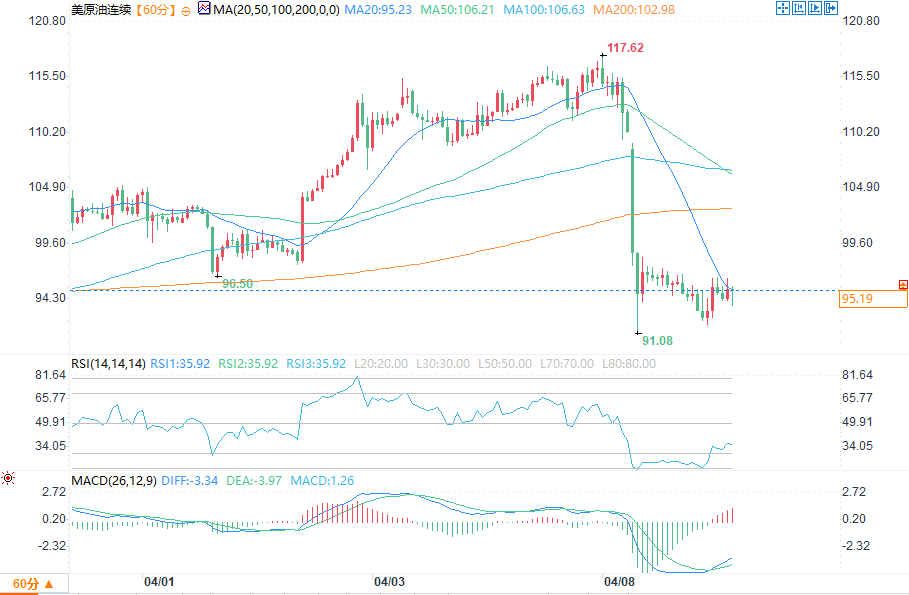
(WTI crude oil price 1-hour chart source: FX678)
This oil price crash is essentially a rapid shift in market pricing logic—from the previous "worst-case pricing" (assuming a long-term disruption of the Strait of Hormuz) to "neutral-case pricing" (limited conflict + negotiation window).
However, it's important to clarify that the current market is not in a truly "risk-free environment," but rather in a more complex state: risks haven't disappeared, they've simply been repriced. The Trump administration's agreement to a ceasefire is essentially a compromise made under multiple pressures—military, economic, and political—resulting in domestic gasoline prices rising by nearly 40%, Trump's approval rating plummeting to a low of 35%, and Republican senators warning that continued fighting could lead to losses in the midterm elections.
Over the next two weeks, the core issue in the market will no longer be the impact of a single event, but rather the combined effect of a series of political signals, including the progress of US-Iran negotiations and the status of air traffic control in the Strait of Hormuz. Against this backdrop, oil price fluctuations will become more frequent and exhibit non-linear characteristics, requiring the market to pay close attention to the progress of negotiations and subtle changes in the regional situation.
At 02:21 Beijing time, WTI crude oil was trading at $95.46 per ounce, down 15.48%.
Analysts point out that as market concerns about oil supply disruptions gradually ease, the geopolitical risk premium accumulated in the early stages is being rapidly eroded. However, due to the still unstable foundation of the ceasefire agreement, market sentiment remains cautious.
Ceasefire agreement hits market: "Open Straits" as core premise
On Wednesday, Trump announced via his personal social media platform that the United States had agreed to a two-week "two-way ceasefire" with Iran. According to his statement, the core prerequisite for the agreement is Iran reopening the Strait of Hormuz—a strait that carries approximately one-fifth of global oil shipments and is a crucial hub for international energy supply. Previously, there were widespread market concerns that a prolonged blockage of the strait would severely impact global crude oil supplies.
It is noteworthy that Trump had previously warned of potentially "catastrophic consequences," but his recent statement clearly shifted towards de-escalation, even mentioning "cooperation" and "discussing sanctions." This change in wording is widely interpreted by the market as a significant signal that tensions in the Middle East have entered a phase of easing. The ceasefire, reportedly brokered by Pakistan, officially took effect at 3:30 AM Iranian time on April 8 (8:00 AM Beijing time). US military operations in Iran have been suspended, and Israel has agreed to suspend bombing during the ceasefire.
Oil prices plunge in a single day: Geopolitical risk premiums are released at an accelerated pace.
Driven directly by the news of the US-Iran ceasefire, international oil prices saw a significant decline, marking one of the largest single-day drops in recent weeks: Brent crude futures fell by about 12%, closing near $95 per barrel; WTI crude futures fell by more than 15%, briefly touching $86 during the session.
Market participants generally believe that the core logic behind this round of oil price plunge is the rapid correction of expectations regarding crude oil supply disruptions. Andrew Lipp, president of the Lipp Institute, stated that the market is reassessing the prospects for passage through the Strait of Hormuz, but due to the numerous uncertainties surrounding the implementation of the ceasefire agreement, trading sentiment has not fully turned optimistic.
The ceasefire is not on solid ground: shipping threats and regional conflicts continue.
Despite the sharp drop in oil prices, firsthand reports from the Middle East indicate that the current situation has not truly stabilized, and the ceasefire is closer to a "tactical de-escalation" than a substantial end to the conflict.
On the one hand, Iranian sources have stated that unauthorized vessels may still face security risks, and the opening of the Strait of Hormuz may be carried out in a "controlled manner," with the specific timing of passage depending on the progress of the upcoming US-Iran talks in Pakistan. It is understood that most of the thousands of vessels currently stranded in the Strait of Hormuz (approximately 187 of which are oil tankers) are in a "wait-and-see" state, with only a very small number attempting to pass through. Ship owners are still awaiting authoritative security confirmation. It is noteworthy that the strait has now formed a northern passage controlled by Iran and a new southern passage along the Omani coast, and the navigation pattern is gradually evolving.
On the other hand, conflicts in the surrounding region have not cooled down in tandem: airstrikes between Israel and Lebanon continue, and Iran's attack on Saudi energy infrastructure adds new uncertainty to the situation. Furthermore, Iran's 10-point negotiating proposal differs significantly from the US's 15-point proposal, indicating a serious lack of mutual trust. Iran has explicitly stated that it "completely distrusts" the US.
A confluence of negative fundamental factors: US crude oil inventories increased more than expected.
In addition to geopolitical factors, domestic crude oil supply data in the United States also exerted additional downward pressure on oil prices. Data released by the U.S. Energy Information Administration (EIA) showed that U.S. crude oil inventories increased by 3.081 million barrels in the week ending April 3, significantly higher than the market expectation of 701,000 barrels, reaching the highest inventory level since June 2023.
The unexpected increase in inventories was interpreted by the market as a signal of relatively ample short-term crude oil supply, which further accelerated the downward trend in oil prices against the backdrop of a gradual decline in geopolitical risk premiums in the early stage.
Key points to watch: Resumption of air traffic in Hormuz and talks with Pakistan
Currently, the core variables of market attention have shifted from "whether the conflict will escalate" to two specific directions: first, whether the Strait of Hormuz can truly resume normal navigation; and second, whether the US-Iran talks in Pakistan can reach a longer-term peace agreement. It is understood that the first round of US-Iran talks will be held on April 10 in Islamabad, the capital of Pakistan. The US delegation will be led by Vice President Vance and includes Middle East Special Envoy Witkov and Trump's son-in-law Kushner, among others. The negotiations will be conducted behind closed doors for two weeks, which may be extended if necessary.
Analysts at Raymond James & Co. point out that oil price volatility is unlikely to significantly decrease only when shipping in the Strait of Hormuz returns to normal.
Market Outlook: Will oil prices fluctuate between $80 and the $100 mark?
From the current market structure, oil prices have entered a new game-playing phase, and the future trend mainly depends on two variables: if the Strait of Hormuz resumes normal navigation, oil prices may continue to fall back to the $80 range; if the US-Iran negotiations break down or regional conflicts escalate again, oil prices may rebound quickly to above $100.
In the short term, the support level in the $86-$90 range comes more from market expectations of the instability of the ceasefire agreement than from traditional supply and demand fundamentals.
The market pricing logic has shifted from "war mode" to "negotiation mode".
(WTI crude oil price 1-hour chart source: FX678)
This oil price crash is essentially a rapid shift in market pricing logic—from the previous "worst-case pricing" (assuming a long-term disruption of the Strait of Hormuz) to "neutral-case pricing" (limited conflict + negotiation window).
However, it's important to clarify that the current market is not in a truly "risk-free environment," but rather in a more complex state: risks haven't disappeared, they've simply been repriced. The Trump administration's agreement to a ceasefire is essentially a compromise made under multiple pressures—military, economic, and political—resulting in domestic gasoline prices rising by nearly 40%, Trump's approval rating plummeting to a low of 35%, and Republican senators warning that continued fighting could lead to losses in the midterm elections.
Over the next two weeks, the core issue in the market will no longer be the impact of a single event, but rather the combined effect of a series of political signals, including the progress of US-Iran negotiations and the status of air traffic control in the Strait of Hormuz. Against this backdrop, oil price fluctuations will become more frequent and exhibit non-linear characteristics, requiring the market to pay close attention to the progress of negotiations and subtle changes in the regional situation.
At 02:21 Beijing time, WTI crude oil was trading at $95.46 per ounce, down 15.48%.
- Risk Warning and Disclaimer
- The market involves risk, and trading may not be suitable for all investors. This article is for reference only and does not constitute personal investment advice, nor does it take into account certain users’ specific investment objectives, financial situation, or other needs. Any investment decisions made based on this information are at your own risk.