One chart: The Baltic Dry Index rises to a one-month high, with shipping volumes increasing across the board.
2026-04-09 00:28:00
Latest data shows that the Baltic Dry Index (BDI) reached 2139 points on April 8, 2026, a new high since March 4, 2026, up 2.10% month-on-month, the largest increase since March 13, 2026, and marking the fourth consecutive day of increase (including zero growth). Looking at the short-term charts, the recent 11 BDI data points show: 7 positive increases, 4 negative increases, and 0 zero increases. Specifically, the Panamax Freight Index (BPI) reached 1823 points, up 1.17% from the previous value; the Capesize Freight Index (BCI) reached 3220 points, up 2.29%; and the Supramax Freight Index (BSI) reached 1261 points, up 2.44%. For detailed 720-day and 10-year trend charts of the Baltic Dry Index and its three main sub-indices, please refer to the specially designed charts.
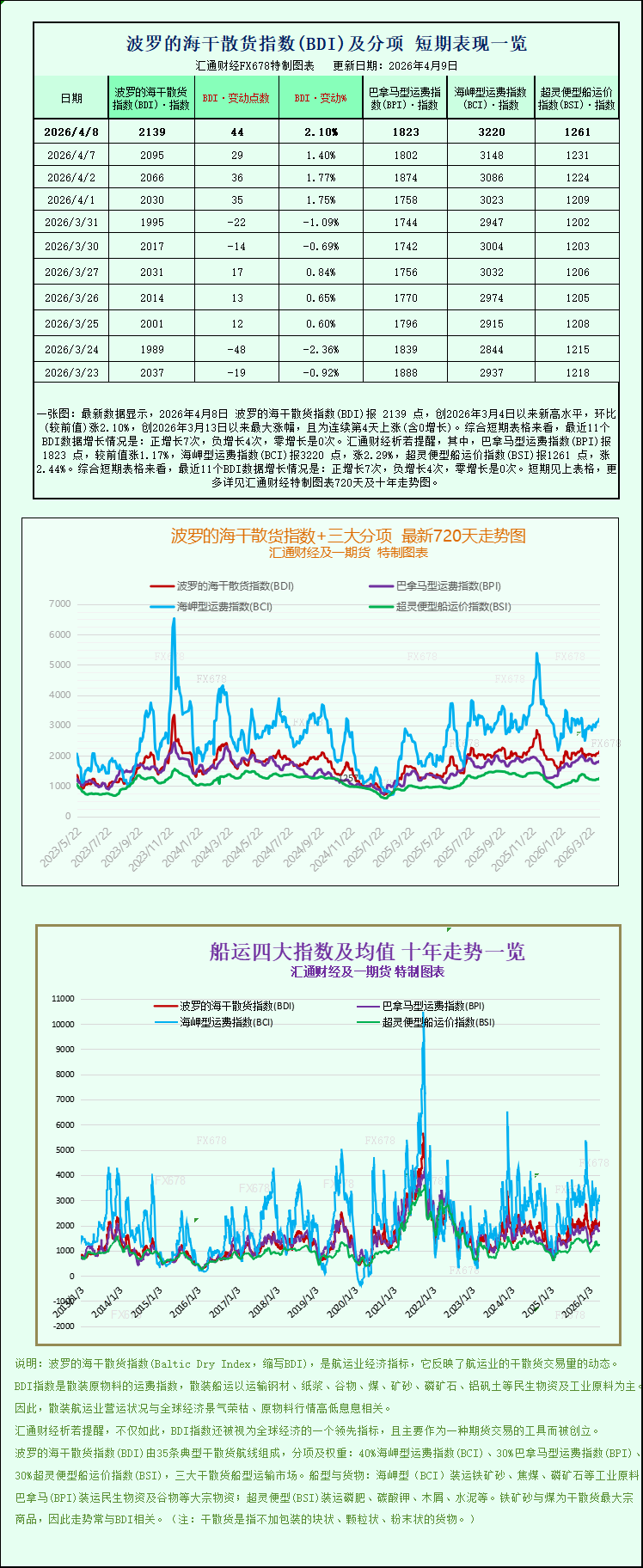
Driven by a comprehensive recovery in the global dry bulk shipping market, freight rates across all vessel segments have risen to varying degrees. The Baltic Dry Index (which monitors freight rates for vessels transporting dry bulk commodities globally and is a core indicator of the international dry bulk shipping market's health) climbed to its highest level in over a month on Wednesday, signaling a clear recovery in the previously sluggish dry bulk shipping market.
As a core indicator for measuring the overall trend of the dry bulk shipping market, the Baltic Dry Index performed strongly on the day, rising 44 points, or 2.1%, to close at 2139 points. This figure not only represents a significant increase from the previous trading day but also marks the highest level since March 5th, highlighting the strong recovery momentum in the current dry bulk shipping market. The index primarily tracks freight rates for the three main types of vessels: Capesize, Panamax, and Supramax. Its comprehensive rise also signifies positive changes on the demand side of the entire dry bulk shipping supply chain.
Among the various shipbuilding sub-sectors, the Capesize market performed particularly well, with its corresponding index rising 72 points, or approximately 2.3%, to close at 3220 points, also reaching a new high in over a month. Capesize vessels, as one of the mainstays of the dry bulk shipping market, typically transport 150,000 tons of bulk dry cargo, with iron ore and coal being their primary commodities. This significant increase in the index for this type of vessel is closely related to the increased global demand for iron ore and coal transportation. Simultaneously, the average daily earnings of Capesize vessels also increased, rising by $657 to reach $25,702, resulting in a significant improvement in shipowner profitability.
The recent recovery in the dry bulk shipping market is directly related to the surge in global iron ore shipments. Major suppliers increased their shipments of iron ore, a key raw material for steelmaking, driving demand for large vessels such as Capesize. At the same time, the easing of geopolitical tensions also injected positive factors into the market. US President Trump's agreement to a two-week ceasefire with Iran effectively alleviated market concerns about shipping safety in the Strait of Hormuz, reducing shipping risk premiums and consequently pushing down iron ore futures prices, further stimulating demand for iron ore transportation.
Besides the Capesize market, the Panamax market also showed a steady upward trend, with its corresponding index rising 21 points, or approximately 1.2%, to close at 1823 points. Panamax vessels primarily handle medium-sized dry bulk cargo transportation, typically with a deadweight tonnage between 60,000 and 70,000 tons, mainly transporting commodities such as coal and grain. The rise in the index for this type of vessel reflects the continued recovery in global demand for transporting commodities like grain and coal. Along with the index increase, the average daily revenue of Panamax vessels also increased, rising by $189 to $16,409, indicating a steady improvement in industry profitability.
The Very Large Crude Carrier (VLCC) market also performed strongly, with its corresponding index rising 30 points, or 2.4%, to close at 1261. As an important supplement to the dry bulk shipping market, VLCCs primarily handle bulk cargo transport on specific routes. The increase in their freight rates further confirms the overall recovery of the dry bulk shipping market and indicates a gradual increase in the activity of global commodity trade. Industry insiders believe that with the gradual recovery of demand from major global economies and the continued easing of geopolitical tensions, the dry bulk shipping market is expected to maintain its current recovery momentum.
Driven by a comprehensive recovery in the global dry bulk shipping market, freight rates across all vessel segments have risen to varying degrees. The Baltic Dry Index (which monitors freight rates for vessels transporting dry bulk commodities globally and is a core indicator of the international dry bulk shipping market's health) climbed to its highest level in over a month on Wednesday, signaling a clear recovery in the previously sluggish dry bulk shipping market.
As a core indicator for measuring the overall trend of the dry bulk shipping market, the Baltic Dry Index performed strongly on the day, rising 44 points, or 2.1%, to close at 2139 points. This figure not only represents a significant increase from the previous trading day but also marks the highest level since March 5th, highlighting the strong recovery momentum in the current dry bulk shipping market. The index primarily tracks freight rates for the three main types of vessels: Capesize, Panamax, and Supramax. Its comprehensive rise also signifies positive changes on the demand side of the entire dry bulk shipping supply chain.
Among the various shipbuilding sub-sectors, the Capesize market performed particularly well, with its corresponding index rising 72 points, or approximately 2.3%, to close at 3220 points, also reaching a new high in over a month. Capesize vessels, as one of the mainstays of the dry bulk shipping market, typically transport 150,000 tons of bulk dry cargo, with iron ore and coal being their primary commodities. This significant increase in the index for this type of vessel is closely related to the increased global demand for iron ore and coal transportation. Simultaneously, the average daily earnings of Capesize vessels also increased, rising by $657 to reach $25,702, resulting in a significant improvement in shipowner profitability.
The recent recovery in the dry bulk shipping market is directly related to the surge in global iron ore shipments. Major suppliers increased their shipments of iron ore, a key raw material for steelmaking, driving demand for large vessels such as Capesize. At the same time, the easing of geopolitical tensions also injected positive factors into the market. US President Trump's agreement to a two-week ceasefire with Iran effectively alleviated market concerns about shipping safety in the Strait of Hormuz, reducing shipping risk premiums and consequently pushing down iron ore futures prices, further stimulating demand for iron ore transportation.
Besides the Capesize market, the Panamax market also showed a steady upward trend, with its corresponding index rising 21 points, or approximately 1.2%, to close at 1823 points. Panamax vessels primarily handle medium-sized dry bulk cargo transportation, typically with a deadweight tonnage between 60,000 and 70,000 tons, mainly transporting commodities such as coal and grain. The rise in the index for this type of vessel reflects the continued recovery in global demand for transporting commodities like grain and coal. Along with the index increase, the average daily revenue of Panamax vessels also increased, rising by $189 to $16,409, indicating a steady improvement in industry profitability.
The Very Large Crude Carrier (VLCC) market also performed strongly, with its corresponding index rising 30 points, or 2.4%, to close at 1261. As an important supplement to the dry bulk shipping market, VLCCs primarily handle bulk cargo transport on specific routes. The increase in their freight rates further confirms the overall recovery of the dry bulk shipping market and indicates a gradual increase in the activity of global commodity trade. Industry insiders believe that with the gradual recovery of demand from major global economies and the continued easing of geopolitical tensions, the dry bulk shipping market is expected to maintain its current recovery momentum.
- Risk Warning and Disclaimer
- The market involves risk, and trading may not be suitable for all investors. This article is for reference only and does not constitute personal investment advice, nor does it take into account certain users’ specific investment objectives, financial situation, or other needs. Any investment decisions made based on this information are at your own risk.