Gold prices retreated after hitting a three-week high, with uncertainty remaining.
2026-04-09 00:58:00
Gold prices rebounded strongly on Wednesday (April 8) on news, hitting a three-week high, before pulling back due to profit-taking. This volatility was primarily driven by the significant progress in the agreement between the US and Iran to suspend hostilities for two weeks. Spot gold was trading at $4756.37, up 1.2% from the previous trading day, having surged more than 3% at one point to near $4857, its highest level since March 19. June gold futures (GCcv1) rose 2.1% to $4782.70. The US dollar index also came under pressure, falling 0.87% to 98.80, while WTI crude oil prices plummeted by more than 10%, breaking below the $100 mark and last trading around $87.
The US-Iran ceasefire agreement improved market sentiment.
US President Trump announced on social media that both sides had agreed to a two-week truce in attacks, provided that Iran immediately, fully, and safely reopens the Strait of Hormuz. Iranian Foreign Minister Abbas Araqchi responded that, through coordination with the armed forces, the safe passage through the strait during the ceasefire could be ensured.
The first round of talks will be held on Friday in Islamabad, Pakistan, focusing on Iran’s ten-point peace plan, which Trump called a “workable basis for negotiations.”
The ceasefire announcement quickly eased market concerns about a prolonged conflict in the Middle East, boosting risk appetite. Strong global stock markets and a weaker dollar further benefited dollar-denominated gold. Traders believe this move could reduce inflationary pressures from energy prices, opening up room for future interest rate cuts by the Federal Reserve, thus supporting the performance of gold, a non-yielding asset.
However, Iran's Tasnim News Agency, citing anonymous sources, warned that Tehran might withdraw from the agreement if Israel continues its attacks on Lebanon, indicating that geopolitical uncertainty has not been completely eliminated.
Falling oil prices eased inflation concerns
In line with gold prices, the crude oil market experienced a significant decline. WTI crude oil fell by more than 10%, primarily due to expectations of easing supply concerns arising from the potential reopening of the Strait of Hormuz. This could help alleviate global inflationary pressures and reduce the need for central banks to maintain high interest rates.
Previously, since the outbreak of the conflict between the US and Israel against Iran at the end of February, soaring energy prices had pushed up inflation expectations and suppressed the appeal of gold as a safe-haven asset—a high-interest-rate environment usually drags down gold, which does not generate returns.
Oil prices have now fallen back to pre-conflict levels, coupled with a weaker dollar, providing double support for gold. Nevertheless, traders remain cautious about further buying in gold. The latest US non-farm payroll data shows a stable labor market, but inflation risks have not completely subsided.
Investors will be closely watching the release of the Federal Reserve's March meeting minutes at 2 p.m. Eastern Time to gauge the path of monetary policy. The Fed kept interest rates unchanged at 3.50%-3.75% at the meeting, and the market expects it to remain patient before resuming rate cuts.
The People's Bank of China's continued gold purchases provide key support for gold prices.
Amidst heightened tensions in the Middle East, China has increased its gold purchases, becoming a significant force in stabilizing gold prices. According to Bloomberg, the People's Bank of China (PBOC) made its largest gold purchase in years in March, marking the 17th consecutive month of increases in its gold reserves. The PBOC added 160,000 ounces (approximately 5 tons) that month, demonstrating its continued commitment to gold even amidst pressure on gold prices due to the conflict with Iran.
Data from the World Gold Council shows that global central banks were net buyers of 25 tons of gold in the first two months of this year, with the National Bank of Poland becoming the largest buyer in February, purchasing 20 tons. Meanwhile, the Central Bank of Türkiye sold approximately 60 tons of gold in March to defend the lira's exchange rate.
Gold prices fell 12% in March, marking their worst monthly performance since 2008, primarily due to a stronger dollar and expectations of high interest rates. However, actions by the People's Bank of China boosted investor confidence, highlighting gold's strategic value amid global uncertainty. As one of the world's largest gold buyers, China's move also set an example for other central banks, further solidifying gold's safe-haven appeal.
Technical Analysis: Upward momentum strengthens but remains within a trading range.
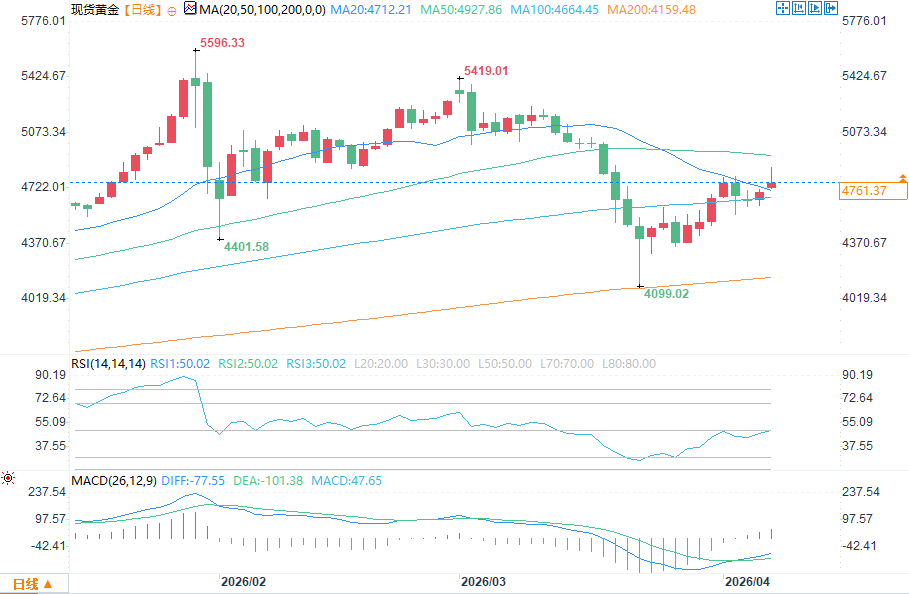
(Spot gold daily chart source: FX678)
From a technical perspective, spot gold is showing a slightly bullish trend. The daily chart shows that the price is above the 100-day simple moving average ($4667.44), but still below the 50-day simple moving average ($4927.91), indicating a neutral short-term trend and a range-bound trading pattern.
The Relative Strength Index (RSI14) is near the midpoint, the Moving Average Convergence Divergence (MACD) indicator is in positive territory, and momentum indicators suggest that buyers have a slight advantage.
The current key resistance level is the 50-day moving average; a successful break above this level would open up more significant upside potential. Initial support lies near the 100-day moving average (approximately $4667); a break below this level could restart the downtrend.
While the ceasefire news provided a short-term boost, analysts cautioned that the details of the negotiations remain uncertain, and the market recovery may only be temporary. Marex analyst Edward Meir noted, "The ceasefire is calming the market and easing pressure. This could help reduce some inflationary pressures and open the door for a Fed rate cut, which is positive for gold. But it remains very volatile; there are still too many factors to negotiate, and any market recovery may only be temporary. We are not out of the woods yet."
Outlook: Uncertainty remains; pay attention to signals from the Federal Reserve.
While a weaker dollar and lower oil prices are favorable for gold, the high-interest-rate environment and tail-end geopolitical risks are limiting further gains. Investors should be wary of potential disruptive factors such as the situation in Lebanon, and also pay attention to US inflation data (PCE and CPI) to be released later this week.
With the Federal Reserve maintaining a cautious stance, gold may continue to fluctuate within the $4,600-$4,900 range, with geopolitical events being the main catalyst.
Overall, the US-Iran ceasefire has injected optimism into the market, but long-term peace still needs time to prove itself. As a traditional safe-haven asset, gold's performance will continue to be closely linked to global risk appetite, the dollar's performance, and monetary policy. Investors should remain cautious and dynamically adjust their strategies based on both technical and fundamental factors to capitalize on opportunities in this highly volatile environment.
The US-Iran ceasefire agreement improved market sentiment.
US President Trump announced on social media that both sides had agreed to a two-week truce in attacks, provided that Iran immediately, fully, and safely reopens the Strait of Hormuz. Iranian Foreign Minister Abbas Araqchi responded that, through coordination with the armed forces, the safe passage through the strait during the ceasefire could be ensured.
The first round of talks will be held on Friday in Islamabad, Pakistan, focusing on Iran’s ten-point peace plan, which Trump called a “workable basis for negotiations.”
The ceasefire announcement quickly eased market concerns about a prolonged conflict in the Middle East, boosting risk appetite. Strong global stock markets and a weaker dollar further benefited dollar-denominated gold. Traders believe this move could reduce inflationary pressures from energy prices, opening up room for future interest rate cuts by the Federal Reserve, thus supporting the performance of gold, a non-yielding asset.
However, Iran's Tasnim News Agency, citing anonymous sources, warned that Tehran might withdraw from the agreement if Israel continues its attacks on Lebanon, indicating that geopolitical uncertainty has not been completely eliminated.
Falling oil prices eased inflation concerns
In line with gold prices, the crude oil market experienced a significant decline. WTI crude oil fell by more than 10%, primarily due to expectations of easing supply concerns arising from the potential reopening of the Strait of Hormuz. This could help alleviate global inflationary pressures and reduce the need for central banks to maintain high interest rates.
Previously, since the outbreak of the conflict between the US and Israel against Iran at the end of February, soaring energy prices had pushed up inflation expectations and suppressed the appeal of gold as a safe-haven asset—a high-interest-rate environment usually drags down gold, which does not generate returns.
Oil prices have now fallen back to pre-conflict levels, coupled with a weaker dollar, providing double support for gold. Nevertheless, traders remain cautious about further buying in gold. The latest US non-farm payroll data shows a stable labor market, but inflation risks have not completely subsided.
Investors will be closely watching the release of the Federal Reserve's March meeting minutes at 2 p.m. Eastern Time to gauge the path of monetary policy. The Fed kept interest rates unchanged at 3.50%-3.75% at the meeting, and the market expects it to remain patient before resuming rate cuts.
The People's Bank of China's continued gold purchases provide key support for gold prices.
Amidst heightened tensions in the Middle East, China has increased its gold purchases, becoming a significant force in stabilizing gold prices. According to Bloomberg, the People's Bank of China (PBOC) made its largest gold purchase in years in March, marking the 17th consecutive month of increases in its gold reserves. The PBOC added 160,000 ounces (approximately 5 tons) that month, demonstrating its continued commitment to gold even amidst pressure on gold prices due to the conflict with Iran.
Data from the World Gold Council shows that global central banks were net buyers of 25 tons of gold in the first two months of this year, with the National Bank of Poland becoming the largest buyer in February, purchasing 20 tons. Meanwhile, the Central Bank of Türkiye sold approximately 60 tons of gold in March to defend the lira's exchange rate.
Gold prices fell 12% in March, marking their worst monthly performance since 2008, primarily due to a stronger dollar and expectations of high interest rates. However, actions by the People's Bank of China boosted investor confidence, highlighting gold's strategic value amid global uncertainty. As one of the world's largest gold buyers, China's move also set an example for other central banks, further solidifying gold's safe-haven appeal.
Technical Analysis: Upward momentum strengthens but remains within a trading range.
(Spot gold daily chart source: FX678)
From a technical perspective, spot gold is showing a slightly bullish trend. The daily chart shows that the price is above the 100-day simple moving average ($4667.44), but still below the 50-day simple moving average ($4927.91), indicating a neutral short-term trend and a range-bound trading pattern.
The Relative Strength Index (RSI14) is near the midpoint, the Moving Average Convergence Divergence (MACD) indicator is in positive territory, and momentum indicators suggest that buyers have a slight advantage.
The current key resistance level is the 50-day moving average; a successful break above this level would open up more significant upside potential. Initial support lies near the 100-day moving average (approximately $4667); a break below this level could restart the downtrend.
While the ceasefire news provided a short-term boost, analysts cautioned that the details of the negotiations remain uncertain, and the market recovery may only be temporary. Marex analyst Edward Meir noted, "The ceasefire is calming the market and easing pressure. This could help reduce some inflationary pressures and open the door for a Fed rate cut, which is positive for gold. But it remains very volatile; there are still too many factors to negotiate, and any market recovery may only be temporary. We are not out of the woods yet."
Outlook: Uncertainty remains; pay attention to signals from the Federal Reserve.
While a weaker dollar and lower oil prices are favorable for gold, the high-interest-rate environment and tail-end geopolitical risks are limiting further gains. Investors should be wary of potential disruptive factors such as the situation in Lebanon, and also pay attention to US inflation data (PCE and CPI) to be released later this week.
With the Federal Reserve maintaining a cautious stance, gold may continue to fluctuate within the $4,600-$4,900 range, with geopolitical events being the main catalyst.
Overall, the US-Iran ceasefire has injected optimism into the market, but long-term peace still needs time to prove itself. As a traditional safe-haven asset, gold's performance will continue to be closely linked to global risk appetite, the dollar's performance, and monetary policy. Investors should remain cautious and dynamically adjust their strategies based on both technical and fundamental factors to capitalize on opportunities in this highly volatile environment.
- Risk Warning and Disclaimer
- The market involves risk, and trading may not be suitable for all investors. This article is for reference only and does not constitute personal investment advice, nor does it take into account certain users’ specific investment objectives, financial situation, or other needs. Any investment decisions made based on this information are at your own risk.