Crude oil trading alert: Geopolitical tensions remain high, and oil prices continue to fluctuate.
2026-04-09 09:18:10
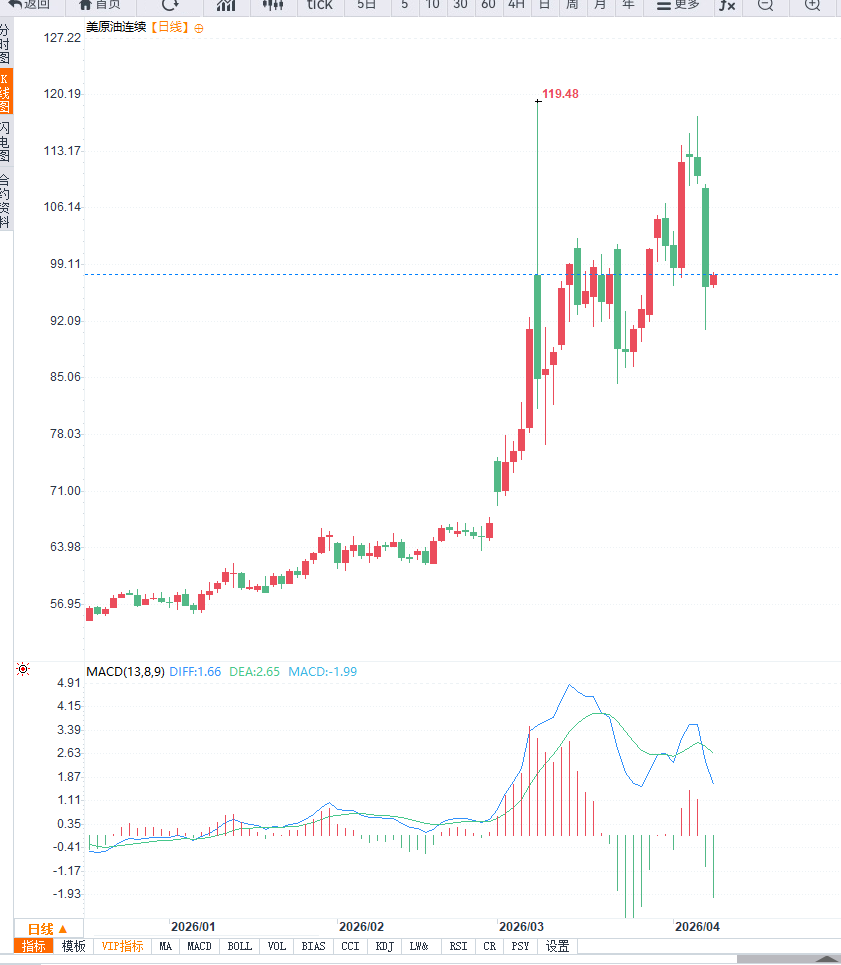
International oil prices have entered a period of consolidation after experiencing significant volatility. Previously, the market quickly priced in the risk premium due to ceasefire expectations, with WTI crude oil experiencing a single-day plunge of approximately 14%, marking its largest drop since April 2020. However, as the market reassessed the uncertainty surrounding the Middle East situation, oil prices rebounded rapidly, with WTI currently back around $97 per barrel, indicating that supply-side risks continue to dominate price movements.

From the perspective of the context, the conflict in the Middle East continues, and the situation has not seen any substantial easing despite the ceasefire proposal. Israel's military operation in Lebanon is still underway, and significant disagreements exist between Iran and other relevant parties regarding the scope of the ceasefire, causing market expectations for regional stability to fluctuate repeatedly. Meanwhile, Iran has pointed out that several clauses in the ceasefire proposal have been violated, further undermining market confidence in a de-escalation of the situation.
The market's primary focus remains on the passage of oil tankers through the Strait of Hormuz. This strait plays a crucial role in global energy transport, handling approximately 20% of the world's seaborne crude oil. Previous reports indicated that the attacks had caused a suspension of tanker traffic, and although there have been signs that the route is gradually reopening, the market generally believes it has not yet fully returned to normal. This uncertainty has directly fueled supply concerns, making a sustained downward trend in oil prices unlikely.
From the supply side, the core reason supporting oil prices in this round lies in the substantial damage suffered by energy infrastructure. Market research shows that more than 40 key energy facilities in the Middle East have been damaged to varying degrees, including refineries, oil fields, and natural gas export terminals, with related repair costs estimated to exceed $25 billion . This scale of damage means that even if the conflict eases, supply recovery will be a long process.
Market institutions generally believe that the oil price structure has shifted from being demand-driven to being supply-constrained. Some analysts point out that before the current uncertainties are completely eliminated, $90 may become an important bottom range for oil prices, and the probability of oil prices remaining above $80 this year is relatively high . Even if the Strait of Hormuz is fully reopened, the lag in supply chain recovery will continue to put pressure on the market.
From a market sentiment perspective, investors are currently maintaining a cautious stance overall. The significant fluctuations in oil prices reflect the market's high sensitivity to information; every piece of news regarding a ceasefire or escalation of conflict can quickly trigger sharp price swings. Meanwhile, the persistently high volatility also indicates that the market has not yet formed a consensus.
From a technical perspective, the daily chart shows that oil prices have rebounded after a rapid decline, but are still trading within a high-level consolidation range, exhibiting a trend of rising consolidation. The current level around $90 forms key support ; this level is both a previous pullback low and a key dividing line between bullish and bearish sentiment. A break below this level could trigger further downside. On the upside, there is resistance at the $100 psychological and technical level. In terms of momentum, daily indicators show some release of bearish momentum, but a trend reversal signal has not yet formed. Looking at the 4-hour chart, prices are currently trading within a rebound channel, but upward momentum is gradually weakening. Multiple failed attempts to break through $100 could trigger a technical pullback; conversely, a break above this level could open up new upside potential. Overall, oil prices are expected to remain range-bound in the short term, awaiting further fundamental guidance.
Editor's Summary:
The core driver of current international oil prices has shifted from short-term event shocks to medium- to long-term supply constraints. While ceasefire expectations initially suppressed risk premiums, the significant damage to energy infrastructure in the Middle East has created considerable uncertainty regarding supply recovery. Against this backdrop, a shift towards higher oil prices has become a market consensus. Future oil price trends will depend on two key variables: whether the geopolitical situation truly stabilizes and the speed of energy supply system recovery. Until these two factors improve significantly, a sustained high-level fluctuation or even periodic surges in oil prices remains the more logical trajectory.
From the perspective of the context, the conflict in the Middle East continues, and the situation has not seen any substantial easing despite the ceasefire proposal. Israel's military operation in Lebanon is still underway, and significant disagreements exist between Iran and other relevant parties regarding the scope of the ceasefire, causing market expectations for regional stability to fluctuate repeatedly. Meanwhile, Iran has pointed out that several clauses in the ceasefire proposal have been violated, further undermining market confidence in a de-escalation of the situation.
The market's primary focus remains on the passage of oil tankers through the Strait of Hormuz. This strait plays a crucial role in global energy transport, handling approximately 20% of the world's seaborne crude oil. Previous reports indicated that the attacks had caused a suspension of tanker traffic, and although there have been signs that the route is gradually reopening, the market generally believes it has not yet fully returned to normal. This uncertainty has directly fueled supply concerns, making a sustained downward trend in oil prices unlikely.
From the supply side, the core reason supporting oil prices in this round lies in the substantial damage suffered by energy infrastructure. Market research shows that more than 40 key energy facilities in the Middle East have been damaged to varying degrees, including refineries, oil fields, and natural gas export terminals, with related repair costs estimated to exceed $25 billion . This scale of damage means that even if the conflict eases, supply recovery will be a long process.
Market institutions generally believe that the oil price structure has shifted from being demand-driven to being supply-constrained. Some analysts point out that before the current uncertainties are completely eliminated, $90 may become an important bottom range for oil prices, and the probability of oil prices remaining above $80 this year is relatively high . Even if the Strait of Hormuz is fully reopened, the lag in supply chain recovery will continue to put pressure on the market.
From a market sentiment perspective, investors are currently maintaining a cautious stance overall. The significant fluctuations in oil prices reflect the market's high sensitivity to information; every piece of news regarding a ceasefire or escalation of conflict can quickly trigger sharp price swings. Meanwhile, the persistently high volatility also indicates that the market has not yet formed a consensus.
From a technical perspective, the daily chart shows that oil prices have rebounded after a rapid decline, but are still trading within a high-level consolidation range, exhibiting a trend of rising consolidation. The current level around $90 forms key support ; this level is both a previous pullback low and a key dividing line between bullish and bearish sentiment. A break below this level could trigger further downside. On the upside, there is resistance at the $100 psychological and technical level. In terms of momentum, daily indicators show some release of bearish momentum, but a trend reversal signal has not yet formed. Looking at the 4-hour chart, prices are currently trading within a rebound channel, but upward momentum is gradually weakening. Multiple failed attempts to break through $100 could trigger a technical pullback; conversely, a break above this level could open up new upside potential. Overall, oil prices are expected to remain range-bound in the short term, awaiting further fundamental guidance.
Editor's Summary:
The core driver of current international oil prices has shifted from short-term event shocks to medium- to long-term supply constraints. While ceasefire expectations initially suppressed risk premiums, the significant damage to energy infrastructure in the Middle East has created considerable uncertainty regarding supply recovery. Against this backdrop, a shift towards higher oil prices has become a market consensus. Future oil price trends will depend on two key variables: whether the geopolitical situation truly stabilizes and the speed of energy supply system recovery. Until these two factors improve significantly, a sustained high-level fluctuation or even periodic surges in oil prices remains the more logical trajectory.
- Risk Warning and Disclaimer
- The market involves risk, and trading may not be suitable for all investors. This article is for reference only and does not constitute personal investment advice, nor does it take into account certain users’ specific investment objectives, financial situation, or other needs. Any investment decisions made based on this information are at your own risk.