Experts: Gold remains the anchor in a diversified investment portfolio
2026-04-09 10:38:41
Despite a significant increase in recent geopolitical risks, gold has not demonstrated the strong performance traditionally seen as a safe-haven asset. Its price has fluctuated considerably, and it has failed to effectively attract safe-haven inflows. However, Indrani De, Global Head of Investment Research at FTSE Russell, believes that gold's structural role in investors' portfolios has not fundamentally changed.
Indrani De stated that recent gold price movements are actually the result of a confluence of various macroeconomic drivers, which are redefining how investors interact with gold in the short term. She pointed out that while gold can still receive some support from geopolitical uncertainty, investors must clearly distinguish between long-term fundamentals and short-term trends.

She further explained that gold's safe-haven appeal is currently facing a strong headwind: the opportunity cost of holding non-yielding assets has risen sharply. The Middle East conflict has caused serious disruptions to the oil market supply chain, pushing up energy prices and reigniting market concerns about inflation. These inflationary pressures have prompted investors to anticipate that central banks may be forced to raise interest rates, thus significantly increasing the implicit cost of allocating gold.
She said, "Gold itself does not generate regular income... So how high is the cost of holding a non-yielding asset? This is the key to the significant change in the current situation."
At the beginning of this year, gold prices surged to a record high of $5,600 per ounce. This rapid rise also made gold exhibit more characteristics of a "financial asset," including a greater susceptibility to profit-taking after a strong upward trend. This shift makes gold more sensitive to changes in overall market liquidity, especially during periods when investors tend to prioritize holding cash.
Despite some investors' disappointment with gold's recent performance, Indrani De points out that the decline in gold prices is largely in line with global stock markets, indicating that gold is not operating in isolation but is participating in a broader market repricing process along with other assets.
Indrani De particularly emphasized that the global economy is showing a new and important trend: market signals are increasingly pointing to a "stagflation" environment, namely, the coexistence of slowing economic growth and persistent inflationary pressures. In this environment, the role of real assets in investment portfolios tends to become more prominent.
She added that while it is too early to conclude that stagflation is a foregone conclusion, the current environment is showing signs of it. Rising oil prices reflect inflationary pressures, while weakening copper prices reflect market concerns about the economic growth outlook.
She stated, "The commodity market is sending clear signals of stagflation risk, and when economic uncertainty intensifies, the returns from diversified investments will increase significantly."
Despite changes in short-term trends, Indrani De believes that gold remains an important diversification tool for investors and has the potential to re-establish its status as a key safe-haven asset in the future. She points out that in the current highly uncertain environment, gold retains its unique value as a defensive anchor asset , although it is no longer the only commodity option. Other assets, particularly energy and industrial metals, are more sensitive to inflation and economic growth dynamics.
Regarding investor allocation strategies, Indrani De did not offer specific percentage recommendations, but her core viewpoint was very clear: against the backdrop of increased uncertainty and widening economic outcome divergences, the rationale for allocating to gold and broader commodity assets will only strengthen further. She also mentioned that global AI development and the green energy transition are creating sustained demand for certain industrial and transition metals, which are likely to continue to benefit in the long term.
Overall, Indrani De's analysis shows that although gold faces pressure in the short term from rising opportunity costs and enhanced financial attributes, its value as a portfolio diversification tool and a defensive asset in a stagflationary environment remains solid from a medium- to long-term perspective. Faced with a complex and volatile macroeconomic environment, investors need to more rationally balance short-term fluctuations with long-term fundamentals, and gold's strategic position in future asset allocation remains significant.
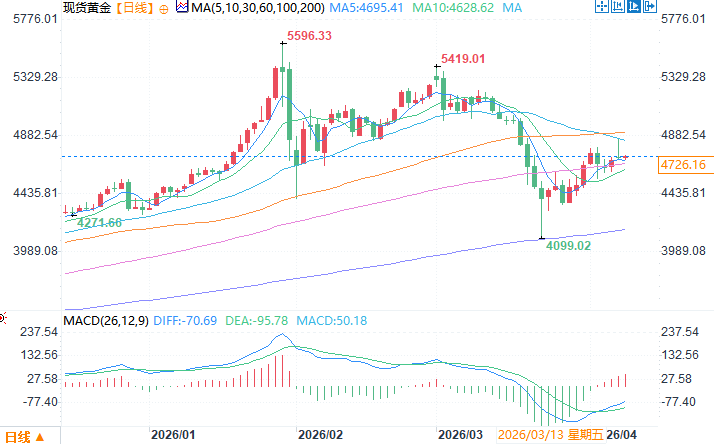
Spot gold daily chart source: EasyForex
At 10:38 AM Beijing time on April 9th, spot gold was trading at $4730.16 per ounce.
Short-term fluctuations stem from a fierce clash of macroeconomic drivers.
Indrani De stated that recent gold price movements are actually the result of a confluence of various macroeconomic drivers, which are redefining how investors interact with gold in the short term. She pointed out that while gold can still receive some support from geopolitical uncertainty, investors must clearly distinguish between long-term fundamentals and short-term trends.
She further explained that gold's safe-haven appeal is currently facing a strong headwind: the opportunity cost of holding non-yielding assets has risen sharply. The Middle East conflict has caused serious disruptions to the oil market supply chain, pushing up energy prices and reigniting market concerns about inflation. These inflationary pressures have prompted investors to anticipate that central banks may be forced to raise interest rates, thus significantly increasing the implicit cost of allocating gold.
She said, "Gold itself does not generate regular income... So how high is the cost of holding a non-yielding asset? This is the key to the significant change in the current situation."
Gold's enhanced financial attributes make it more susceptible to market liquidity fluctuations.
At the beginning of this year, gold prices surged to a record high of $5,600 per ounce. This rapid rise also made gold exhibit more characteristics of a "financial asset," including a greater susceptibility to profit-taking after a strong upward trend. This shift makes gold more sensitive to changes in overall market liquidity, especially during periods when investors tend to prioritize holding cash.
Despite some investors' disappointment with gold's recent performance, Indrani De points out that the decline in gold prices is largely in line with global stock markets, indicating that gold is not operating in isolation but is participating in a broader market repricing process along with other assets.
Rising stagflation risks highlight the value of real asset allocation
Indrani De particularly emphasized that the global economy is showing a new and important trend: market signals are increasingly pointing to a "stagflation" environment, namely, the coexistence of slowing economic growth and persistent inflationary pressures. In this environment, the role of real assets in investment portfolios tends to become more prominent.
She added that while it is too early to conclude that stagflation is a foregone conclusion, the current environment is showing signs of it. Rising oil prices reflect inflationary pressures, while weakening copper prices reflect market concerns about the economic growth outlook.
She stated, "The commodity market is sending clear signals of stagflation risk, and when economic uncertainty intensifies, the returns from diversified investments will increase significantly."
Gold still has strategic value but needs to be repositioned.
Despite changes in short-term trends, Indrani De believes that gold remains an important diversification tool for investors and has the potential to re-establish its status as a key safe-haven asset in the future. She points out that in the current highly uncertain environment, gold retains its unique value as a defensive anchor asset , although it is no longer the only commodity option. Other assets, particularly energy and industrial metals, are more sensitive to inflation and economic growth dynamics.
Regarding investor allocation strategies, Indrani De did not offer specific percentage recommendations, but her core viewpoint was very clear: against the backdrop of increased uncertainty and widening economic outcome divergences, the rationale for allocating to gold and broader commodity assets will only strengthen further. She also mentioned that global AI development and the green energy transition are creating sustained demand for certain industrial and transition metals, which are likely to continue to benefit in the long term.
Overall, Indrani De's analysis shows that although gold faces pressure in the short term from rising opportunity costs and enhanced financial attributes, its value as a portfolio diversification tool and a defensive asset in a stagflationary environment remains solid from a medium- to long-term perspective. Faced with a complex and volatile macroeconomic environment, investors need to more rationally balance short-term fluctuations with long-term fundamentals, and gold's strategic position in future asset allocation remains significant.
Spot gold daily chart source: EasyForex
At 10:38 AM Beijing time on April 9th, spot gold was trading at $4730.16 per ounce.
- Risk Warning and Disclaimer
- The market involves risk, and trading may not be suitable for all investors. This article is for reference only and does not constitute personal investment advice, nor does it take into account certain users’ specific investment objectives, financial situation, or other needs. Any investment decisions made based on this information are at your own risk.